

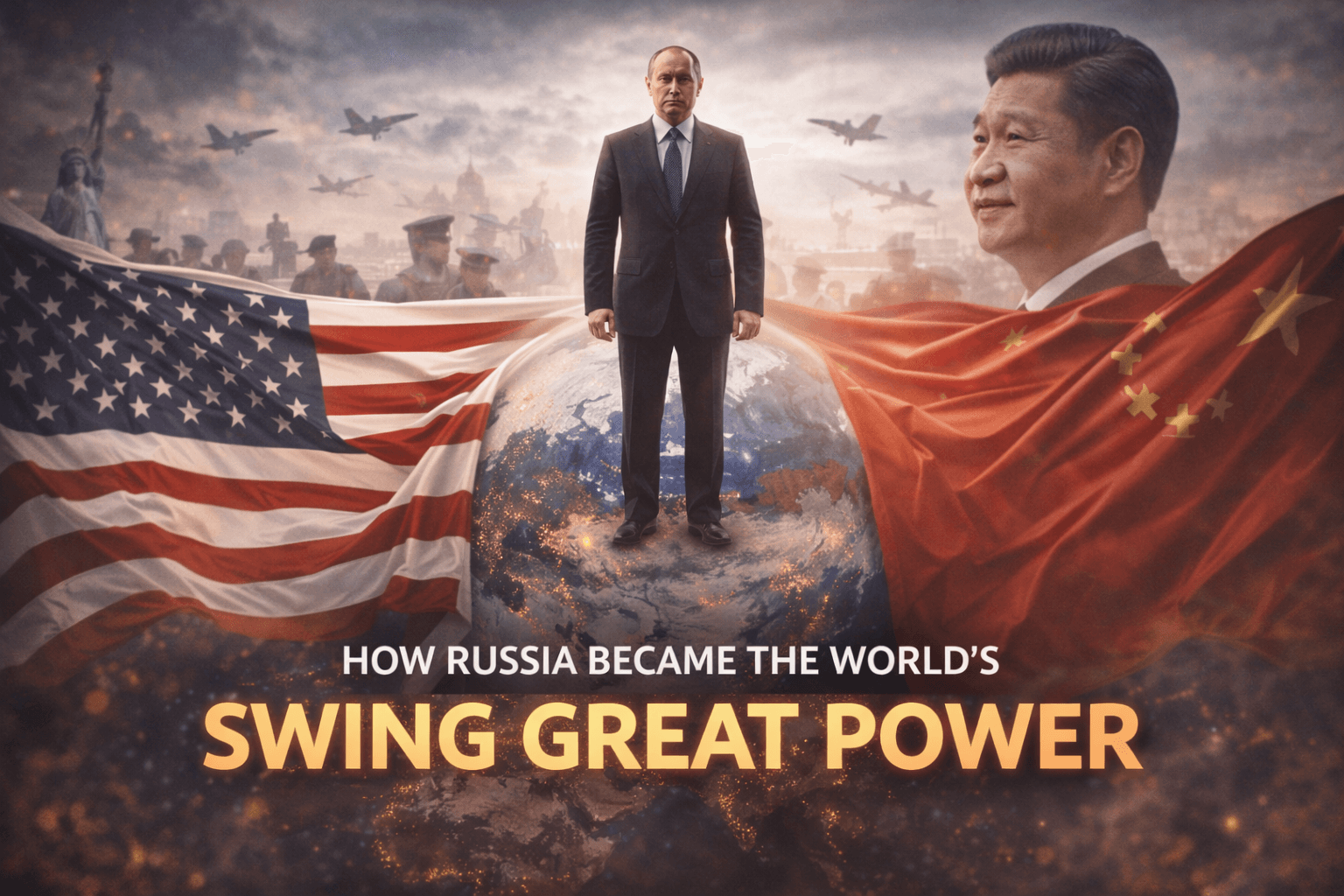
Some global shifts arrive like earthquakes. Others seep in, quietly rearranging the ground beneath institutions, alliances, and assumptions. The current transition is the second kind. The world is no longer unipolar, yet it is also not comfortably multipolar. Instead, it is starting to resemble a three-power system where two poles dominate the gravity, and the third power decides how heavy that gravity feels in practice.
What’s in the news
The United States has sharply intensified pressure on Venezuela, alongside a broader strategic emphasis on Latin America and the Caribbean. This coincides with a visible cooling in Washington’s appetite to underwrite European security at the same scale as the post-1945 era. The pattern suggests a reallocation of attention: consolidate primacy closer to home, demand more from allies elsewhere, and prepare for a prolonged contest with China.
Background and context
After 1991, the U.S.-led order benefited from a rare alignment: unmatched American power, expanding globalisation, and relatively weak challengers. That moment has passed, not because the U.S. has collapsed, but because other major powers have acquired the ability to shape outcomes independently.
A key marker in the long end of unipolarity was Russia’s willingness to revise borders and security arrangements, and its demonstrated capacity to absorb economic punishment without strategic retreat. China’s rise is the larger structural story: it is not merely a regional power with ambition, but a techno-economic system with the scale to compete across trade, standards, infrastructure, defence production, and influence networks.
What emerges from this is not a neat “concert of powers” but a competitive triangle. And triangles are inherently unstable because each side keeps trying to change the angles.
Key details
1) The U.S. is reprioritising geography.
Instead of spreading itself thin across multiple theatres, Washington is signalling sharper prioritisation. The Western Hemisphere is being treated as a strategic theatre where outside influence, especially China’s economic footprint, is to be constrained.
2) Europe is being pushed towards strategic adulthood.
For decades, Europe’s security architecture relied on American political will, American logistics, American intelligence, and American deterrence. A shift towards “burden sharing” is not new, but the tone now implies something more consequential: European security is no longer an automatic American project; it is a European responsibility with American support, not American ownership.
3) China is framed as the primary systemic challenger.
This is the central organising principle of the era. Even when U.S. actions appear impulsive, the underlying structure is consistent: preserve technological edge, deny rivals regional hegemony, and shape supply chains, standards, and alliances to constrain China’s climb.
4) Russia is the pivot, not the peer.
Russia’s economy is smaller than China’s and the U.S.’s, and its long-term demographic and technological constraints are real. Yet its military capacity, energy and minerals leverage, geography spanning critical corridors, and readiness to use force make it strategically indispensable. That is why Russia can behave like a “swing” power even without the economic base of a superpower.
Why it matters
Because the shape of the global order decides the price of everything. Energy markets, shipping insurance, sanctions risk, technology access, currency volatility, and supply chain resilience are all functions of geopolitics now.
Because middle powers will carry heavier strategic weight. In a fluid system, outcomes are not set by one hegemon but negotiated through coalitions, alignments, and issue-based groupings. Countries such as India, Brazil, Indonesia, Japan, Germany, and Gulf economies will hedge, bargain, and selectively align, shaping the operating environment for trade, tech, defence, and climate.
Because the new contest is not only military. It is also about rules, standards, and chokepoints: semiconductors, critical minerals, ports, undersea cables, payment rails, and AI compute. Control is increasingly exercised through networks, not just borders.
Arguments for and against
The case for the U.S. pivot and “offshore balancing” posture
-
Strategic focus can restore deterrence. Concentrating resources where stakes are highest can be more credible than diffuse commitments.
-
Allies free-riding has long been a structural vulnerability. Forcing greater allied capacity can, over time, create a more durable balance.
-
Hemispheric consolidation is a classic great-power instinct. States historically seek strategic depth and a secure near abroad before projecting power elsewhere.
The case against it
-
Selective disengagement can invite opportunism. If Europe reads ambiguity as abandonment, it may overcorrect in ways that fragment collective security.
-
Militarised pressure without political settlement often hardens resistance. In places like Venezuela, coercion can strengthen siege narratives and deepen domestic repression.
-
Overplaying the Monroe-style logic can backfire. Latin America is not a chessboard; it is a region with sovereignty, memory of intervention, and its own political cycles.
Constitutional / legal angle
The sharper use of force, maritime interdictions, and coercive economic restrictions raises familiar international-law questions: proportionality, evidence thresholds, and the boundary between enforcement and aggression. Even when a state frames actions as counter-narcotics or counter-terrorism, sustained kinetic activity and broad interdictions invite scrutiny under the UN Charter framework on the use of force and non-intervention. For the global order, the danger is precedent: once major powers normalise exceptional methods, rivals adopt the template in their own neighbourhoods.
Implications
1) A “triangular” world will keep producing shocks.
If the U.S.-China axis hardens and Russia retains manoeuvrability, crises will flare in peripheral theatres where each side tests credibility at manageable cost.
2) Sanctions and counter-sanctions become routine.
Trade and finance will carry higher compliance costs, and businesses will price geopolitical risk into everyday operations.
3) The Indo-Pacific remains the long game.
Even if U.S. attention appears to swing to the Western Hemisphere, the deepest structural contest stays anchored in Asia’s production capacity, technology ecosystems, and maritime routes.
4) For India, autonomy becomes an asset only if backed by capability.
Strategic autonomy is not a slogan; it is the ability to sustain choices under pressure. That means stronger domestic manufacturing depth, resilient energy strategy, diversified trade corridors, and credible defence readiness, especially in the maritime domain.
Way ahead
A fluid multipolarity demands calmer statecraft, not louder rhetoric.
-
For the U.S. and its allies: coherence matters more than theatrics. Pressure campaigns should be tied to realistic political end-states, not only punitive cycles.
-
For middle powers like India: the smartest posture is selective alignment without dependency. Engage the U.S. where interests converge, compete with China where sovereignty and industry require it, and keep channels open with Russia without becoming hostage to any one relationship.
-
For the wider system: build “shock absorbers” in trade, payments, and supply chains. When politics polarises, the economic system needs redundancy to prevent every crisis from becoming inflation, shortage, or breakdown.
The defining feature of the coming phase is not that power is evenly distributed. It is that power is contested everywhere, and legitimacy is contested even more. In such a world, stability will come less from grand declarations and more from disciplined capacity, credible partnerships, and the patience to manage rivalries without turning each contest into a rupture.
Source credits
The Hindu, White House, Reuters, Brookings Institution, Chatham House, The Guardian, Al Jazeera, Time