

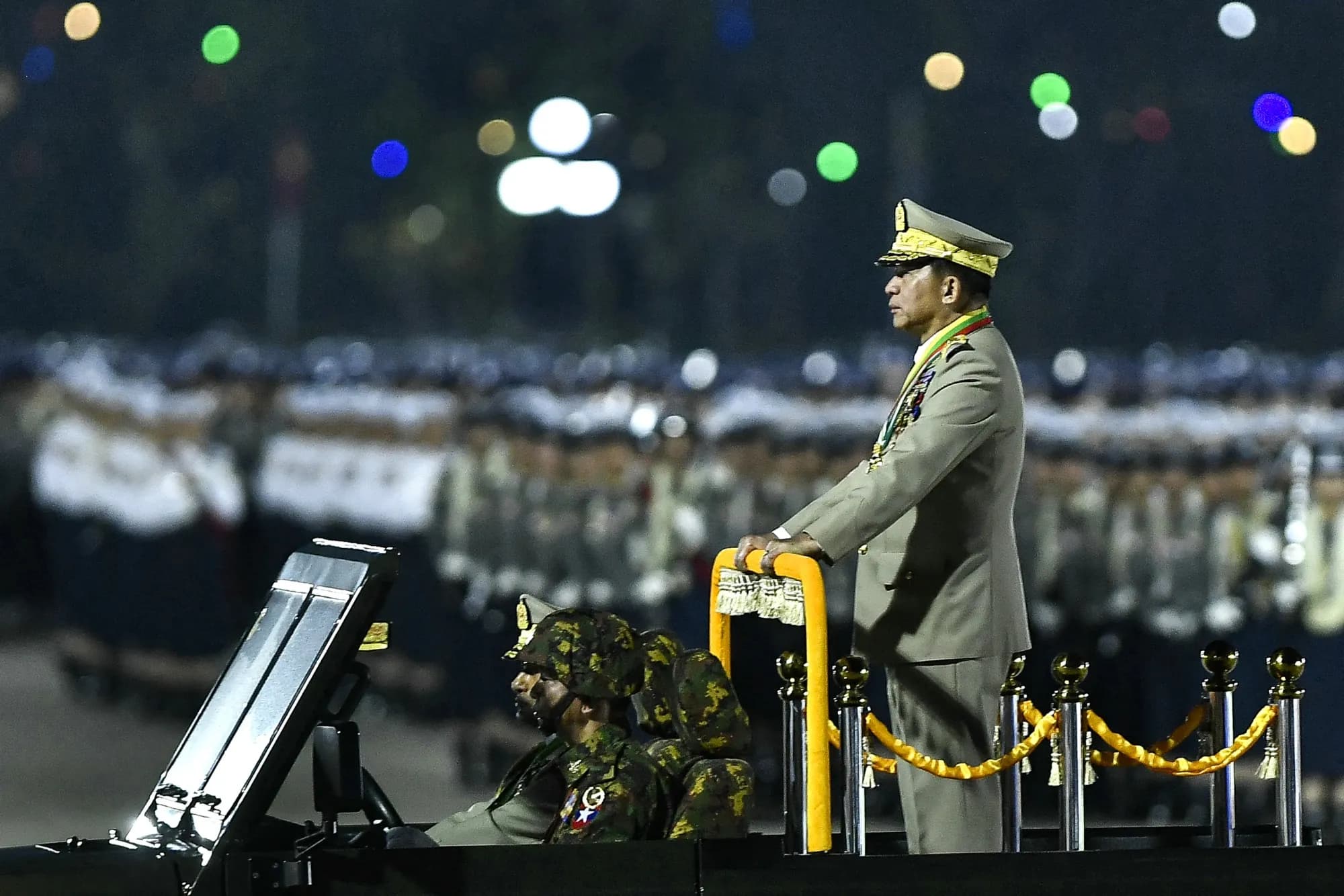
Elections are meant to translate popular will into representative authority. But when a ballot is engineered to shrink choice, silence dissent, and exclude vast parts of a country, it becomes something else: a procedural ritual that tries to imitate consent. Myanmar’s junta is now attempting exactly that through a phased election held amid a civil war that has splintered the state.
What’s in the news
-
Myanmar has started a multi-phase general election with subsequent phases scheduled in January; voting is not nationwide because of conflict and administrative limits.
-
The military-backed Union Solidarity and Development Party (USDP) is expected to dominate a restricted field after major opposition forces, including the National League for Democracy (NLD), were dissolved or barred; Aung San Suu Kyi remains imprisoned.
-
Turnout appears muted in several junta-controlled areas, and international reactions remain sharply divided, with many governments dismissing the exercise as lacking credibility.
Background and context
The 2021 coup did not simply replace a government; it detonated a nationwide resistance that evolved into a multi-front civil war. Myanmar’s political landscape today is not a standard contest between parties. It is an unresolved struggle over who governs, where, and with what legitimacy.
In such a setting, the junta’s election serves a clear strategic function: to shift the argument from battlefield control to constitutional normalcy, and from seizure of power to “mandate”. But normalcy cannot be declared by schedule. It is earned through competition, consent, and a state apparatus that can credibly guarantee participation without fear.
The deeper complication is territorial. A meaningful election assumes a reasonably coherent state. Myanmar, by contrast, has seen large zones influenced or controlled by ethnic armed organisations and resistance forces, reshaping control along key border belts and trade routes.
Key provisions / key details
-
Phased voting, partial geography: The election is spread across three rounds, reflecting the junta’s own acknowledgement that voting cannot be conducted across the whole country amid ongoing conflict.
-
Constrained political field: The dissolution or exclusion of major opposition parties, particularly the NLD, limits meaningful contestation and makes the outcome appear pre-scripted.
-
Security-state conditions: Reports of fear, legal restrictions, and intimidation around political activity erode the basic conditions required for a free choice.
-
Built-in military dominance: Under the 2008 constitutional framework, the military retains an entrenched position through reserved parliamentary seats, reducing the ability of any elected government to alter the security architecture.
Why it matters
Legitimacy cannot be manufactured in a civil war.
A controlled election may produce office-holders, but not acceptance. When key constituencies see the process as coerced or meaningless, the result becomes an accelerant for conflict, not a bridge to stability.
It locks Myanmar into a “low-legitimacy state” trap.
Institutions may exist on paper, but governance remains thin, contested, and heavily securitised. That combination tends to deepen humanitarian distress and economic collapse, and makes durable peace harder.
It internationalises the conflict through recognition politics.
Some states may treat the election as a step toward stability, others as an exercise in deception. That split shapes sanctions, engagement, arms flows, and the room available for mediation.
It impacts India’s neighbourhood security.
For India, Myanmar is not an abstract democracy debate. It touches Northeast border stability, cross-border crime, refugee pressures, and connectivity ambitions. A fragile, militarised Myanmar complicates all of them.
Arguments for and against
The junta’s case for elections
-
A route back to institutional governance: the claim that elections will restore administration, budgets, and civilian-facing governance.
-
A path to stability: the assertion that formal politics, even constrained, is preferable to open-ended emergency rule.
-
A diplomatic signal: that a ballot can soften isolation and reopen channels for engagement.
The case against the exercise
-
Choice is the core, not the ceremony. With major parties absent and political freedoms curtailed, elections become a tool to ratify power, not transfer it.
-
Representation without territory is inherently brittle. A government “elected” in selected townships cannot credibly speak for a fragmented state.
-
War conditions distort participation. Fear, conscription pressures, and coercion claims make turnout a poor measure of consent.
-
Constitutional design preserves military primacy anyway. Reserved seats and veto levers ensure dominance regardless of electoral arithmetic.
Constitutional / legal angle
Myanmar’s 2008 Constitution structurally insulates the military’s role in politics. It reserves 25% of parliamentary seats for serving military officers, and constitutional amendment thresholds effectively give the armed forces blocking power.
In such a framework, elections can produce a legislature, but not civilian supremacy. The legal architecture turns democratic form into managed continuity, unless political competition is genuinely open and the constitutional balance is renegotiated through a credible, inclusive settlement.
Implications
Short-range: The junta may cite the phased polls as proof of “normalisation”, while resistance forces may intensify efforts to delegitimise and disrupt the exercise, keeping violence elevated.
Medium-range: External actors will continue to prioritise stability around strategic corridors and border trade, influencing ceasefires and local balances rather than pushing full political resolution.
Long-range: Myanmar risks institutionalising a governance model where elections coexist with permanent coercion, producing neither peace nor development, only a durable stalemate with periodic spikes in conflict.
Way ahead
-
Make political space real: Any claim to democratic transition requires genuine participation, not a curated ballot. Without opposition inclusion and freedom of political activity, elections deepen the legitimacy crisis.
-
Decouple humanitarian access from political endorsement: Regional engagement should expand aid and protection pathways without treating a managed poll as a blank cheque for recognition.
-
Pursue ceasefire architectures that can hold locally: The conflict is not centrally controlled on all sides; workable arrangements must be verifiable and sensitive to Myanmar’s fragmented authority, especially across ethnic states.
-
Treat the constitution as part of the conflict, not a neutral frame: Reserved-seat dominance and veto design are not side issues; they are a core reason elections fail to settle power.
-
For India, a steady realism: protect border interests, keep channels open, support people-centric assistance, and avoid steps that could be read as underwriting a legitimacy claim that Myanmar’s own citizens reject.
Source credits
Reuters, Associated Press, The Hindu, The Guardian, Al Jazeera, UN statements, ASEAN briefings