

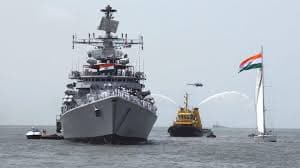
On 6 October in Visakhapatnam, the Indian Navy commissioned INS Androth, the second unit of its new Anti-Submarine Warfare Shallow Water Craft programme. Presided over by Vice Admiral Rajesh Pendharkar, Flag Officer Commanding-in-Chief, Eastern Naval Command, the ceremony marked another milestone in India’s drive for maritime self-reliance, with the ship built by Garden Reach Shipbuilders and Engineers (GRSE), Kolkata.
The Story
INS Androth belongs to a class purpose-designed for littoral anti-submarine warfare where conventional blue-water platforms can be overkill or operationally constrained. Shallow waters along the subcontinent’s coasts present complex acoustics, dense traffic and short reaction times. The ASW Shallow Water Craft (ASW-SWC) bridge that gap with compact hulls optimised for coastal endurance, rapid sprint-and-drift tactics, quick turn-arounds in harbour and high availability rates for day-to-day contact-of-interest prosecution.
The commissioning aligns with a broader modernisation cadence that recently saw INS Arnala join service, INS Nistar strengthen diving and rescue support, and P-17A frigates Udaygiri and Nilgiri add multi-mission punch. Together they reflect a portfolio approach: large combatants for open-ocean deterrence, and specialised assets like ASW-SWCs for the crowded approaches to ports, energy terminals and strategic choke points.
Built by GRSE, Androth is part of a multi-ship order that deepens the Navy’s indigenous supply chain in hull fabrication, sensors, combat systems integration and through-life support. The class is intended to conduct sub-surface surveillance, localization and engagement in coastal arcs, escort high-value units through harbor approaches, and plug into the Navy’s expanding maritime domain awareness network. The ship will operate closely with shore commands, Dornier maritime patrol aircraft, coastal radar chains and, where cued, helicopters for localization hand-offs.
Navy officials highlighted the humanitarian and constabulary dividends of such craft. Besides ASW, shallow-draft, highly maneuverable vessels are valuable for search and rescue, disaster relief close to shore, and security during major events in port cities. Their maintenance simplicity and smaller crews also make them economical for persistent presence missions that free up larger combatants.
Why It Matters
India’s coastline hosts dense commercial shipping, offshore energy, submarine cable landings and naval bases. Littoral ASW is a distinct mission set that requires high-tempo sprints, tight turns, frequent contacts and rapid classification of unknown subsurface tracks. Purpose-built shallow-water craft improve reaction times in these cluttered environments. With the Indian Ocean witnessing more submarine and unmanned undersea activity, volume and persistence at the coastal layer are as important as blue-water reach.
Background / Context
• Role of ASW-SWC: Coastal submarine detection and deterrence, harbor defense escort, sea-lane sanitization near ports, training and range services.
• Industrial base: The series order with GRSE anchors component vendors in steel fabrication, propulsion, power generation, sonar foundations and combat system cabling.
• Operational fit: Works in concert with fixed coastal sensors, patrol aircraft and naval air stations on the east coast, including Visakhapatnam.
• Recent inductions: Arnala-class lead ship, diving support and rescue enablers like Nistar, and P-17A frigates Udaygiri and Nilgiri.
• Policy frame: Aatmanirbhar Bharat in defence, SAGAR and Act East priorities, and stepped-up coastal security since 26/11.
Implications
For deterrence and security: The addition of Androth thickens the Navy’s inner ASW screen around major ports and strategic infrastructure. In peacetime it raises the detection baseline. In crisis it complicates an adversary’s risk calculus by adding more eyes and ears close to shore.
For industry and readiness: Serial construction at a domestic yard raises fleet commonality and spares predictability, cutting downtime. It supports workforce skills in modular build, outfit and trials, and improves timelines for follow-on hulls.
For jointness and MDA: ASW-SWCs are data nodes. Their patrol tracks, passive contacts and environmental measurements enrich maritime domain awareness feeds for Eastern Naval Command and allied agencies, sharpening cueing for aircraft and larger combatants.
For HADR and civil support: Shallow-draft craft with robust boat handling can reach flooded jetties, fishing harbours and cyclone-hit coastal belts faster than deeper-draft ships, extending their value beyond combat roles.
Conclusion
INS Androth gives the Navy more persistent, purpose-built capacity where it matters daily: in the busy, noisy waters that connect India’s ports to the world. It reinforces a force design that balances high-end blue-water capability with hard-working coastal specialists, while anchoring jobs and know-how in Indian shipyards.