

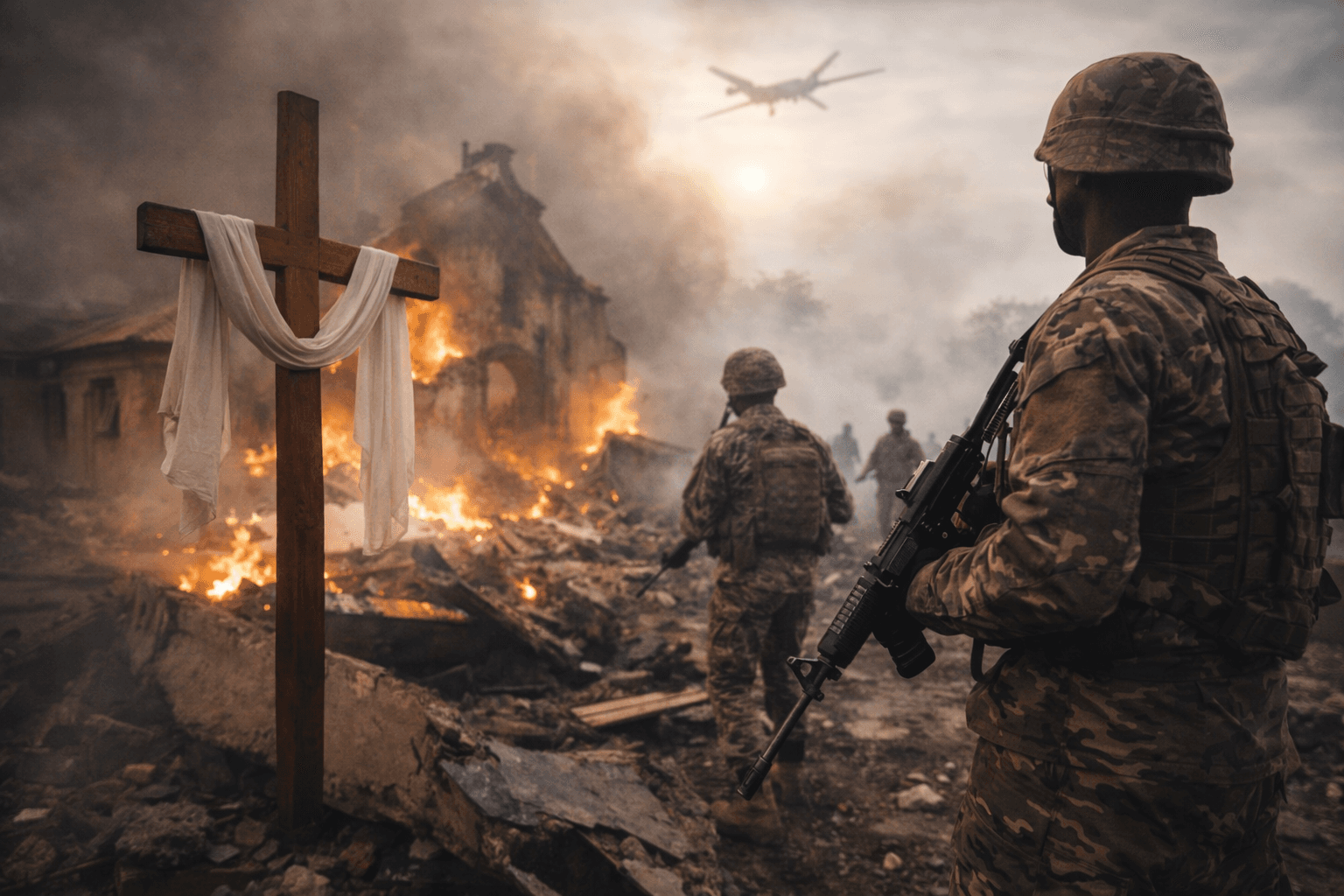
A clean airstrike is the world’s most tempting shortcut: quick, televised, and emotionally easy to sell. But Nigeria is not a shortcut country. When Washington frames a complex West African insurgency as a religious rescue mission, it risks turning a counterterrorism operation into a catalyst for fresh grievance — the one fuel that extremist networks never run short of.
What’s in the news
In the last week of December, the U.S. carried out strikes on alleged Islamic State-linked targets in Nigeria’s northwest, in an operation Nigeria’s government said it had authorised. The strikes, reported around Christmas, were followed by sharp debate inside Nigeria about target selection, transparency, and whether the action was being narrated externally through a “Christian persecution” lens that does not match the on-ground victim profile.
Background and context
Nigeria’s security crisis is best understood as overlapping rings of fire. One ring is the long-running jihadist insurgency in and around the Lake Chad basin, where Boko Haram’s evolution and splintering created multiple violent factions, including ISWAP-linked formations. Another ring is the northwest bandit economy — kidnapping, arms trafficking, and local militias — which sometimes overlaps with ideological outfits, but often runs on profit rather than theology. A third ring is the wider Sahel corridor, where state collapse, porous borders, and weapon circulation have allowed armed groups to move, recruit, and rebrand with frightening ease.
Nigeria’s religious geography adds emotional voltage to this mix: broad regional concentrations exist, but violence does not follow neat lines. Extremists and armed groups target state institutions, communities, and rival factions opportunistically. In northern Nigeria, Muslims have frequently been among the primary victims of jihadist violence; in other belts, communal and identity violence can take a viciously sectarian turn. Any external actor that narrates the conflict as a single-community genocide risks weaponising identity — and shrinking space for local coalitions that are essential for intelligence, policing, and reconciliation.
Key provisions / key details
The publicly reported operational details point to a coordinated strike package: maritime-launched precision fire and drone-delivered munitions, with Nigerian authorities describing the targets as camps used by foreign fighters infiltrating from the Sahel and collaborating with local elements. Nigerian officials also stressed the absence of civilian casualties, though there were reports of debris reaching inhabited areas, which inevitably raises questions about risk assessment, public communication, and accountability.
Two details matter more than the hardware.
First, consent and ownership: if Abuja requested the strikes, the legal basis strengthens — but legitimacy still depends on whether Nigerians believe the targeting was accurate, necessary, and transparently explained.
Second, the political narrative: President Trump’s language linking the action to protection of Christians shifts the meaning of the strike from counterterrorism to civilisational signalling — a dangerous upgrade in a society already strained by identity politics.
Why it matters
For Nigeria: Security policy succeeds only when it expands trust between citizens and the state. A strike that is perceived as externally driven, or religiously framed, can deepen suspicion across regions and communities — precisely when Nigeria needs broad-based cooperation against militant infiltration and criminal networks. If local populations doubt the presence of ISIS-linked structures in the targeted geography, that doubt becomes an open invitation for militants to claim propaganda wins: “the state and foreigners bombed you; we are your defenders.”
For West Africa and the Sahel: The jihadist map is increasingly networked. Tactical blows can disrupt cells, but they rarely dismantle recruitment pipelines that feed on unemployment, injustice, local vendettas, and ungoverned spaces. Short, episodic strikes without sustained governance and regional coordination often shift violence rather than reduce it.
For global counterterrorism norms: When a major power sells military action through religious rhetoric, it blurs the line between counterterrorism and sectarian politics. That sets a precedent others can copy — with even less restraint — and it complicates multilateral cooperation where legitimacy rests on neutral, evidence-based threat assessment.
For India: Nigeria is a consequential African partner — demographically, economically, and diplomatically. Instability affects energy markets, maritime routes, diaspora safety, and the broader strategic contest in Africa where external powers seek influence through security partnerships. India’s long-standing principles — sovereignty, non-intervention, and capacity-building partnerships — look more credible in contrast when other actors appear performative or polarising.
Arguments for and against
The case for the strikes
A narrow, consent-based strike on identified militant infrastructure can be justified as urgent disruption — especially if credible intelligence indicates imminent attack planning or cross-border infiltration. If the operation degrades a real operational hub, it can buy time for Nigerian forces and deny militants safe assembly points.
The case against the strikes
The biggest risk is mis-targeting or mis-framing. Even if targets are correct, presenting the operation as “defending Christians” can inflame communal narratives and create retaliatory incentives. Another risk is substitution: groups fragment, relocate, and reconstitute; without parallel action on policing, border governance, financing, and local dispute resolution, the strike may be a headline without durable security gains. Finally, repeated reliance on external firepower can weaken domestic institutional accountability: citizens end up debating foreign intent rather than demanding reforms in their own security and justice systems.
Constitutional / legal angle
Internationally, the legality of cross-border force typically turns on three pillars: host-state consent, UN Security Council authorisation, or self-defence under the UN Charter. If Nigeria formally requested the strikes and retained operational ownership, consent provides the clearest legal cover. But legality is not the same as legitimacy: legitimacy requires transparency on targeting standards, civilian harm mitigation, and post-strike assessment.
Domestically within Nigeria, the democratic question is whether such cooperation is subject to meaningful oversight — parliamentary scrutiny, clear rules of engagement, and public communication that does not inflame identity divides. In fragile security environments, secrecy may be operationally necessary, but secrecy without trust becomes politically expensive.
Implications
Security: Militants may shift routes and tactics, or seek symbolic targets to “answer” the strike. If local communities feel humiliated or unheard, recruitment can rise even when camps are destroyed.
Politics: Religious framing can harden identity blocs and complicate internal coalition-building. It can also pull Nigeria into another country’s domestic culture war — a poor bargain for any sovereign state.
Regional order: Neighbouring states may read the strikes as a precedent, prompting either copycat requests or nationalist backlash. Either way, the Sahel’s security puzzle remains unsolved without coordinated border management and intelligence fusion.
Information integrity: In a social-media environment, contested claims about targets and casualties travel faster than verified assessments. That space is where extremist propaganda thrives.
Way ahead
Nigeria and its partners should treat airstrikes as a tool — not a doctrine.
-
Anchor counterterrorism in legitimacy, not theology. The messaging must be threat-based and citizen-centric, not faith-centric. Nigeria’s victims cut across religions; policy language should reflect that reality.
-
Build “hold” capacity after the “hit.” If camps are struck, Nigerian forces need the capacity to secure the area, protect civilians, and prevent re-infiltration — otherwise the vacuum returns.
-
Regionalise the response. Cross-border infiltration from the Sahel cannot be solved with episodic firepower alone. Intelligence-sharing, joint border operations, and coordinated disruption of arms supply lines matter more than a single strike night.
-
Strengthen local governance where recruitment begins. Police reform, credible justice delivery, community dispute mechanisms, and economic stabilisation in high-risk belts are slow work — but they are what actually reduce manpower for extremist groups.
-
Make external partners facilitators, not protagonists. Foreign support should prioritise training, ISR, financial tracking, and civilian protection standards — with Nigeria visibly in command and accountable to its own citizens.
A serious counterterrorism strategy is not a show of force; it is a sustained expansion of state credibility. Nigeria needs that credibility more than it needs anyone else’s headlines.
Source credits
The Hindu, Reuters, Financial Times, Al Jazeera, CSIS, Pew Research Center, United Nations (press releases), CFR (Global Conflict Tracker)