

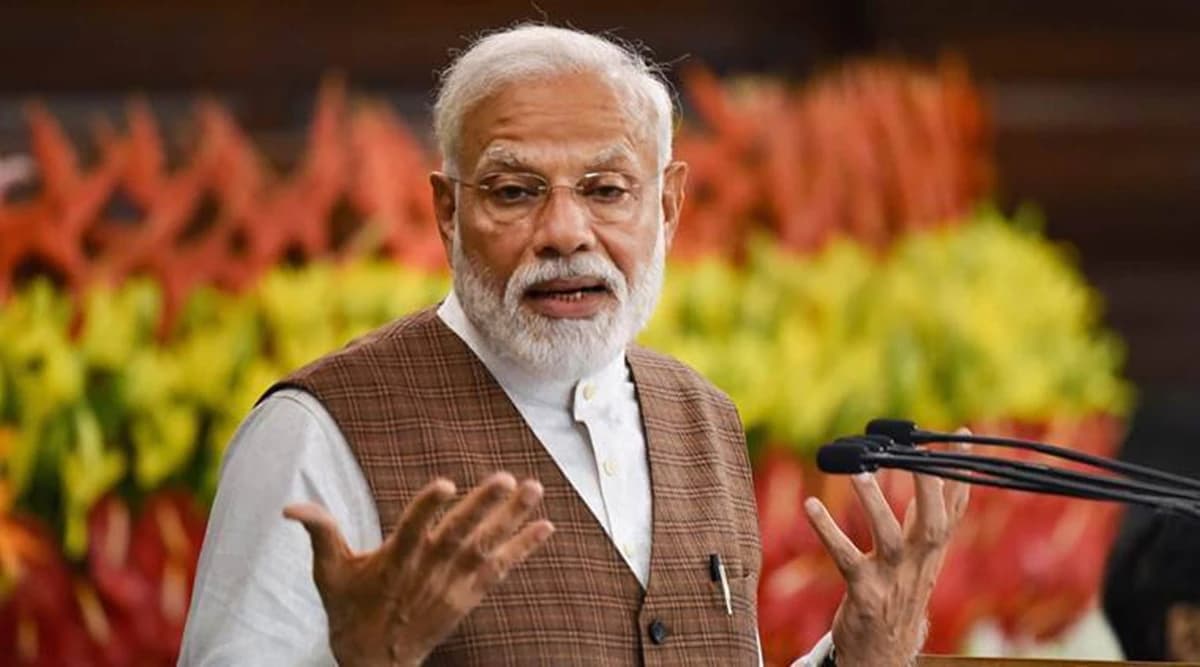
Hours before GST 2.0 was rolled out at midnight on Sunday, Prime Minister Narendra Modi addressed the nation, calling the reform a “bachat utsav” or festival of savings. He framed the two-slab tax system as a step toward economic self-reliance, linking it to cheaper goods, stronger domestic manufacturing, and household savings.
The Story
In a televised address from New Delhi, Modi said GST 2.0 marked a simplification of India’s indirect tax regime — reducing the four-slab structure to just two. Many essential and daily-use goods have moved into the 5% tax bracket, down from the earlier 12%. The Prime Minister argued that this will lower prices, ease compliance for businesses, and put more money back into consumers’ pockets.
He cited government estimates that households could collectively save nearly ₹2.5 lakh crore annually. Alongside GST, Modi highlighted the income tax exemption raised to ₹12 lakh, calling it a “double bonanza” for the middle class.
The Prime Minister linked the tax reform with a larger national mission: strengthening India’s Micro, Small and Medium Enterprises (MSMEs) and reviving swadeshi pride. “Be proud to say you are swadeshi, and buy and sell swadeshi goods,” he urged, stressing that India’s historic prosperity was built on the excellence of its manufacturing sector.
Why It Matters
For ordinary citizens, GST 2.0 promises cheaper everyday essentials, reduced tax burdens, and easier compliance for small traders. For businesses, especially MSMEs, it simplifies accounting and could expand market competitiveness. By nudging consumers to prefer domestic goods, the reform aims to strengthen India’s self-reliance and reduce dependence on imports.
For example, a household buying groceries, medicines, or consumer goods may see direct savings as items shift into the 5% tax bracket. Similarly, small shopkeepers and manufacturers will navigate fewer slabs, lowering administrative costs. Together, these changes are expected to boost domestic consumption and encourage a cycle of savings, investment, and growth.
Background / Context
The Goods and Services Tax (GST) was first introduced in 2017 after prolonged discussions between the Centre and States. It replaced a complex web of central and state-level levies with a unified system. Initially structured with four slabs — 5%, 12%, 18%, and 28% — it attracted criticism for complexity and compliance burdens.
GST 2.0 now trims this to two slabs, 5% and 18%, with most daily-use goods placed in the lower category. According to government data, MSMEs account for nearly 30% of India’s GDP and 45% of exports. Simplifying GST is expected to reduce costs for these enterprises while strengthening India’s manufacturing base.
Implications
Economists note that while lower tax slabs can drive consumption, the impact on revenue collection will need careful monitoring. States may see short-term revenue dips, making the role of GST compensation crucial.
For consumers, savings could translate into higher disposable incomes, aiding household budgets strained by inflation. For MSMEs, reduced compliance costs may boost competitiveness, though challenges like access to credit and infrastructure remain.
Politically, the government is signaling its intent to support the middle class and small businesses ahead of upcoming elections. Internationally, simplification of India’s tax regime is likely to improve the country’s ease of doing business ranking, enhancing investor confidence.
Conclusion
GST 2.0 marks one of the most significant reforms since 2017, with the government projecting a direct impact on household savings and business ease. Whether it delivers on both affordability for citizens and resilience for MSMEs will depend on effective implementation and state cooperation.