

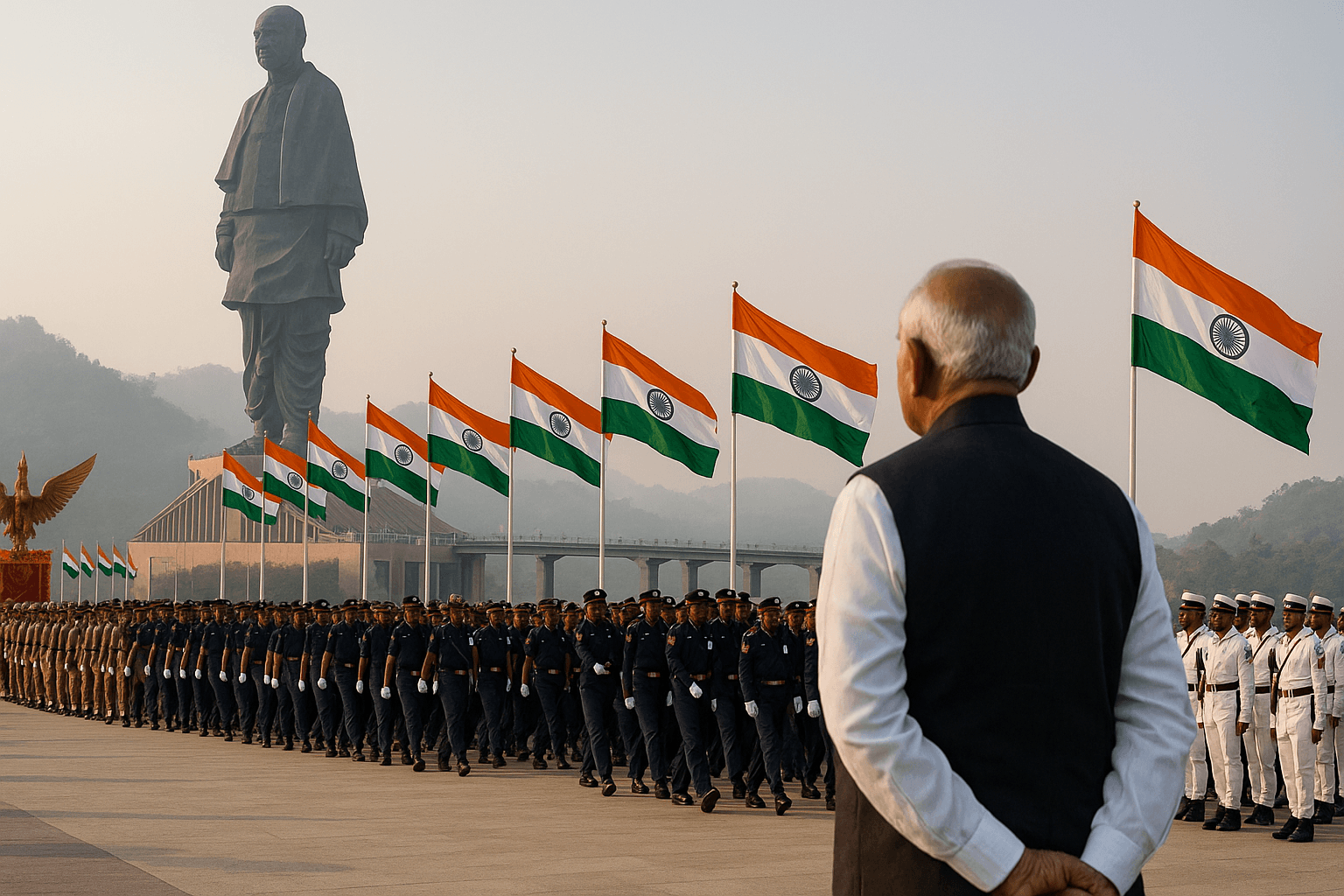
Prime Minister Narendra Modi will lead the National Unity Day (Rashtriya Ekta Diwas) parade near the Statue of Unity at Ekta Nagar (Kevadia), Gujarat, on October 31, 2025, marking Sardar Vallabhbhai Patel’s 150th birth anniversary. Beyond ceremony, the day invites a hard look at Patel’s unmatched role in political integration and institution-building—and why those choices still determine how India governs, grows, and secures itself.
The news: what’s planned at Kevadia
-
National parade & pledge: Police/central forces contingents, NCC, youth bands, and a nationwide Unity Pledge in offices and schools.
-
Cultural & outreach focus: Exhibitions and public programmes around Patel’s life; “Run for Unity” events across states.
-
Symbolism of venue: The Statue of Unity—the world’s tallest statue—stands where annual Unity Day observances anchor Patel’s legacy.
Sardar Patel’s core contributions (the enduring pillars)
1) Political integration of princely states (1947–50)
-
The problem: At Independence, ~565 princely states weren’t automatically part of the Indian Union. Fragmentation risked security vacuums, rival spheres of influence, and economic disarray.
-
Patel’s solution toolkit: As Deputy PM and Home Minister, Patel—working closely with V. P. Menon—used a mix of diplomacy, constitutional instruments, and calibrated force.
-
Instrument of Accession (IoA): Princes acceded on defence, external affairs, and communications—creating a common sovereign core while allowing phased integration.
-
Merger agreements & reorganisation: Hundreds of micro-states were consolidated into viable unions(e.g., Saurashtra, Madhya Bharat, PEPSU), preventing a patchwork of ungovernable enclaves.
-
Firmness where required:
-
Junagadh (1948): A disputed accession was resolved via administration takeover and plebiscite, aligning decision with people’s will.
-
Hyderabad (1948): Operation Polo ended a prolonged standoff and internal disorder, integrating the Deccan’s largest state.
-
-
-
Outcome: A continental-scale federation took coherent territorial shape within a few years—the decisive precondition for national security, market formation, and democratic consolidation.
2) Foundational role in the Constitution’s federal architecture
-
States & minorities committees: Patel steered key Constituent Assembly committees on states’ relations, fundamental rights/minorities, and tribal/excluded areas, balancing unity with diversity.
-
Pragmatic federalism: He backed strong Union powers in security and macro-stability, with room for state autonomy in everyday governance—an equilibrium still visible in the Union, State, and Concurrent Lists.
3) Building the “steel frame” of the Republic
-
All-India Services: Patel was the decisive champion for retaining and Indianising the IAS and IPS, arguing that an impartial, merit-based civil service was essential to hold a vast, plural republic together.
-
Administrative culture: His emphasis on probity, discipline, and field orientation seeded a professional ethos that underwrites centre–state coordination, disaster response, internal security, and election logistics to this day.
4) Economic and social stabilisation in the transition years
-
Law & order first: Patel prioritised internal security and refugee relief in 1947–48, enabling the first government to launch food distribution, currency transition, and early development measures without breakdown.
-
Institutional temperament: His style—firm on fundamentals, flexible on method—kept fractious negotiations on track while signalling that the new Union possessed both will and capacity.
Why Patel’s choices still matter in 2025
-
Security and markets need a coherent map
Integrated territory and predictable jurisdiction are the base layer for everything—from interstate logistics and energy corridors to counter-insurgency and disaster management. Patel’s integration solved this at birth; today’s national projects still rely on that architecture. -
A living federal balance
Debates on governors’ powers, inter-state water/river boards, GST Council dynamics, and cooperative federalism all sit within the balance Patel helped codify: a strong centre for unity, robust states for execution. -
Impartial services as connective tissue
Whether it’s conducting nationwide elections, rolling out digital public infrastructure, or crisis response, the All-India Services model remains the Republic’s operational backbone—Patel’s most durable bet on state capacity. -
Modern unity challenges
From internal migration and urbanisation to information disorder and border management, new pressures test cohesion. The October 31 observance isn’t nostalgia; it’s a performance review of how well we uphold integration, inclusion, and rule-bound governance.
Rashtriya Ekta Diwas: the idea behind the day
-
Instituted: 2014, observed every October 31 to honour Patel’s role in unification and to renew the Unity Pledge.
-
Civic aim: Move unity from slogan to practice—lawful conduct, respect for diversity, and shared national purpose—through public participation, drills, and youth engagement.
What to watch for at this year’s parade
-
Women-led formations and youth displays that foreground inclusion.
-
Cultural tableaux on integration milestones (Junagadh/Hyderabad, consolidation of states, All-India Services).
-
Civic outreach linking Unity Day to everyday duties—traffic discipline, anti-disinformation awareness, disaster readiness.
Quick primer
-
Patel’s designation: Deputy Prime Minister & Home Minister (1947–50).
-
States integrated: ~565 princely states via IoA/mergers; key cases—Junagadh (plebiscite), Hyderabad (police action).
-
Institutional legacy: All-India Services (IAS/IPS); stewardship of key Constituent Assembly committees shaping federalism and rights.
-
Unity Day: Observed Oct 31 nationwide; pledge + public programmes; central ceremony at Statue of Unity, Kevadia.
Credits: The UPSC Times desk; based on official releases, Constituent Assembly Debates, and standard biographies/archives.