

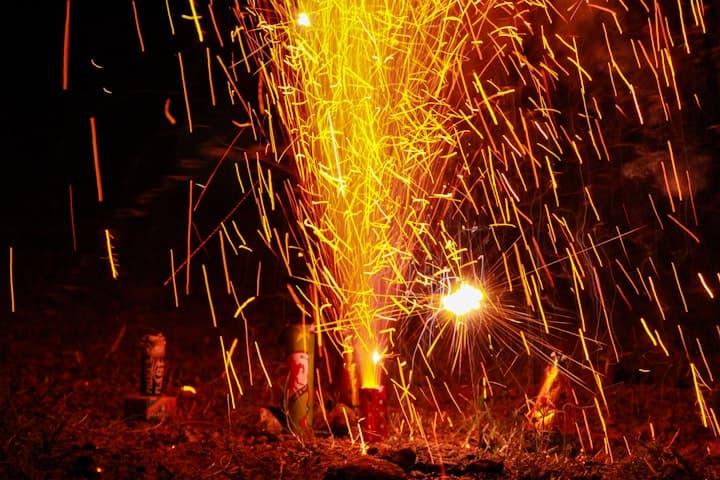
The long view: what’s typical after Diwali? Every year, fireworks add a short, sharp pulse of pollutants—mostly fine particulates (PM2.5)—on top of Delhi’s already high background from vehicles, industry, waste burning and dust. When winds are calm and the boundary layer is low on cool nights, this spike lingers into the next morning, pushing AQI into “very poor” or “severe.” Studies and multi-year datasets consistently show this pattern.
Year-by-year milestones
-
2016: Among the worst smog episodes; next-day AQI around 431, ushering in the modern “severe post-Diwali” narrative.
-
2017: Supreme Court bans sale of crackers in Delhi-NCR ahead of Diwali; despite curbs, a severe smog wave follows in early November (PM2.5 peaks reported around 710 μg/m³ on Nov 7–8 at some stations).
-
2018: SC introduces “green crackers” and a two-hour window (8–10 pm). Post-Diwali AQI still “very poor” (roughly 281–337 band).
-
2019: AQI again “very poor” (~337) underscoring limits of enforcement and high background pollution.
-
2020: Despite pandemic-year improvements earlier, post-Diwali AQI surges; 24-hr AQI ~435, and real-time indices briefly cross 500 (“severe-plus”).
-
2021: Worst Diwali-week air in several years; AQI peaked ~462 on Nov 5.
-
2022: Some relief relative to 2021; post-Diwali day AQI near 312 (still “very poor”).
-
2023: A comparatively better year; post-Diwali AQI near 218 (“poor”)—meteorology helped dispersion.
-
2024: Back to “very poor,” around 328–345; the seasonal smog cycle remained intact.
-
2025: After a limited green-cracker reprieve, widespread violations were reported; Delhi woke up to very poor/hazardous air (citywide AQI ~350; hotspot station PM2.5 spikes reported >1,400–1,800 μg/m³). Climate Trends estimated post-Diwali PM2.5 averaging ~488 μg/m³, about 212% above the pre-Diwali baseline.
Fireworks vs stubble burning vs weather: who’s to blame?
-
Fireworks: They create the sharpest overnight spike (hours) in elemental/ionic constituents of PM2.5 (K, sulfate, chloride, metals). The immediate evening-to-midnight surge aligns with bursting windows.
-
Stubble burning: A regional background factor that varies with farm-fire intensity and winds; even when farm fires dip, the post-Diwali spike persists due to crackers plus urban emissions.
-
Meteorology: Calm winds + shallow mixing heights trap smoke; when winds pick up next day, AQI can improve quickly. This explains why 2023 looked “better” and 2021/2025 looked “worse.”
The policy arc (2015–2025)
-
2015–2017: Litigation gathers pace; 2017 pre-Diwali sale ban in NCR.
-
2018 onward: Green-cracker regime + 2-hour window; periodic local bans and variable enforcement.
-
2024: Delhi notifies a permanent firecracker ban under pollution-control laws; complaint channels opened.
-
2025: Limited relaxation for green crackers; enforcement gaps widely reported; post-Diwali spike returns.
Bottom line
Post-Diwali pollution spikes are a recurring, meteorology-amplified phenomenon. Fireworks are the trigger; the size of the spike is shaped by winds/temperature and a high urban emissions baseline. Durable gains depend on both curbing fireworks and year-round emissions control (transport, industry, waste, dust), plus consistent enforcement.