

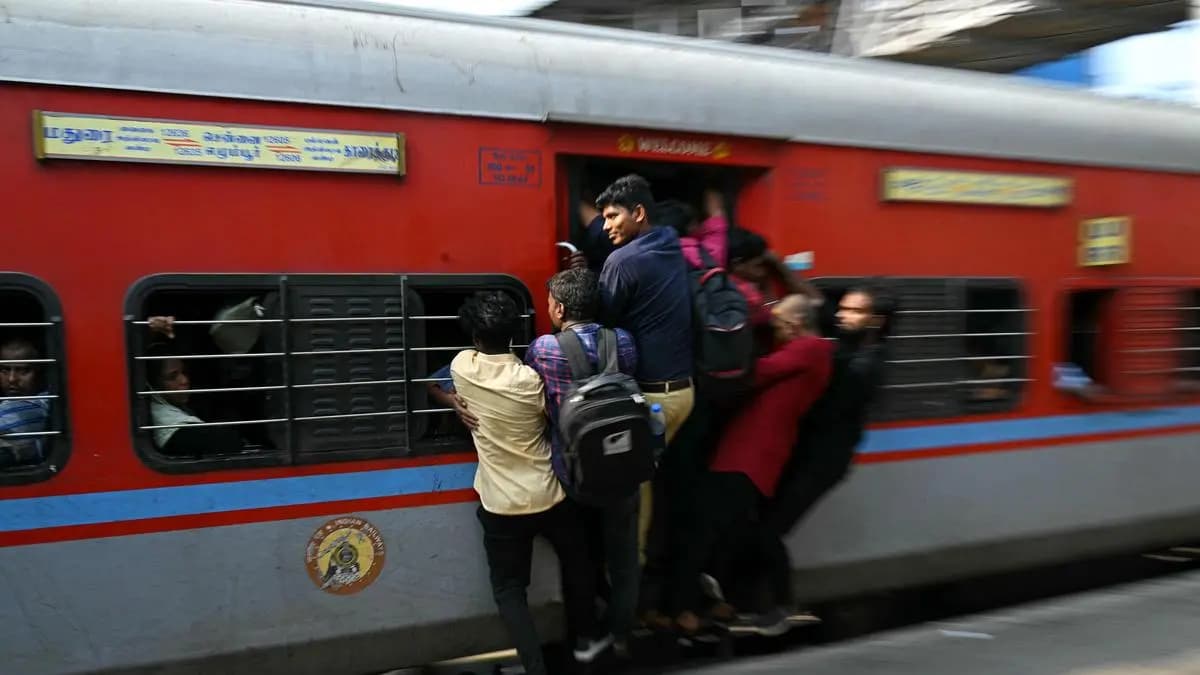
Rail fares in India carry more than a price tag; they carry the weight of affordability, inflation anxiety, and the political promise of mobility for the aam passenger. The Railways’ decision to raise fares from December 26 by a tiny per-km margin may appear minor, but it sends a larger message: the system is seeking additional passenger revenue—carefully ring-fenced to spare suburban commuters and short-distance ordinary-class travel. The debate now shifts from “how much” to “how fairly, how transparently, and how sustainably” the Railways balances social obligation with financial discipline.
What’s in the news
-
Railways will increase fares effective December 26, aiming to mobilise ₹600 crore.
-
The hike is 1 paisa per km for journeys in ordinary class beyond 215 km.
-
The hike is 2 paise per km for non-AC classes of mail/express trains and AC classes of all trains.
-
No increase in suburban monthly season tickets and ordinary-class travel up to 215 km.
-
Passengers who already booked tickets for journeys after December 26 will not pay any additional amount.
-
The Congress criticised the decision, alleging it should have been announced through the Budget and questioning the manner of implementation.
Background and context
Railways sits at a difficult junction: it is expected to be commercially viable, yet also function as India’s most expansive welfare-linked transport system. Historically, a key tension has been the cross-subsidy structure—freight often carries a heavier burden to keep passenger fares lower. But rising operating costs, service expectations, and the need for safety and modernisation keep pressure on the Railways’ finances.
In such a setting, incremental fare changes are often preferred over sharp revisions. They generate revenue without triggering a visible “shock,” and they can be framed as rationalisation rather than a full-scale hike. Still, even small increases become politically charged because they touch daily life and the cost-of-living narrative.
Key provisions of the decision
1) Differential per-km increase by category
-
Ordinary class (beyond 215 km): + 1 paisa per km
-
Non-AC mail/express & all AC classes: + 2 paise per km
2) Explicit exemptions to protect routine commuters
-
No change for suburban monthly season tickets
-
No change for ordinary class travel up to 215 km
3) Protection for those who booked earlier
-
Tickets already booked for travel after the effective date will not be reopened for additional collection, reducing passenger inconvenience and operational friction.
4) Revenue objective stated upfront
-
The Railways has publicly pegged the expected additional revenue at about ₹600 crore, which makes the policy measurable—and therefore more accountable.
Why it matters
1) It normalises “micro-adjustments” in passenger pricing
A paisa-per-km model is a classic incremental tool. It signals that Railways wants the freedom to make small, frequent changes rather than rare, politically explosive hikes. That can be good policy—if paired with transparency.
2) It draws a clear line between commuters and long-distance discretionary travel
By shielding suburban passes and short ordinary-class journeys, Railways is implicitly prioritising essential daily mobility. That is a socially sensitive design choice, likely intended to limit backlash.
3) It reopens the bigger question: who funds Indian Railways’ modernisation?
If passenger fares remain politically constrained, funding must come from freight, budgetary support, or non-fare revenue. Each has trade-offs. This hike indicates Railways is seeking a modest passenger contribution rather than relying entirely on other channels.
4) It becomes a governance story, not just a pricing story
The Congress’ criticism highlights process legitimacy: should such revisions be routed through formal budgetary disclosure, or can they be done as administrative fare rationalisation? Even if the financial impact is small, procedure affects public trust.
Arguments for and against
Arguments supporting the hike
-
Small per-passenger burden: The Railways claims the increase remains modest—for example, around ₹10 extra on a 500-km journey in non-AC categories under the 2 paise/km logic.
-
Targeted relief: Protecting suburban season ticket holders and short ordinary-class travel cushions the most price-sensitive, routine users.
-
Revenue for service needs: Even a few hundred crore can support operational gaps, maintenance, and service improvements when pooled across a large network.
Arguments against the hike
-
Inflation and affordability optics: Even small additions can pinch families making frequent long-distance journeys for work, health, or education.
-
Process and transparency concerns: Critics argue fare changes should be debated more openly, ideally alongside broader budget priorities and performance commitments.
-
Trust deficit risk: If passengers do not see service improvements—cleanliness, punctuality, safety—fare changes feel like extraction rather than rationalisation.
Constitutional and legal angle
Rail fares are typically set through executive and administrative powers under the Railways’ regulatory and tariff framework, rather than requiring a separate legislative vote for each adjustment. However, the core legal-policy test is not simply “power to revise,” but reasoned transparency: whether fare revisions are predictable, non-arbitrary, and communicated with adequate clarity.
From a public finance perspective, the political argument that such measures should be surfaced through the Budget is essentially a demand for stronger parliamentary visibility and a clearer link between additional collections and service outcomes.
Implications
1) Passenger sentiment will hinge on perception of value
The hike is small; the narrative impact can be large. If service quality continues to improve, the adjustment will be seen as reasonable. If not, it can feed a wider dissatisfaction with “pay more, receive same.”
2) Freight cross-subsidy debate may intensify
Any move to raise passenger revenue—even slightly—revives the discussion on whether Railways should gradually reduce reliance on freight overpricing that can hurt industrial competitiveness.
3) More such “rationalisations” could follow
Once micro-revisions become acceptable, the policy door opens to periodic recalibrations—especially when costs rise. That makes predictability and communication even more important.
4) Political contestation may shift to procedure
If opposition frames the issue as bypassing budgetary scrutiny, future fare changes could see sharper demands for formal disclosure, impact notes, and public consultation-like signalling.
Way ahead
-
Publish a simple fare-impact note: Clear examples across common routes and classes can reduce misinformation and confusion.
-
Tie fare rationalisation to service commitments: Even modest, visible improvements—cleanliness, coach maintenance, punctuality metrics—strengthen legitimacy.
-
Protect the most vulnerable consistently: The commuter exemptions are a good start; similar clarity is needed for other vulnerable categories.
-
Build a predictable pricing philosophy: A transparent rule—based on costs, inflation, and service indices—can reduce the sense of ad-hoc decision-making.
-
Strengthen accountability for the ₹600 crore: A public statement on where incremental revenue will be deployed can convert irritation into acceptance.
Conclusion
This is not a dramatic fare shock; it is a calibrated nudge. But policy nudges, repeated over time, shape the public contract between Railways and passengers. The decision’s success will depend on two things: whether the burden remains genuinely modest for ordinary travellers, and whether the Railways can match “rationalisation” with visible reliability and service value.
Source credits : The Hindu; Railway Ministry note circulated to presspersons as reported; statements by Congress leaders as reported.