

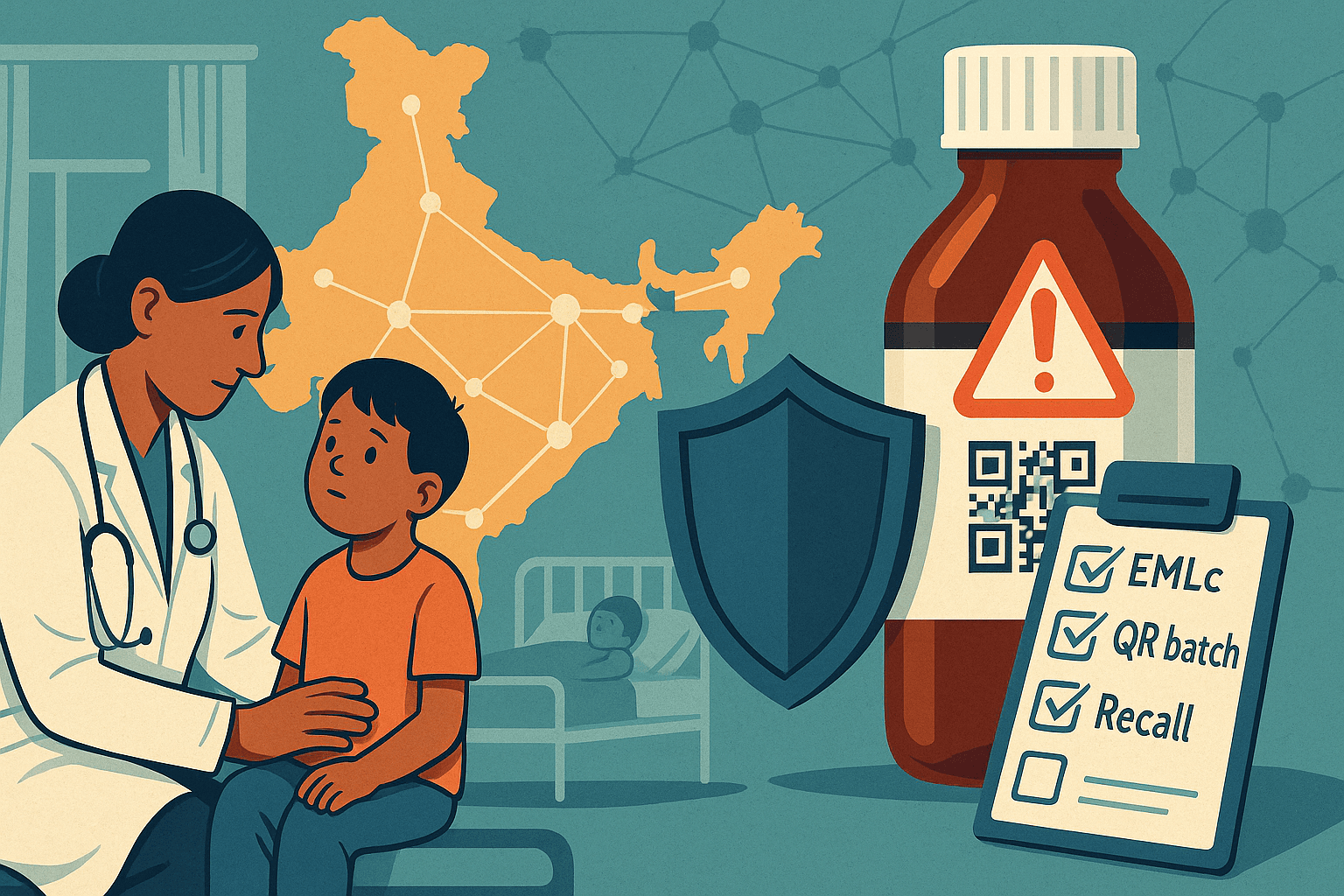
The shock of 25 preventable child deaths should not fade into the usual cycle of blame-and-move-on. India owes its children more than condolences: it owes them a paediatric drug-safety architecture that recognises a basic truth—children are not small adults. Their bodies process medicines differently; yet our rules, surveillance, labels, supply chains and incentives largely assume otherwise. This editorial lays out what must change now, next, and long-term.
What went wrong (and keeps going wrong)
-
Adult-first design: Most clinical evidence, labels and dosing guidance are extrapolated from adults; paediatric formulations are an afterthought.
-
Excipient risk blind spots: The killer in many syrup tragedies wasn’t the “drug” but contaminated excipients(e.g., glycerin/propylene glycol) with diethylene/ethylene glycol—calling for input-level controls, not just finished-product tests.
-
Fragmented oversight: Central licensing for large manufacturers and exports sits alongside State enforcement for thousands of units; gaps at interfaces (vendor qualification, batch release, field sampling) are where bad lots slip through.
-
Weak last-mile controls: OTC sales, informal advice, and commission-driven prescribing can override age warnings, with dosing devices missing or labels unreadable.
-
Slow, opaque recalls: Families and frontline clinicians often learn of a recall after harm occurs; public recall dashboards and batch verifications are not routine.
Children are “therapeutic orphans”: the science case
-
Different kinetics/dynamics: Gastric pH, body water, liver enzymes, renal clearance—all differ by age; neonates, infants, toddlers and adolescents need age-specific doses and formulations.
-
Trial ethics ≠ trial absence: Ethical caution is essential, but it should translate into paediatric-appropriate study designs (minimal-risk PK/PD studies, modelling/simulation, registry-based follow-up), not a policy vacuum.
-
Formulation first: Palatability, osmolarity, excipient grade, dosing devices (oral syringes, not spoons) and unit-dose packaging are safety features, not marketing extras.
International cues India can adapt
-
EU Paediatric Regulation / PUMA: Paediatric Investigation Plans (PIPs) and a Paediatric Use Marketing Authorisation that rewards child-specific data and dosage forms.
-
U.S. BPCA & PREA: A mix of obligations (study in children when appropriate) and incentives (exclusivity extensions) to generate paediatric evidence.
-
Lesson: Pair clear obligations with real incentives so companies develop child-fit medicines, not cut-down adult drugs.
The reform blueprint
A) Immediate actions (0–6 months)
-
Emergency excipient controls: Mandatory source verification and pre-shipment testing for glycerin/propylene glycol/sorbitol used in paediatric liquids; NABL-accredited, surprise cross-checks.
-
Batch-level trace & verify: GS1-standard QR on every bottle linking to batch number, CoA summary, manufacture/expiry, and recall status; public recall portal updated in real time.
-
OTC red lines for children: Enforce the existing ban for under-4s; make OTC cough/cold combinations for under-6 pharmacist-gated with mandatory counselling and dosing device.
-
Black-box warnings & devices: For all paediatric liquids, bold front-label age warnings, oral syringe in every pack, and weight-band dosing tables (not age-only).
-
Field force code with teeth: Convert the voluntary code on promotions into an enforceable rule: zero tolerance for cash commissions, misleading claims, or age-contraindicated pitching; swift suspension on first offence.
-
Hospital sentinels: Activate a 100-hospital Paediatric Pharmacovigilance Sentinel Network to fast-flag clusters (hepatic/renal injury signals), with 72-hour national alerts.
B) Structural fixes (6–24 months)
-
Paediatric Medicines Rules for India:
-
Mandatory Paediatric Development Plans for relevant drugs.
-
Age-appropriate formulations (low-osmolar syrups, mini-tabs, dispersibles).
-
Excipients monographs specific to paediatric use in the Indian Pharmacopoeia.
-
-
EML-Children (EMLc) refresh cycle: National EMLc updated every 2 years, with procurement and Jan Aushadhi aligned to the list; crowd in Indian academy input.
-
Stronger GMP for liquids: Schedule M addendum for paediatric liquid lines: excipient segregation, online DEG/EG screening, and enhanced line clearance SOPs.
-
Digital prescriptions & dose calculators: Embed weight-based calculators and interaction checks into eSanjeevani/ABDM-linked e-Rx; auto-flag under-age contraindications.
-
Recall drills: Quarterly mock recalls with time-to-notify and reach metrics; penalties for delays.
C) Long-term capacity (2–5 years)
-
Indian Paediatric Investigation Plans (iPIPs): Adapt EMA’s PIP model; allow modelling/simulation to reduce sample sizes; build paediatric PK/PD biobanks.
-
Incentives that matter: Fast-track reviews, fee waivers, and limited exclusivity extensions for genuine paediatric innovations and reformulations.
-
People & skills: National programme to train conservators of liquids (QA chemists), paediatric clinical pharmacologists, biomedical statisticians; fund reference labs in each zone.
-
One-map enforcement: A single nationwide licence-to-recall map tying central licences, state inspections, test results and export clearances—so no bad lot plays jurisdictional pinball.
Practical guardrails for the last mile
-
Pharmacist checklists: Confirm weight-based dose, provide an oral syringe, demonstrate measurement, and record counselling in POS.
-
Caregiver literacy: 3-point label literacy—what, how much, how often—plus a stop-and-seek list (vomiting, unusual sleepiness, reduced urine).
-
Teen risk: Tighten controls on misuse (cough syrups with psychoactive potential); monitor bulk sales, mandate ID for repeat purchases.
Justice and accountability
-
Victim compensation fast-track: A predefined, no-fault compensation grid for proven product contamination, with subrogation against culpable entities after technical adjudication.
-
Transparent enforcement outcomes: Publish plant inspections, warning letters, and penalties in plain language to restore trust.
-
Criminal liability for wilful negligence: When executives or distributors knowingly bypass quality gates, prosecution must be visible and swift.
Quick notes
-
Constitution: Article 39(f)—State duty to ensure children’s development and protection.
-
Institutional actors: CDSCO/DCGI (central), State Drug Controllers (local manufacture/sale), IPC–PvPI(pharmacovigilance).
-
Global frameworks to know: EU Paediatric Regulation/PUMA, US BPCA & PREA.
-
Core idea: Paediatric medicines need distinct evidence, distinct formulations, distinct safeguards.