

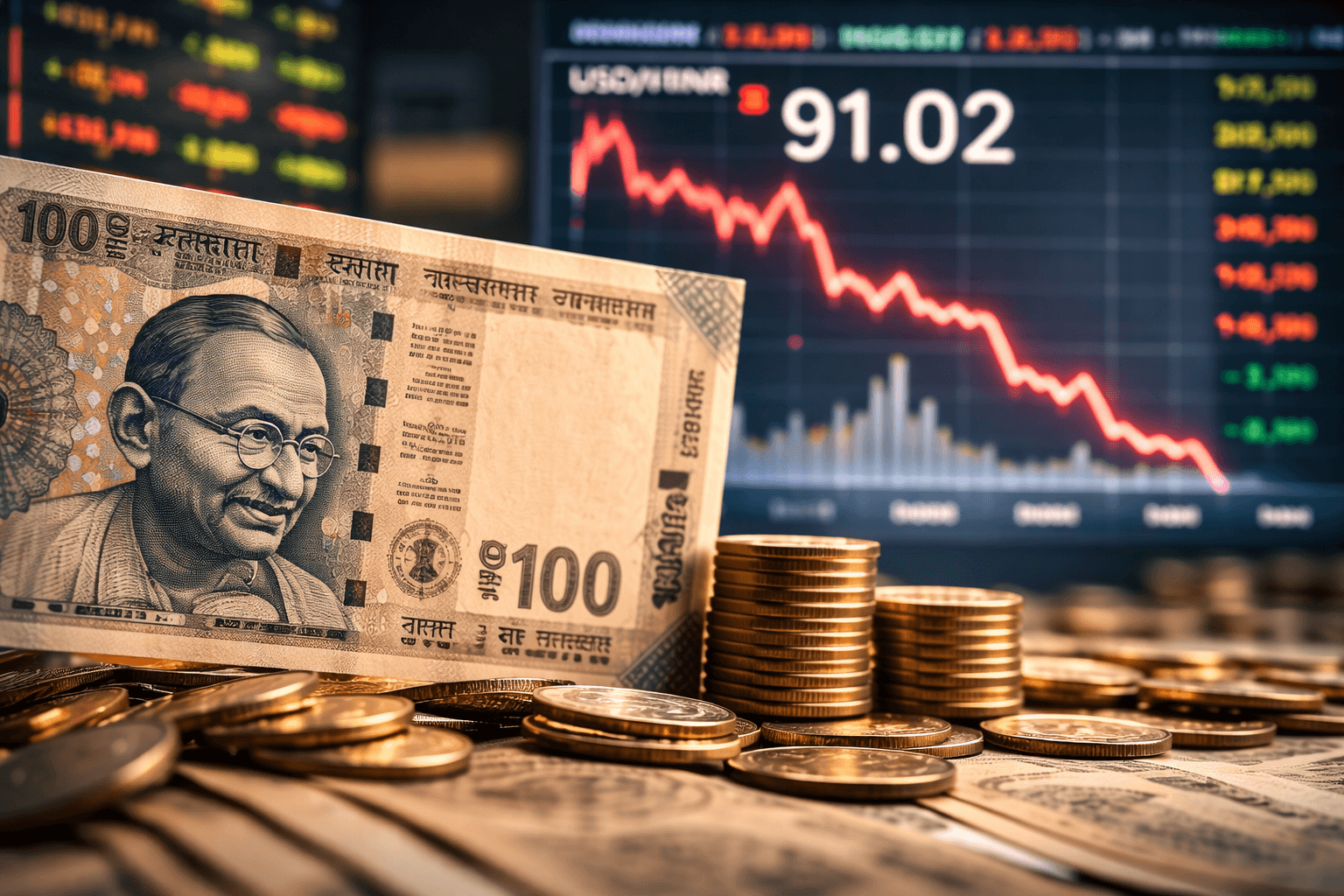
The rupee’s dip past the 91-per-dollar mark during intraday trade is less a verdict on India’s growth story and more a reminder that currencies are priced at the intersection of flows, sentiment and global rates. The move matters because it changes expectations: once a psychological level breaks, markets begin to test how much volatility policymakers are willing to tolerate.
What’s in the news
-
The rupee weakened beyond 91 intraday (to 91.14) before closing at 90.93, a fresh low versus the previous close of 90.78.
-
Market voices attribute pressure to foreign portfolio outflows, uncertainty around India–U.S. trade negotiations, and a risk-off global backdrop shaped by higher U.S. yields and the unwinding of the yen carry trade.
-
The Reserve Bank of India’s intervention is being read as measured, aimed at smoothing sharp moves rather than defending a specific level.
What is driving the rupee lower
1) Capital flows and dollar demand
When portfolio investors pull money out, demand for dollars rises. Even if domestic fundamentals are steady, short-term flows can dominate, especially in months when risk appetite softens globally.
2) Global rates and the “risk-off” channel
Higher U.S. bond yields tend to strengthen the dollar and tighten global financial conditions. Add a possible re-pricing of Japanese rates and the unwinding of leveraged “carry” positions, and emerging-market currencies often face a sudden, broad-based pressure.
3) Trade-war uncertainty and sentiment
In an environment where tariffs, market access and deal timelines are unclear, currency markets price in caution. That caution shows up first in hedging activity and then in spot markets.
Does this signal weakness in India’s economy
Not necessarily. A currency can weaken even with strong growth if:
-
global conditions turn defensive,
-
the dollar strengthens broadly, and
-
foreign flows move out faster than domestic flows move in.
The more useful question is whether the depreciation remains orderly or turns disruptive through sharp, persistent volatility.
Who feels the impact first
Importers and input-heavy sectors
A weaker rupee typically raises landed costs for firms that import crude-linked inputs, speciality chemicals, electronics components or capital goods. The pass-through depends on contract terms and hedging coverage.
Exporters and services earners
A softer rupee can improve rupee realisations for exporters and IT services firms, offering some cushion—though global demand conditions still matter more than exchange rates for volumes.
Households
Households feel it indirectly: via higher prices if imported inflation seeps into fuel-linked logistics, durables, or select food supply chains. The impact is often uneven and slower than headlines suggest.
What RBI’s posture could be signalling
A central bank typically tries to avoid two extremes:
-
a rigid defence of a single level, and
-
a free fall that feeds speculation.
If the rupee is allowed to move gradually, it can help the economy adjust without burning reserves aggressively. The real red line is usually excess volatility—because that disrupts trade, pricing, and corporate planning more than a steady depreciation does.
What to watch next
Near-term markers
-
trajectory of FPI flows and domestic liquidity support
-
U.S. yields and global risk sentiment
-
clarity (or fresh uncertainty) on trade negotiations
-
RBI’s signalling through market operations and forward positioning
The bigger picture
If depreciation stays measured, it can be absorbed. If it becomes abrupt and disorderly, it can tighten financial conditions, complicate inflation management, and dent confidence. The policy challenge is to keep the rupee flexible—but not fragile.