

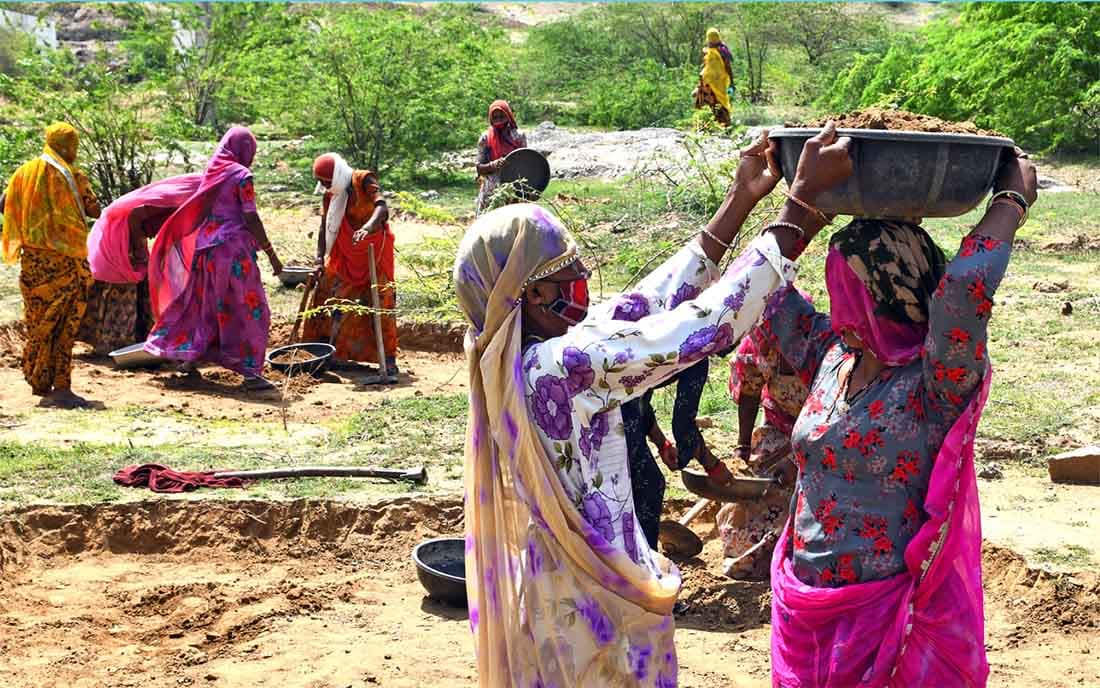
With Presidential assent, India’s most iconic rural employment guarantee framework enters a new phase. The Viksit Bharat–Guarantee for Rozgar and Ajeevika Mission (Gramin) Act replaces MGNREGA while promising a visible upgrade: guaranteed workdays rise from 100 to 125, and the law claims stronger provisions for unemployment allowance and penalties for delayed wage payments. The Centre’s messaging is equally clear: the scheme will pivot from “creating works” to “creating outcomes,” concentrating effort across four areas that reflect today’s rural risk landscape—water stress, infrastructure gaps, livelihoods, and extreme weather. The real test will not be the headline number of days. It will be whether the architecture delivers timely wages, real demand-based employment, durable assets, and local planning space—without turning the guarantee into a top-down programme.
What’s in the news
-
President Droupadi Murmu has granted assent to the VB-G Ram G Act, which replaces MGNREGA.
-
The Centre says the new law increases guaranteed employment days from 100 to 125.
-
Union Minister Shivraj Singh Chouhan defended the legislation, saying it is a step forward and that provisions for unemployment allowance have been strengthened.
-
The government says there are provisions for penalty for delayed wages.
-
A budget of ₹1,51,282 crore is cited for comprehensive village development under the scheme.
-
Works under the scheme will be prioritised across four focus areas:
-
water security
-
core rural infrastructure
-
livelihood-related infrastructure
-
extreme weather mitigation
-
-
The Centre remains the principal funding partner, following the broadly used 60:40 pattern for centrally sponsored schemes.
Background and context
MGNREGA was designed as a rights-based, demand-driven safety net: if a rural household demands work, the state must provide it within a stipulated time or pay unemployment allowance. Over time, the scheme became both:
-
a shock absorber during droughts, distress migration, and crises, and
-
a state capacity test, because timely wage payments, worksite planning, and local transparency determine whether the “guarantee” feels real.
Replacing such a law is not merely an administrative refresh. It reshapes the political economy of rural welfare: who controls planning, how funds flow, what assets are prioritised, and how accountability is enforced.
Key provisions and what they practically mean
1) 125 days: more work on paper, or more work in reality?
Increasing guaranteed days expands the potential safety net. But work availability depends on:
-
fund adequacy and release cadence,
-
how quickly works are sanctioned and opened,
-
and whether local bodies can plan in time for seasonal distress.
If the pipeline is slow, the “125” becomes symbolic. If it is well-run, it can reduce migration stress and stabilise incomes.
2) Stronger unemployment allowance: a quiet but crucial promise
Unemployment allowance is the legal spine of any employment guarantee. If implemented firmly, it pushes administrators to provide work rather than delay. If implemented weakly, the guarantee becomes discretionary.
The key practical question is whether the allowance is:
-
easy to claim,
-
time-bound,
-
and routinely paid when work is not provided.
3) Penalty for delayed wages: deterrence depends on enforcement
Wage delays are the single biggest trust-killer in rural employment schemes. A penalty provision matters only if:
-
it triggers automatically,
-
the burden is not shifted back onto local officials without support,
-
and payment systems (muster rolls, measurement, approvals) are streamlined.
Without process reforms, penalties can become another headline without changing the ground reality.
4) Four focus areas: a strategic pivot toward climate-risk and productivity
The four focus areas are a strong signal of what the Centre wants the programme to become:
-
Water security: ponds, recharge, watershed works, irrigation efficiency — directly linked to drought resilience and farm productivity.
-
Core rural infrastructure: roads, drains, community assets — improves mobility, health outcomes, and service delivery.
-
Livelihood-related infrastructure: assets that support income generation — storage, processing, market linkage enablement (depending on design).
-
Extreme weather mitigation: embankments, soil conservation, protective works — reflects the new normal of floods, heat stress, erratic rains.
This “outcomes” language is essentially a push to tie public works to measurable resilience and productivity, not just short-term employment.
5) Funding architecture: the 60:40 reality
The Centre remaining the principal funding partner and using the 60:40 pattern matters because:
-
States carry a substantial share and implementation load,
-
yet political accountability often flows upward to the Centre,
-
creating tension when funds are delayed or when local demand spikes.
Why it matters
1) Rural India is facing a new risk profile
Extreme weather is no longer episodic; it is structural. A jobs programme that also builds climate-resilient assets can become one of India’s most scalable adaptation instruments — if assets are durable and well-chosen.
2) The “works vs outcomes” framing is a governance shift
Outcomes demand measurement: asset quality, utility, maintenance, and long-term community value. That requires better planning, engineering support, and transparency — otherwise “outcomes” becomes rhetoric.
3) The right-to-work principle is at stake
MGNREGA’s strength was legal enforceability. Any redesign that centralises planning or caps budgets too tightly risks turning an enforceable right into a managed allocation. The credibility of the new law will be judged by whether rural households can still demand work and receive it on time.
4) Trust will rise or fall on wages
For rural households, the scheme’s dignity is in the wage hitting the account on time. Not the slogan, not the focus area. Timely wages are the policy’s moral centre.
Arguments for and against
Arguments supporting the new Act
-
Higher guaranteed days can strengthen income security.
-
A focus on water, infrastructure, livelihoods, and climate mitigation aligns with real rural needs.
-
Stronger provisions for unemployment allowance and wage-delay penalties can improve enforceability if implemented well.
-
An “outcomes” lens may improve asset quality and long-term value.
Arguments raising concerns
-
Replacing a rights-based framework can be seen as rewriting the social contract if demand-driven features weaken.
-
“Outcome” framing can justify tighter central control over what works are permitted, reducing local autonomy.
-
Penalties and allowances can remain weak if administrative capacity and fund-flow constraints persist.
-
Large budgets announced centrally do not automatically translate into predictable fund releases at the last mile.
Constitutional and legal angle
Rural employment guarantees sit within the broader constitutional promise of social and economic justice and the state’s responsibility to improve livelihoods and welfare. The legal power of such a scheme lies in enforceable entitlements backed by clear procedures, grievance redress, and accountability mechanisms.
If the new Act strengthens enforceability (automatic unemployment allowance triggers, time-bound wage payments, transparent audits), it deepens the rights-based character in practice. If it introduces discretionary controls that limit demand-based provisioning, it risks reducing the scheme to an administratively allocated programme rather than a true guarantee.
Implications
1) A climate-adaptation pathway could emerge at scale
If extreme weather mitigation and water security become high-quality asset pipelines, the scheme can anchor village-level climate resilience in a way few programmes can match.
2) State–Centre coordination will become more contested
Funding shares, work prioritisation, and administrative discretion can become flashpoints—especially in States with high demand or differing development priorities.
3) Quality of assets will move to the centre of scrutiny
An “outcome” promise invites evaluation: Are assets durable? Are they maintained? Do they reduce vulnerability? This will push performance auditing into sharper focus.
4) Rural political economy may shift
If the scheme becomes more structured toward infrastructure and climate works, it could create new local contractor pressures, measurement disputes, and implementation politics unless transparency and social audits remain strong.
Way ahead
The new Act’s credibility will be built through implementation choices that make the guarantee real:
-
Protect demand-driven access: ensure job demand registration is easy, and work allocation is time-bound and verifiable.
-
Make wage timeliness non-negotiable: simplify approvals, strengthen digital workflows, and ensure funds arrive before liabilities pile up.
-
Engineer outcomes with local planning: outcomes improve when Gram Panchayats have the freedom to plan within broad priorities, supported by technical staff.
-
Define “outcomes” clearly: specify measurable asset standards, durability benchmarks, and maintenance responsibilities.
-
Strengthen grievance redress: quick, accessible mechanisms matter as much as penalties on paper.
-
Use transparency as a trust engine: proactive disclosure of works, payments, and timelines reduces confusion and misinformation.
Conclusion
The VB-G Ram G Act marks a decisive redesign of India’s rural employment guarantee framework: more days of assured work, a sharper emphasis on climate and infrastructure outcomes, and stated intent to strengthen wage and unemployment protections. Whether this becomes a genuine upgrade or a contested rewrite depends on one principle: can the rural household still demand work as a right, receive it on time, and see assets that truly improve village life?
Source credits : The Hindu; official government note on the Act’s focus areas and funding pattern as reported; Union Minister’s public statement as reported.