

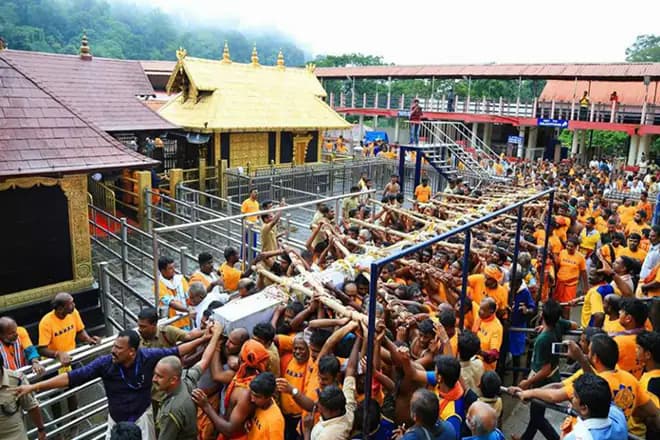
On the eve of the Kerala Assembly session, a political row has erupted over claims that the Travancore Devaswom Board diverted Sabarimala revenue to stage the Global Ayyappa Sangamam at Pampa. The Opposition demands a CBI probe; the government and CPI(M) say funds will be remitted after sponsor receipts. Beyond the charge and countercharge lies a deeper legal canvas: constitutional rights of devotees, institutional autonomy of temple bodies, and Supreme Court jurisprudence on managing Hindu religious institutions.
The Story
Congress leader Thiruvanchoor Radhakrishnan alleges that temple revenue collected from devotees was used to underwrite a large public event, contrary to assurances reportedly given to the High Court. He calls the Sangamam a political spectacle aimed at mobilising Ayyappa devotees before polls and accuses the government of perjury. BJP leader Kummanam Rajasekharan cites figures, saying ₹8.22 crore was allocated by the Board, with ₹4.11 crore already paid to a contractor cooperative.
The government response, articulated by CPI(M) functionaries, is that the Travancore Devaswom Board informed the court it would reimburse the sums into the Board treasury within a stipulated period, contingent on sponsor payments, and that no illegality exists. Meanwhile, parallel allegations of “misuse and theft” of temple offerings at Sabarimala, aired by social organisations, have intensified scrutiny. The Opposition plans protests and seeks a High Court-monitored CBI probe, signalling distrust of a state-led investigation.
At the core is the permissible use of temple income: may a Devaswom Board deploy surplus funds for large-scale public events portrayed as devotional outreach or development, and on what safeguards, approvals, or court-recorded undertakings must such spending rest?
Why It Matters
Temple governance in Kerala sits at the intersection of faith, public administration, and constitutional guarantees. Sabarimala’s scale means decisions reverberate beyond devotees, shaping crowd management, infrastructure, and finances across districts. If funds are diverted for purposes not tightly tethered to the temple’s objects, fiduciary norms and public trust are implicated. Equally, if Boards cannot plan legitimate cultural or infrastructural initiatives, institutional autonomy risks paralysis. This balance, between autonomy and accountability, is exactly where Articles 21, 25, and 26—and decades of Supreme Court precedent—do their quiet work.
Background / Context
• The Institution: The Travancore Devaswom Board (TDB) administers Sabarimala under the Travancore-Cochin Hindu Religious Institutions framework. It is a statutory trustee, not a private proprietor, and must apply funds for the temple’s objects: worship, facilities for devotees, maintenance, and legally approved ancillary purposes.
• Financial Norms: Statutory bodies handling religious funds are fiduciaries. Typical controls include budget approvals, audit, tender norms, and, where applicable, court-recorded undertakings. Departures invite judicial review for arbitrariness, mala fides, or breach of trust.
• Political Temperature: After years of friction over Sabarimala’s entry practices, any spending choice that looks political is scrutinised for partisanship or vote mobilisation using sacred funds.
Article 21, Article 25, Article 26: How They Frame the Dispute
Article 21: Right to Life and Dignity
Article 21 protects life and personal liberty, interpreted to include dignity, safety, and orderly access in public spaces. In the temple context, Article 21 has been invoked to demand crowd-safety protocols, humane facilities, and non-exploitative administrative practices. When revenue is large and crowds immense, 21’s logic implies that a trustee must prioritise devotee welfare, safety, and essential services. A funding decision that compromises these priorities could be assailed as unreasonable or violative of due process norms embedded in 21’s dignity framework.
Article 25: Freedom of Conscience and the Right to Profess, Practise and Propagate Religion
Article 25(1) guarantees individual freedom of religion, subject to public order, morality, health and other fundamental rights. For Sabarimala, Article 25 is often the lens for the devotee’s right to worship and an orderly pilgrimage. If resource diversion curtails core worship services, sanitation, access roads, crowd management or season preparedness, petitioners may argue that it indirectly burdens Article 25 rights. Conversely, if spending demonstrably furthers devotees’ experience and religious observances, administrators may justify it as advancing Article 25 interests within the Constitution’s limits.
Article 26: Rights of Religious Denominations to Manage Their Own Affairs
Article 26(b) gives a denomination the right to manage its own affairs in matters of religion; 26(c) and (d) protect ownership, acquisition of property, and administration of such property in accordance with law. In Kerala, statutory Devaswom Boards administer temples as public religious trusts. Courts have consistently held that administration is “in accordance with law”, which permits reasonable regulation. Article 26 therefore supports institutional autonomy but within statutory and fiduciary boundaries. Spending must relate to the temple’s religious objects or legally permissible allied purposes, with transparency and audit.
Supreme Court Judgments: The Architecture that Applies
1) Essential Religious Practices and Regulation
The Court has long distinguished between the core of religion and secular administration of religious endowments. The State may regulate secular aspects to prevent mismanagement, ensure public order, and safeguard devotees. This line of authority undergirds Devaswom oversight, audits, and court intervention when trusteeship is questioned.
2) Sabarimala Entry (2018) and the Pending Reference
In Indian Young Lawyers Association v. State of Kerala (2018), a Constitution Bench by majority held that excluding women of certain ages violated equality and religious freedom principles. Later, in Kantaru Rajeevaru proceedings, broader questions on essential practices and denominational rights were referred to a larger Bench. While those issues concern access, the larger point for finance is this: Sabarimala is a public temple under statutory administration, and its management remains subject to constitutional discipline and judicial review.
3) Temple Funds as Trust Property
A consistent line of cases treats temple income as trust property impressed with a purpose. Trustees are bound by the object of the endowment; expenditures must be traceable to that object or within permissible ancillary heads. Where Boards undertake non-core spending, courts test whether it serves devotees’ interests, improves worship conditions, or is sanctioned by statute, scheme, or specific court orders. Unjustifiable diversions can be stayed, clawed back, or subjected to investigation.
4) Judicial Tools to Police Misuse
The Court and High Courts often use:
• Writ oversight: To review arbitrariness or breach of fiduciary duty by statutory bodies.
• Court-monitored probes: In exceptional cases where confidence in routine investigation is low.
• Interim safeguards: Such as directing funds to be kept in escrow, requiring reimbursements by a date, or mandating third-party audits.
Background / Context Box (quick facts to retain)
• TDB is a statutory trustee for Sabarimala; funds are not general revenue.
• Spending must satisfy endowment objects, statutory controls, and any court-recorded undertakings.
• Article 21 anchors devotee dignity and safety; Articles 25 and 26 balance individual worship rights with institutional autonomy “in accordance with law.”
• Courts distinguish religious essentials from secular administration; the latter is regulable to prevent misuse.
• Remedies include audits, reimbursement orders, writ relief, and in rare cases, court-monitored investigations.
Implications
For the Government and TDB:
If the Devaswom Board recorded a commitment to reimburse after sponsor inflows, it must evidence compliance transparently and on time. Detailed board resolutions, tender files, sponsorship contracts, and utilisation certificates should be placed on record. An independent audit, if ordered or voluntarily offered, can restore confidence.
For the Opposition and Petitioners:
Allegations must be backed by documents: sanction notes, file notings, and any variance from court submissions. If the gravamen is breach of assurance to the High Court, petitioners may seek directions for immediate restitution and an audit. For a CBI probe, courts typically look for cross-border ramifications, complexity, or a case for insulating the inquiry from local influence.
For the High Court:
The court’s gatekeeping task is to separate politics from fiduciary questions. If expenditures are within legal heads and promptly reimbursed as undertaken, relief may be limited to monitoring compliance. If not, remedies can escalate: interim restraints on further non-essential spends, forensic audit, escrow directions, or a monitored probe.
For Devotees and the Public:
Transparency is the lasting fix. Publishing annual plans, audited statements, and event-wise receipts and payments, alongside a policy on “devotional outreach” spending, reduces suspicion. Clear norms for sponsorship-backed events—caps, escrow rules, and prior approvals—prevent future controversy.
Conclusion
Sabarimala’s funds are not a political till; they are trust monies for worship, facilities, and devotees’ welfare. Articles 21, 25, and 26 together require that administrators protect dignity and worship while exercising autonomy within law. If spending on a public event departs from those guardrails, courts will demand correction. If it is within mandate and transparently reimbursed, courts will likely enforce compliance rather than displace administration. The durable answer is routine transparency, strict audit, and a clear, court-tested policy that ring-fences sacred funds from partisan suspicion.