

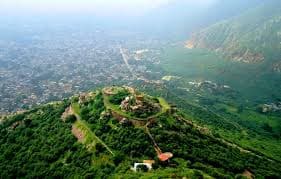
The Aravallis are not merely an old mountain system; they are an ecological spine for north-west India—buffering desertification, shaping microclimates, storing groundwater pathways, and acting as a natural green barrier for some of the country’s most polluted urban regions. That is precisely why a technical-sounding question—what legally counts as “the Aravalli Range”—has turned into a high-stakes test of environmental governance. This week, the Supreme Court effectively admitted that the earlier legal framework may have created a dangerous gap, and hit pause before irreversible damage could follow.
What’s in the news
The Supreme Court has kept in abeyance its November 20 judgment that upheld a government expert panel’s restrictive definition of the Aravalli Range. The Court ordered that the stay will continue until the proceedings reach “logical finality”, explicitly to prevent irreversible administrative or ecological actions. Crucially, it directed that no fresh or renewed mining leases should be granted without prior permission of the Court.
The Bench has also proposed forming a high-powered committee to examine whether mining, even if styled as “regulated” or “sustainable”, within the newly demarcated Aravalli areas could still cause adverse ecological impacts, and whether areas excluded by the definition risk degradation that would compromise the entire range.
Background and context
What happened till now — the full chain
1) The November 20 framework (the trigger):
The Court had upheld a government-backed expert approach that effectively narrowed the Aravallis to (a) hills 100 metres or higher, plus (b) hill clusters/slopes/hillocks within 500 metres of each other. This created immediate public concern that vast stretches of lower-elevation, broken, or more widely spaced but ecologically contiguous terrain could be labelled “non-Aravalli” on paper.
2) The scale of the fear (why it exploded):
The controversy sharpened because, under the elevation threshold logic, only 1,048 hills in Rajasthan were said to qualify out of 12,081—a dramatic shrinkage in what would receive the protective halo associated with the Aravallis. The worry was not academic: once a landscape is administratively reclassified, mining permissions and land-use decisions can shift rapidly.
3) The Court’s course correction (Monday’s pause):
Taking suo motu note of widespread apprehension, the Court accepted that if the shrinkage claim is correct, it may amount to a “significant regulatory lacuna”—a gap that allows damaging activity in areas that are ecologically part of the same system but technically excluded.
4) The new approach (reset via expert scrutiny):
Instead of doubling down on the earlier definition, the Court signalled that Aravalli demarcation must be based on exhaustive scientific and geological estimations and precise measurement of hills and hillocks, and must be sufficiently nuanced to preserve the ecological integrity of the entire range, not just isolated peaks.
Key provisions / key details
Two parts of the order matter most for real-world impact:
First, the “no new mining without SC nod” firewall.
The Court has stopped the administrative machine from issuing fresh or renewed mining leases unless the Court permits it. This is a preventive brake: even if the definition debate continues, mining expansion cannot use the disputed framework as a free pass.
Second, the high-powered committee idea.
The proposed committee is meant to answer the uncomfortable question the earlier judgment left open: even with “regulated” mining and oversight, does allowing mining in newly demarcated zones create cumulative harm—especially when the definition may push ecologically connected terrain outside the protected map?
The Bench also flagged a “structural paradox”: the 500-metre clustering rule may narrow the protected geography, while effectively widening “non-Aravalli” space—potentially enabling disruptive activity in gaps and fringes that are functionally part of the same landscape.
Why it matters
The Aravallis matter not only because they are ancient, but because they are active infrastructure for climate resilience.
They act as a barrier against the eastward advance of the Thar, influence dust movement, and support vegetation that helps moderate land degradation. They also matter for Delhi-NCR and adjoining regions, where ecological buffers are not decorative but essential for air quality and heat stress mitigation.
Most importantly, mining is not a localised disturbance in hill systems. It has cumulative and contagious effects: blasting, dust, groundwater disruption, habitat fragmentation, truck movement, and settlement pressure spread beyond lease boundaries. If protection is narrowed on paper, what appears “regulated” in a few pockets can still unravel the larger system.
Arguments for and against
The debate is not simply “mining vs environment”. It is about how law defines nature.
Arguments supporting a tighter definition (the government’s broad position):
A precise definition can reduce ambiguity, create enforceable boundaries, and prevent arbitrary classifications. The government also points to the idea of a “Management Plan for Sustainable Mining”, implying that mining can be made compatible with safeguards and oversight.
Arguments against the restrictive framework (activists’ core concern):
A hill system is not only its tallest points; it is a continuous ecological unit with corridors, watersheds, and buffers. A rigid elevation threshold and a 500-metre clustering logic risk excluding the “connective tissue” of the range—exactly where unregulated mining and land conversion can do the most systemic damage. The fear is that legality will be used to create ecological blind spots.
The Court’s pause suggests it is no longer comfortable treating the earlier definition as final, especially when the consequences could be irreversible.
Constitutional / legal angle
This dispute sits squarely inside India’s environmental constitutionalism. The Court is essentially balancing development claims against the State’s and citizens’ obligations to protect ecological systems.
Key principles implicitly in play include:
-
Article 21 (right to life) as judicially expanded to include a clean environment.
-
Directive Principles and duties that encourage environmental protection.
-
Core doctrines repeatedly applied in environmental cases: precautionary principle, sustainable development, intergenerational equity, and public trust.
Equally important is the Court’s method: by pausing its own earlier ruling and exploring a high-powered committee, it is moving toward a continuing oversight model where scientific clarity and cumulative impact evaluation become central before the law locks in a definition that can change land-use outcomes.
Implications
Short-range: A de facto freeze on expansion of mining permissions in the Aravalli context, because fresh/renewed leases need the Court’s prior approval. This reduces the risk of “fait accompli” mining decisions while the definition dispute is pending.
Medium-range: The committee route could reset how Aravalli demarcation is treated—shifting from a narrow threshold test to a fuller landscape approach that considers ecological contiguity, cumulative impacts, and buffer logic.
Long-range: If the final framework is nuanced and scientifically grounded, it could become a template for how India treats other fragile landscapes—where administrative definitions can either protect ecosystems or accidentally legalise their fragmentation.
Way ahead
A workable resolution needs to protect ecology without creating administrative chaos.
The scientific backbone should move beyond a single elevation threshold and adopt multi-parameter mapping: geomorphology, watershed linkages, biodiversity corridors, soil and vegetation continuity, and human pressure gradients. A cumulative impact lens is essential: the question is not whether one lease can be “sustainable”, but whether many “regulated” leases together hollow out the system.
On governance, the Court’s mining-permission firewall should be paired with transparent baseline data, strict monitoring, and restoration obligations that are enforceable on the ground. The definition must also avoid creating “non-Aravalli islands” inside an Aravalli landscape—because ecosystems do not respect paperwork boundaries.
In short, the Court has paused not merely a definition, but a potential pathway to irreversible ecological dilution. The next steps will decide whether the Aravallis are treated as a living system—or as a collection of isolated hills tall enough to qualify.
Source credits
The Hindu; Supreme Court of India proceedings; Ministry of Environment, Forest and Climate Change; Indian Council of Forestry Research and Education; public domain environmental research on the Aravalli range; civil society statements from Aravalli-state stakeholders