

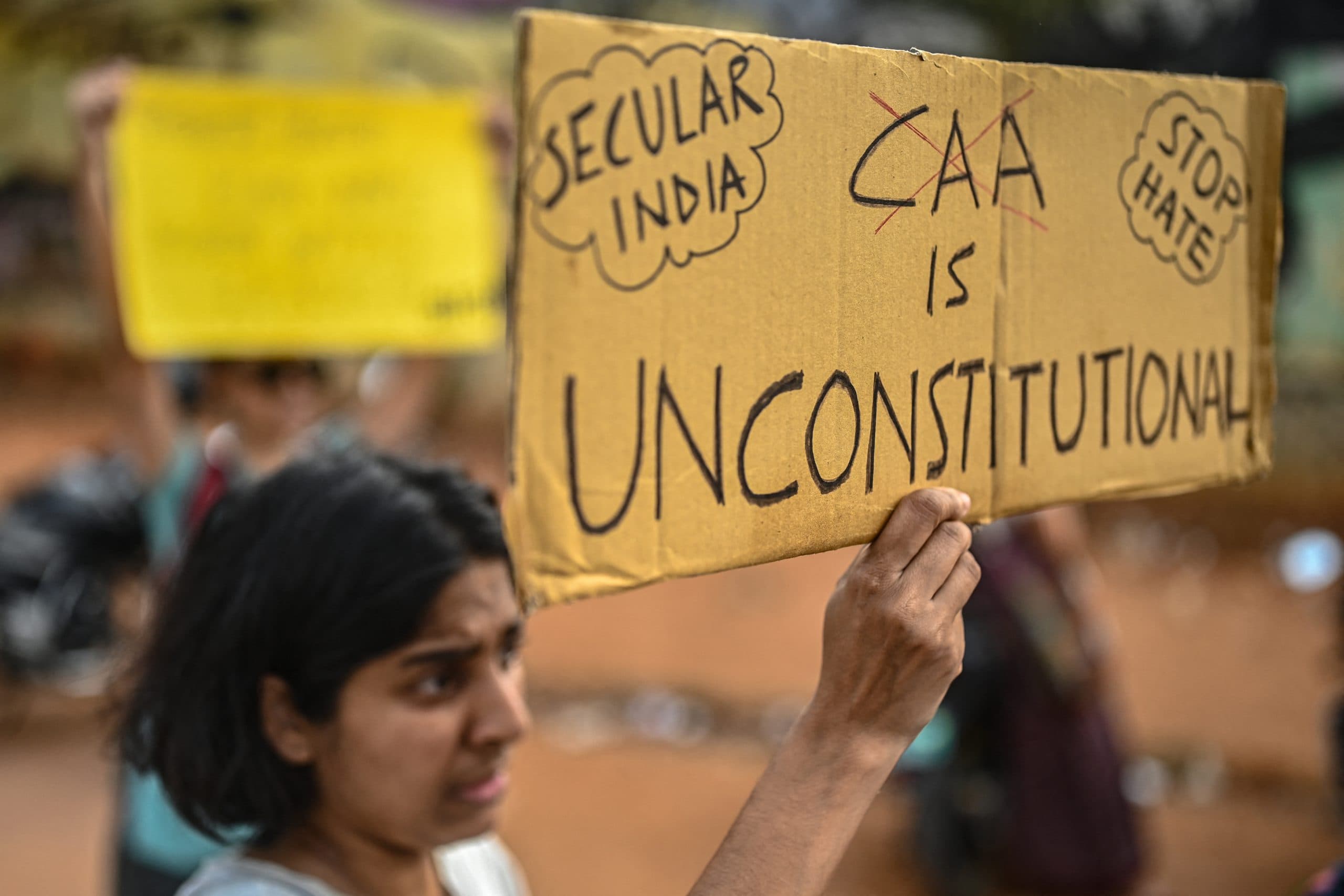
The Supreme Court on 10 December 2025 clarified that the Citizenship (Amendment) Act, 2019 does not guarantee automatic Indian citizenship to any applicant. A Bench headed by Chief Justice of India Surya Kant said that refugees invoking the CAA must still satisfy statutory conditions and undergo verification before enjoying rights such as inclusion in electoral rolls. The court issued notice to the Union government and the Election Commission of India on a plea highlighting panic among CAA-eligible refugees during the ongoing special revision of voters’ lists.
The Story
The petition, filed by NGO Aatmadeep, focused on religious minorities from Pakistan, Afghanistan and Bangladesh who entered India on or before 31 December 2014 and are covered by the CAA’s protections. These communities include Hindus, Sikhs, Buddhists, Jains, Parsis and Christians. The NGO argued that Parliament had already recognised them as persecuted minorities deserving protection and eventual integration into Indian society, and that administrative delays were now placing them at risk.
Aatmadeep submitted that the proviso to Section 2(1)(b) of the amended Citizenship Act exempts such persons from being treated as “illegal migrants”. Section 6B enables them to apply for registration or naturalisation as Indian citizens. The petition contended that once these individuals had applied under Section 6B, they should not be denied the practical benefits of citizenship, including protection from exclusion during electoral roll revisions.
The immediate trigger was the ongoing Special Intensive Revision (SIR) of electoral rolls. According to the NGO, many applicants in West Bengal and other States, particularly refugees from Bangladesh, feared that the SIR could leave them effectively stateless. The plea also alleged that acknowledgment receipts issued to CAA applicants were not being treated as valid proof by electoral authorities, aggravating their insecurity.
Chief Justice Kant, sitting with Justice Joymalya Bagchi, made it clear that the amended law conferred a right to seek citizenship, not citizenship itself. “You are claiming that you are entitled by virtue of these amended provisions in the CAA to become citizens of this country. But you have not been conferred citizenship so far,” he observed. The Bench underlined that every applicant’s claim must be examined on parameters such as whether they actually belong to a protected minority in the specified countries, were residents there, and in what capacity they came to India.
The court indicated that the Union government is expected to establish a mechanism to assess such claims and issue citizenship certificates through naturalisation or registration, in line with the CAA. Once an applicant is granted citizenship through this process, he or she can then seek inclusion in the electoral roll under existing election law.
At this stage, the Supreme Court did not grant substantive relief but issued notice to the Centre and the Election Commission, seeking their response to the issues raised. The matter has been listed for further hearing next week.
Why It Matters
The hearing underscores that the CAA operates in two stages: it creates a pathway and protection for certain refugees, but individual citizenship still depends on administrative scrutiny. This clarification is important for both refugees and political actors who may treat CAA coverage as equivalent to automatic citizenship.
For refugees who have lived in India for years, the case highlights the gap between legal recognition on paper and effective enjoyment of rights. For the state, it raises questions of how quickly and transparently the scrutiny and certification process can move, especially during sensitive exercises like electoral roll revisions.
Background / Context
The Citizenship (Amendment) Act, 2019 modified the Citizenship Act, 1955 to fast-track citizenship for non-Muslim religious minorities from Pakistan, Afghanistan and Bangladesh who entered India on or before 31 December 2014, citing religious persecution. The Act:
• Inserts a proviso to Section 2(1)(b), exempting such persons from the category of “illegal migrant”.
• Introduces Section 6B to allow registration or naturalisation for eligible groups.
The law has been challenged before the Supreme Court on constitutional grounds, but the Union government notified the CAA rules earlier in 2024 and began accepting applications. Parallelly, the Election Commission periodically undertakes SIR of electoral rolls to add, delete or modify entries based on eligibility and residence.
Implications
In the short term, the court’s remarks may temper expectations among CAA applicants that they are automatically entitled to all citizenship rights, including voting. Instead, they emphasise a verification-first, rights-later sequence within the statutory framework.
For the Union government, the petition spotlights the need to operationalise a clear, timely and transparent mechanism for processing CAA applications and issuing certificates. Prolonged delays, coupled with exercises like electoral roll revision, risk fuelling perceptions of insecurity and alleged statelessness among refugee communities.
For the Election Commission, the proceedings raise the narrower question of how to treat CAA applicants during SIR exercises: whether acknowledgment receipts or pending applications can be given any interim recognition, or whether voter registration must strictly follow the grant of citizenship.
Politically, the case feeds into ongoing debates around the CAA, refugee protection and the balance between sovereign control over citizenship and humanitarian obligations towards persecuted minorities.
Conclusion
By stressing that CAA citizenship will follow only after individual scrutiny, the Supreme Court has drawn a line between legislative intent and administrative due process. The next hearing, and the responses from the Centre and the Election Commission, will determine whether practical safeguards can be devised so that refugees covered by the CAA are neither prematurely treated as citizens nor left in prolonged uncertainty.