

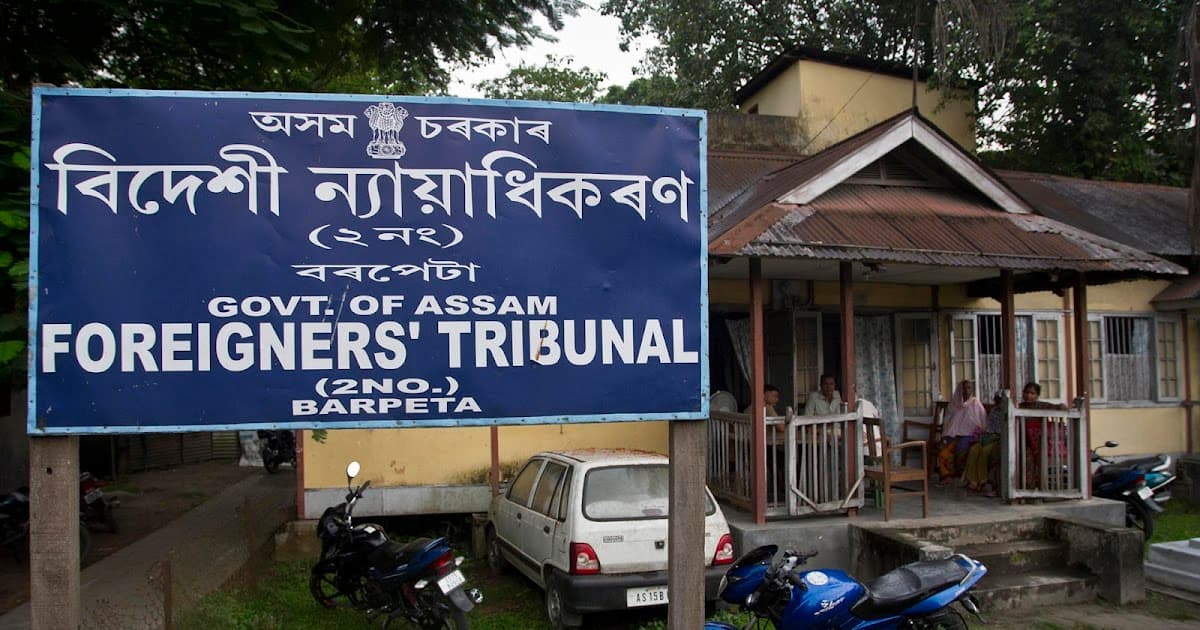
The Supreme Court on 25 September 2025 agreed to examine whether Foreigners Tribunals in Assam impose an unfair standard of proof on rural women by insisting on documentary evidence to establish citizenship. A Bench led by Justice Surya Kant issued notices to the Union government, Assam, and other authorities.
The Story
The petition, filed by Meherunnessa of Barpeta district, challenges a Gauhati High Court ruling that upheld a Foreigners Tribunal decision declaring her a foreigner who entered Assam after 25 March 1971, the cut-off date in Section 6A of the Citizenship Act.
The Tribunal held that she failed to prove linkage to her projected parents or grandfather. The High Court in 2019 agreed, noting that she had not provided sufficient documentary evidence.
Her petition argues this approach disproportionately burdens rural, unlettered women who often marry young and lack parental records. It contends that excluding oral evidence under the Foreigners (Tribunals) Order, 1964, worsens their vulnerability and amounts to indirect discrimination.
Represented by senior advocate Kapil Sibal and others, she asserts that she was born in 1969 in Mazdia village, Barpeta, making her an Indian citizen by birth under Section 3(1)(a) of the Citizenship Act. Her family, she claims, has lived in Assam for generations, with her father and grandfather listed in the 1951 National Register of Citizens and family names appearing in electoral rolls.
Why It Matters
Foreigners Tribunals in Assam decide the fate of thousands accused of being illegal migrants. A strict documentary requirement can disproportionately exclude women in rural areas who may lack formal records, raising concerns of statelessness and disenfranchisement.
Background / Context
-
Assam Accord: Fixed 25 March 1971 as the cut-off date for identifying illegal migrants.
-
Foreigners Tribunals: Quasi-judicial bodies set up under the Foreigners Act, 1946, empowered to decide citizenship disputes.
-
Judicial debates: Courts have previously noted challenges faced by rural women in proving parentage and documentation.
Implications
-
For women: Many may struggle to provide parental birth records, risking wrongful exclusion from citizenship rolls.
-
For government: A Supreme Court ruling could reshape the evidentiary standard applied by Tribunals.
-
For Assam: The case may influence ongoing citizenship disputes and affect how the NRC and Tribunal orders are implemented.
Conclusion
By agreeing to hear the petition, the Supreme Court has opened scrutiny into whether Foreigners Tribunals are unfairly burdening rural women with documentary proof requirements. The decision could have far-reaching consequences for citizenship determinations in Assam.