

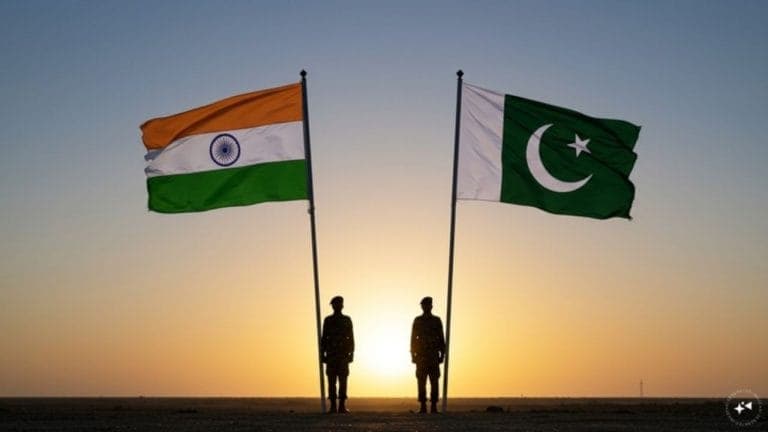
Defence Minister Rajnath Singh has warned that any Pakistani aggression around Sir Creek would invite a response strong enough to “change history and geography,” a remark delivered during Vijayadashami events in Gujarat’s Bhuj sector. His comments follow reports of Pakistani military activity near the tidal estuary and India’s recent cross-border counter-terror operation, publicly discussed as “Operation Sindoor.”
The Story
Sir Creek is a 96-kilometre tidal estuary in the Rann of Kutch, forming part of the India–Pakistan boundary between Gujarat and Sindh. The dispute stems from colonial-era maps and documents: Pakistan argues the boundary lies along the eastern bank of the creek, while India maintains that the thalweg principle—the mid-channel of the navigable waterway—should apply. The stakes go beyond the marshes: the line determines where the maritime boundary begins, which in turn defines each country’s Exclusive Economic Zone, rich in fisheries and potential offshore oil and gas.
Over the years, India and Pakistan have held several rounds of talks and even conducted joint surveys, but mistrust has stalled a final agreement. India has consistently preferred bilateral negotiation, while Pakistan has floated third-party arbitration, which India rejects under the Simla Agreement framework. Against this backdrop, Rajnath Singh’s warning signals that any misadventure in this sector will be treated not as a technical squabble, but as a strategic provocation.
Background / Context
1) Partition and the Four Wars
The roots of the India–Pakistan conflict lie in the Partition of 1947, when British India was divided into the dominions of India and Pakistan. Alongside mass migrations and violence, Partition left unresolved questions of princely states’ accession, most notably Jammu & Kashmir. This became the flashpoint for the first war of 1947–48, when tribal militias and Pakistani forces entered Kashmir, prompting India to airlift troops after the state’s accession. The war ended with a UN-mediated ceasefire that created a de facto division, later formalised as the Ceasefire Line.
The second war in 1965 again centered on Kashmir, following Pakistan’s “Operation Gibraltar” to infiltrate fighters. It ended with the Tashkent Agreement, but the underlying dispute remained.
The third war in 1971 arose primarily out of Pakistan’s internal crisis, where India supported the Bangladesh Liberation struggle. After a short but decisive war, East Pakistan became Bangladesh, altering the subcontinent’s geopolitics permanently.
The Kargil conflict in 1999 was the fourth war-like confrontation, when Pakistani troops and militants occupied Indian positions in Kargil, Ladakh. India’s military operation reclaimed the heights, but the episode reaffirmed how fragile peace could be even after formal diplomatic gestures.
Across these wars, three out of four were directly tied to Kashmir, demonstrating how the unresolved territorial dispute has dominated bilateral relations.
2) The Diplomatic Frameworks
Despite wars, both sides have repeatedly attempted frameworks for peace:
-
The Indus Waters Treaty (1960): Brokered by the World Bank, this treaty divided the six Indus basin rivers between India and Pakistan. It has survived wars and tensions, making it one of the few functional bilateral accords. However, India has hardened its stance in recent years, particularly after terror incidents, hinting that even this “sacred” pact could be leveraged.
-
The Simla Agreement (1972): Signed after the 1971 war, it committed both sides to resolve differences bilaterally, rejecting third-party mediation. The 1971 ceasefire line in Kashmir was re-designated as the Line of Control (LoC). India cites Simla whenever Pakistan seeks UN or third-party involvement in disputes like Sir Creek or Kashmir.
-
The Lahore Declaration (1999): In the wake of both countries’ 1998 nuclear tests, Prime Ministers Atal Bihari Vajpayee and Nawaz Sharif pledged restraint, nuclear confidence-building measures (CBMs), and respect for the LoC. The optimism was short-lived, as the Kargil war erupted within months.
-
Ceasefires on the LoC: Sporadic violence has been the norm, but in 2003, both sides declared a broad LoC and International Border ceasefire. This truce frayed often, yet in February 2021, the Directors General of Military Operations (DGMOs) of both countries made a rare joint announcement to strictly observe the ceasefire—helping bring relative calm along the LoC in recent years.
-
Trade and People-to-People Initiatives: Trade ties have been volatile. India revoked Pakistan’s Most Favoured Nation (MFN) status in 2019 after the Pulwama terror attack. Yet initiatives like the Kartarpur Corridor, opened in November 2019 to allow Indian pilgrims visa-free access to the Gurdwara Darbar Sahib, remain symbolic bridges even amid hostility.
This arc of war and diplomacy highlights a pattern: moments of breakthrough are often followed by breakdowns, as military incidents or terror attacks derail dialogue. Against this backdrop, even seemingly “technical” disputes like Sir Creek are loaded with history, suspicion, and broader strategic stakes.
Other Persistent Friction Points
Kashmir and the Line of Control (LoC)
Kashmir has been the core dispute between India and Pakistan since 1947. The territory, claimed in full by both but administered in parts, remains divided by the Line of Control (LoC), established under the 1972 Simla Agreement. For decades, the LoC has been a site of infiltration attempts, artillery duels, and sniper fire. Despite the reaffirmed ceasefire of February 2021, violations occasionally flare up, causing civilian and military casualties. For Pakistan, Kashmir is framed as an unfinished agenda of Partition; for India, it is an integral part of its sovereignty. This clash of narratives ensures Kashmir remains the single most sensitive trigger for conflict.
Siachen and the Actual Ground Position Line (AGPL)
The Siachen Glacier, at over 20,000 feet in the eastern Karakoram, has been the world’s highest battlefield since 1984, when India launched Operation Meghdoot to preempt Pakistan’s move to occupy the area. The line separating forces here is called the Actual Ground Position Line (AGPL), not demarcated on maps but held by physical occupation. Both sides have lost more soldiers to frostbite, avalanches, and altitude than to combat. Talks have been held for demilitarisation, but India insists Pakistan must first accept existing troop positions before withdrawal, a condition Pakistan resists. Siachen thus remains an expensive and symbolic standoff.
Cross-Border Terrorism and Safe Havens
Since the late 1980s, terrorism has complicated the bilateral equation. Militancy in Kashmir, supported by training camps and financing across the border, has been India’s consistent allegation against Pakistan. High-profile attacks—such as the 2001 Parliament attack, the 2008 Mumbai terror strikes, the 2016 Uri base attack, and the 2019 Pulwama attack—have derailed dialogue and hardened India’s stance. New Delhi now insists that talks and terror cannot go hand-in-hand. In recent years, India has responded with surgical strikes (2016) and the Balakot airstrike (2019), signalling a willingness to retaliate across borders.
Water Sharing under the Indus Waters Treaty (IWT)
The 1960 Indus Waters Treaty, mediated by the World Bank, divided six rivers between the two countries—three eastern rivers (Ravi, Beas, Sutlej) to India, and three western rivers (Indus, Jhelum, Chenab) to Pakistan. Despite wars, the treaty has endured, but disputes over hydropower projects (such as Kishanganga and Baglihar) often arise. India has, in recent years, reviewed aspects of the treaty, suggesting that continued terrorism could prompt reconsideration of its leniency in water usage. For Pakistan, which depends heavily on the Indus basin, such moves are viewed as existential threats.
Trade, Airspace, and Cultural Engagement
Economic and cultural ties, though secondary to political disputes, have been flashpoints too. After Pulwama (2019), India revoked Pakistan’s MFN trade status and raised customs duties. Airspace restrictions during crises disrupt civil aviation. Sporting and cultural exchanges—particularly cricket—become hostage to political climate. While occasional goodwill gestures (such as allowing medical visas or religious pilgrimages) are made, these are exceptions against a backdrop of hostility.
The “Grey Zones”: Sir Creek and Maritime Issues
Unlike Kashmir or Siachen, Sir Creek and maritime boundaries are technical disputes, involving maps, colonial records, and international law principles. Yet they remain unresolved, because mistrust spills over even into “low-politics” issues. Fishermen on both sides are frequently arrested when they stray across undefined waters, adding humanitarian costs to the stalemate.
Why These Points Endure
These friction points endure because they are not only about geography but about national identity, security doctrine, and domestic politics. For Pakistan, Kashmir is central to its founding ideology; for India, territorial integrity is non-negotiable. Siachen and Sir Creek, while smaller in scale, represent “precedent-setting” cases—settlement here could show whether bilateralism under Simla still has teeth. Terrorism, meanwhile, creates cycles of mistrust that repeatedly halt peace processes.
“Operation Sindoor”: What Is Known
Operation Sindoor has been described by officials as a recent cross-border counter-terror operation using precision stand-off weapons, including drones and long-range air-launched munitions. Defence Minister Rajnath Singh invoked the operation to highlight India’s readiness to retaliate against terrorism. The messaging emphasises two points: that India has the capacity to strike with precision at a time of its choosing, and that its intent remains counter-terrorism, not escalation.
Although full details remain classified, the operation is seen as part of India’s evolving doctrine of limited, punitive responses aimed at imposing costs on terrorist infrastructure while avoiding uncontrolled escalation.
Why Sir Creek Matters Now
Sir Creek’s importance lies in three dimensions. First, it is a strategic geography issue: whoever controls the estuary shapes the maritime boundary and access to resources in the Arabian Sea. Second, it is an escalation risk: fishing boat arrests and naval patrols create chances for unintended clashes. Third, it has diplomatic weight: resolving Sir Creek bilaterally would demonstrate that India and Pakistan can still settle boundary issues peacefully under Simla’s bilateral framework.
Implications
For Security
India’s stern warning underscores its doctrine of deterrence with restraint: it will not initiate escalation but will reply firmly to provocation. Operations like Sindoor also show that modern stand-off weaponry allows India to impose costs without full-scale war.
For Diplomacy
The Sir Creek dispute is less politically emotive than Kashmir, making it a potential “low-hanging fruit” for bilateral settlement. Success here could open space for technical problem-solving in other areas. But if it festers, it may feed broader mistrust.
For International Law and Governance
Resolving Sir Creek would allow India and Pakistan to finally delimit their maritime boundary in line with UNCLOS, unlocking energy exploration and reducing fishing conflicts. Resorting to arbitration, however, would undermine India’s long-standing bilateralism principle from Simla.
For Regional Stability
Escalation in Sir Creek could unravel the fragile calm along the LoC established since 2021. Keeping both fronts quiet is essential to prevent a multi-front crisis that would harm both economies and derail regional development.
Conclusion
Sir Creek may appear a remote marshland, but it is a flashpoint where history, geography, and geopolitics converge. India’s Defence Minister has signalled that aggression there will be met with force, while Operation Sindoor underlines New Delhi’s willingness to strike terrorists across borders. Yet the dispute also offers a test: can India and Pakistan resolve a technical boundary issue bilaterally, without letting mistrust escalate into crisis? The answer may determine whether the subcontinent moves toward stability or remains caught in its cycle of flare-ups and missed opportunities.