

With only a third of the time left to meet the 2030 Agenda, South-South and Triangular Cooperation (SSTC) has evolved into a practical engine for development—rooted in solidarity, replicability, and local relevance—where India is a key catalyst.
Key Takeaways
-
From idea to instrument: SSTC complements traditional aid with context-matched, cost-effective solutions, crucial amid shrinking global development finance.
-
India’s edge: A “Vasudhaiva Kutumbakam” approach plus scale (food safety nets, DPI like Aadhaar/UPI) and dedicated institutions (DPA, ITEC, India-UN Fund) make India a natural hub.
-
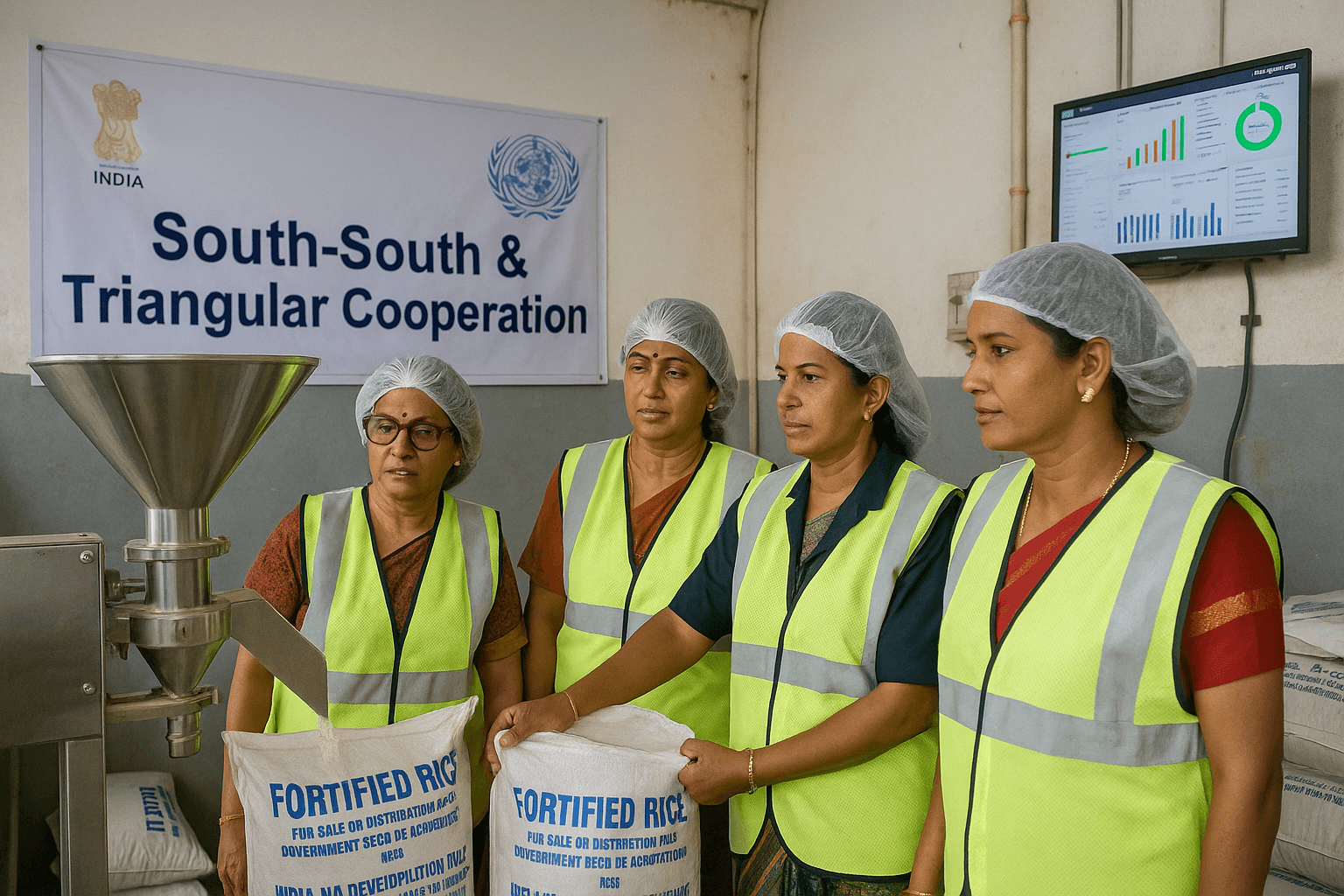
Proof of practice: India–WFP pilots—Grain ATMs (Annapurti), PDS supply-chain optimisation, women-led Take-Home Ration, and rice fortification—offer templates other nations can adapt.
-
Triangular cooperation: Linking Global South implementers with traditional/emerging donors widens resources, builds trust, and accelerates transfer of good practices.
-
Momentum indicators: 47 governments have supported the UN Fund for SSC; the India-UN Fund backs 75+ projects across 56 countries; WFP mobilised ~$10.9M in 2024 from Global South and private sector for SSTC.
India’s SSTC Playbook
-
Institutions & Platforms: Voice of Global South summits; Development Partnership Administration; ITEC capacity-building across 160+ countries; India-UN Development Partnership Fund.
-
Digital Public Infrastructure: Global sharing of Aadhaar/UPI learnings; DPI as a low-cost, high-reach backbone for inclusion, payments, and service delivery.
-
Food & Nutrition Security: Co-created innovations with WFP (Annapurti, fortified rice, supply-chain analytics), women-centred nutrition programmes, climate-resilient farming pilots.
-
Plurilateral Engagements: Leveraging G20 to mainstream Global South priorities (e.g., African Union membership), and partnering across UN agencies and regional bodies.
Why SSTC Works
-
Contextual Fit: Solutions designed in similar socio-economic settings transfer more smoothly.
-
Frugality & Scale: Lower unit costs and modular designs ease adoption and replication.
-
Trust & Reciprocity: Peer-to-peer learning reduces “conditionality” friction and increases local ownership.
What Triangular Cooperation Adds
-
Blended Strengths: South-origin solutions + finance/tech from traditional donors = faster scale-up.
-
Accountability: Shared governance across partners builds credibility for results.
-
Reach: Extends successful pilots regionally (e.g., rice fortification, supply-chain optimisation in Nepal; UN India Fund support in Lao PDR).
Gaps & Challenges
-
Financing Dip: Development/humanitarian funding is tightening; SSTC must mobilise new sources.
-
Institutional Capacity: Execution needs stronger local institutions and data systems.
-
Standards & M&E: Comparable metrics for outcomes, cost-effectiveness, and learning loops remain patchy.
-
Inclusion: Gender, smallholder, and least-developed-country needs must be built in by design.
Policy Priorities (Actionable)
-
Institutionalise Triangular Windows: Dedicated facilities that pair South-origin solutions with co-financing and technical assurance.
-
Codify “Replicability Kits”: Open playbooks for DPI, food systems, and climate resilience (tech specs, cost models, training stacks).
-
Results & Learning Marketplace: A shared dashboard for outcomes, unit costs, and case studies to speed cross-border adoption.
-
Local Capacity Grants: Fund last-mile implementers (state departments, municipalities, FPOs, SHGs) to absorb and own solutions.
-
Gender-Intentional Design: Ensure women-led enterprises and administrators are co-creators, not just beneficiaries.
-
Risk-Pooling Instruments: Use guarantees and catastrophe windows to protect fragile adopters and sustain programmes through shocks.
Numbers to Note
-
47 governments have contributed to the UN Fund for SSC, reaching 70+ countries and benefiting people in 155 nations.
-
Since 2017, the India-UN Development Partnership Fund has supported 75+ projects across 56 developing countries.
-
In 2024, WFP mobilised ~$10.9 million from Global South & private sector for SSTC aligned to SDG-2 (Zero Hunger).