

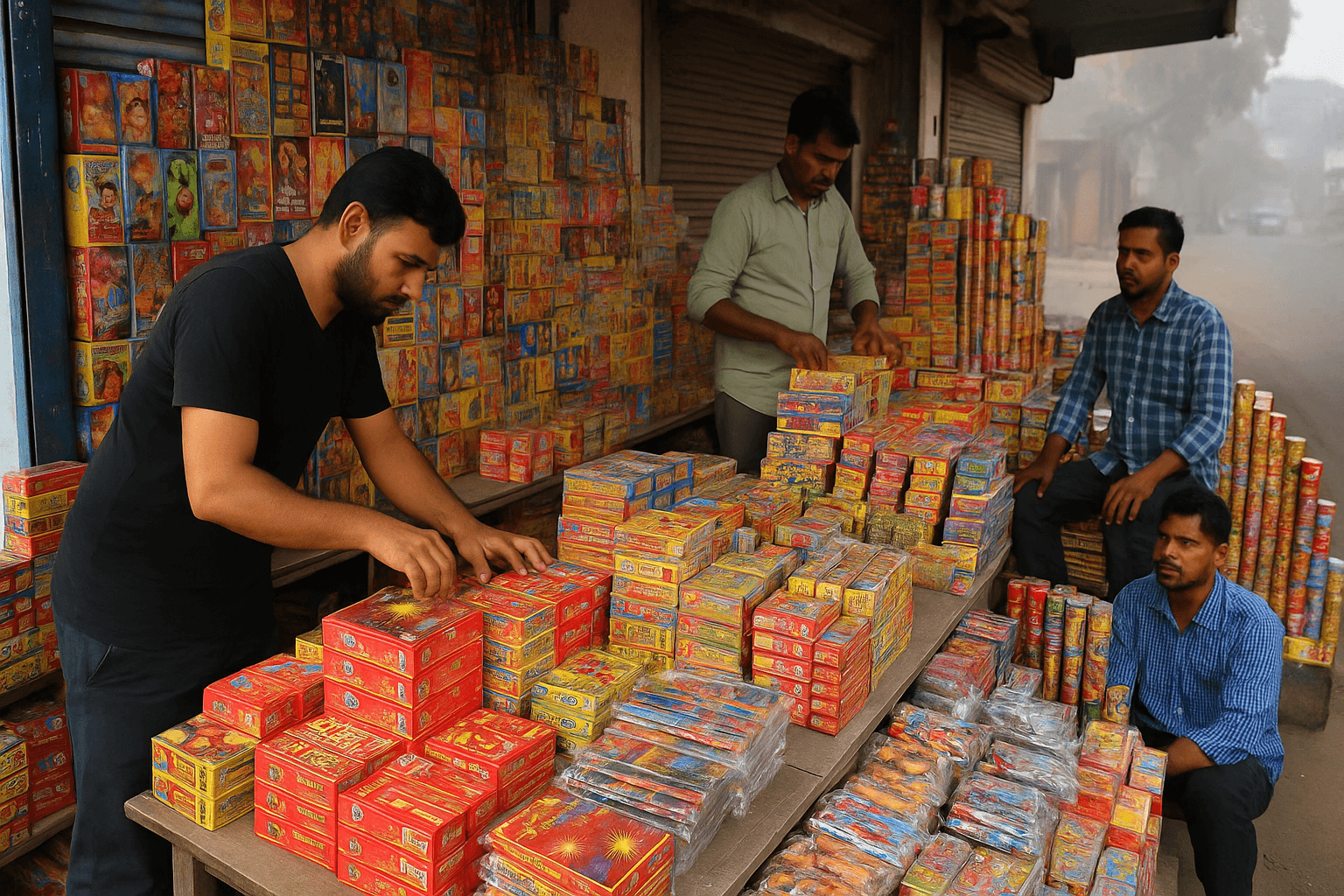
The Supreme Court on Friday said a complete ban on firecrackers would be counterproductive, allowing mafia groups to exploit the vacuum and push illegal products. The court called instead for a “balanced approach” that protects both the environment and livelihoods, directing the Environment Ministry to consult all stakeholders and propose a solution.
A Bench led by Chief Justice of India B.R. Gavai observed that experience from other sectors, such as mining in Bihar, shows that outright bans often create opportunities for illegal operators. “As we have experienced in the past, a complete ban cannot be implemented,” the CJI said during proceedings.
The court highlighted that India’s firecracker industry employs thousands of workers, many from vulnerable communities, and that a sudden blanket ban would devastate livelihoods. At the same time, the judges emphasised the constitutional right to a clean environment, stressing that a policy framework must balance economic and environmental considerations.
The Bench allowed certified manufacturers producing “green crackers” — those cleared by the National Environmental Engineering Research Institute (NEERI) and the Petroleum and Explosives Safety Organisation (PESO) — to continue operations. These manufacturers must, however, provide undertakings that they will not sell in prohibited areas until further orders.
Earlier, on 12 September, the Chief Justice had called for a uniform nationwide policy on firecrackers, questioning why pollution relief should be restricted to Delhi. “If firecrackers have to be banned, it has to be done for the entire country,” he remarked.
Why It Matters
The ruling underscores a recurring dilemma in India’s environmental governance: how to balance ecological health with economic survival. Firecrackers contribute to dangerous air pollution levels, particularly in urban centres, but the industry also sustains thousands of families.
A total ban risks pushing sales underground, where unsafe, unregulated products could worsen pollution and increase accidents. On the other hand, lax regulation risks worsening the public health crisis linked to air quality. The court’s attempt to balance both sides reflects a broader policy challenge—crafting rules that protect both lungs and livelihoods.
Background / Context
-
Court’s past stance: In April 2025, the Supreme Court had confirmed a “permanent ban” on the manufacture and sale of firecrackers in Delhi and the National Capital Region (NCR), calling it “absolutely necessary.”
-
Uniform policy debate: On 12 September, the CJI stressed the need for nationwide rules, noting that pollution is not limited to the capital.
-
Public health impact: Experts note that daily wage earners, street vendors, and construction workers suffer most from polluted air, not just the elite.
-
Industry position: Senior advocate K. Parameshwar, representing manufacturers, argued that licences valid till 2028 were being revoked due to the court’s earlier ban in NCR.
Implications
The Supreme Court’s latest position signals a shift from absolutism to pragmatism. A nationwide policy could bring consistency and predictability for both citizens and the industry.
If well-designed, regulation could promote wider adoption of green crackers, reduce smuggling, and safeguard jobs. But enforcement remains a challenge—especially in small towns where monitoring is weak. The government must also ensure transparency in certification and provide financial support for manufacturers to transition to cleaner technologies.
Failure to act swiftly risks prolonging legal uncertainty and leaving space for grey markets to flourish, undermining both environmental goals and worker security.
Conclusion
The firecracker debate reflects the complexity of modern policymaking in India: clean air on one side, livelihoods on the other. The Supreme Court has left the door open for a nuanced solution, asking the Environment Ministry to chart a middle path. The success of this approach will depend not on bans alone, but on inclusive dialogue, practical enforcement, and technological adaptation.