

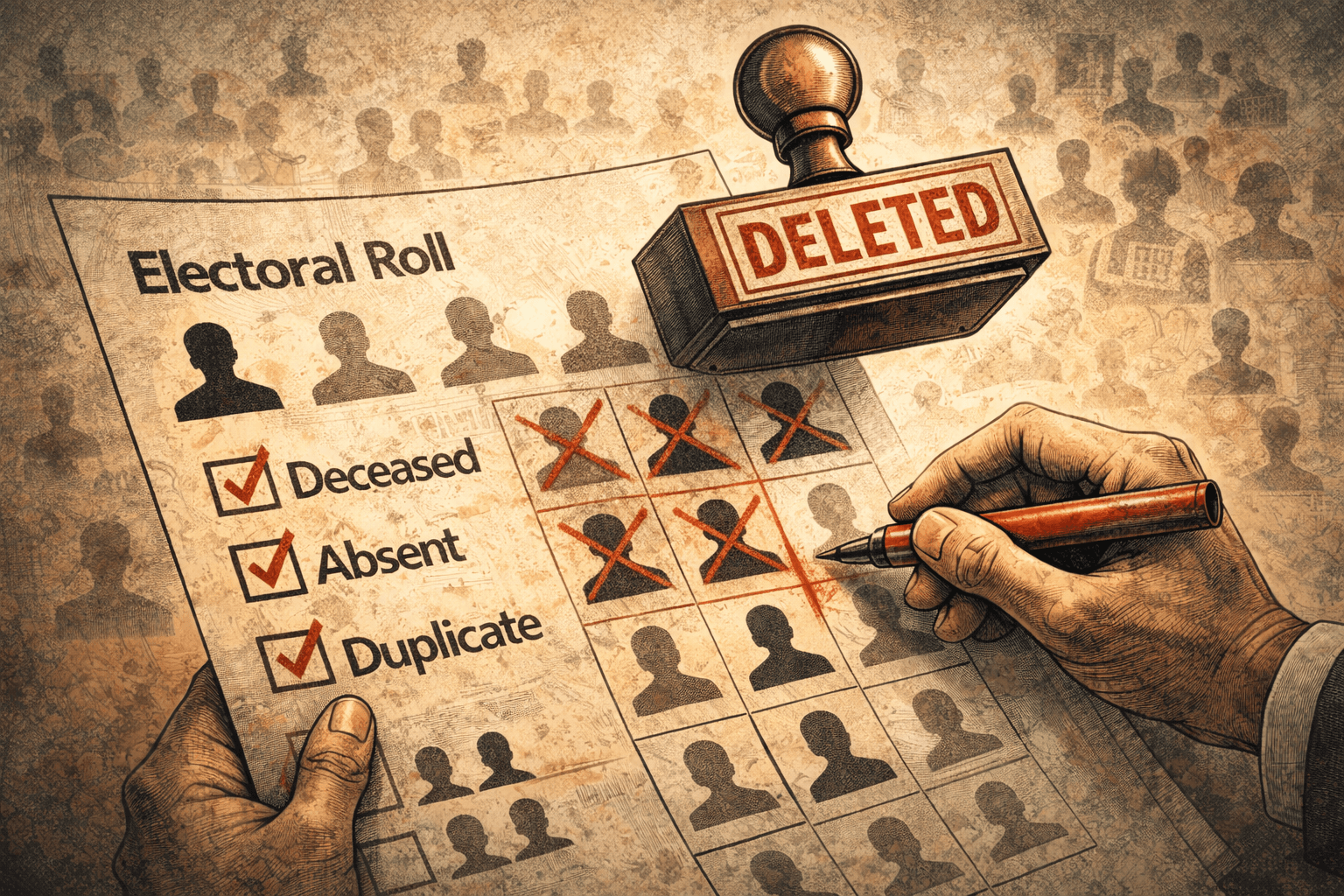
Every democracy depends on one quiet instrument more than any rally or slogan: the electoral roll. When that roll is corrected, the public should feel reassured — not anxious. Tamil Nadu’s Special Intensive Revision (SIR) has now thrown up an uneasy paradox. The State’s deleted-electors list is not just large; it displays patterns that look statistically and socially “off” in specific places. To be clear, an anomaly is not a verdict of wrongdoing. But a cluster of anomalies is a verdict of something else: a process that demands immediate transparency, verification, and course-correction. Because the greatest danger in roll revision is not a loud conspiracy; it is quiet administrative disenfranchisement — where eligible voters discover exclusion only when it is too late.
What’s in the news
A granular review of Tamil Nadu’s polling station-level deleted-electors data flags eight broad categories of irregular patterns, including:
-
polling stations with unusually high proportions of “young deaths”,
-
booths with strong gender skew in deletions,
-
thousands of booths with deletion volumes far above typical levels,
-
a large number of booths where deletions are overwhelmingly (or entirely) attributed to deaths,
-
mass tagging of electors as “absent” or “shifted”, and
-
pockets where women constitute a strikingly high share of “permanently shifted” deletions.
Background and context
Why deletions happen in any revision
Voter list maintenance legitimately involves removing:
-
deceased electors,
-
duplicate entries,
-
and entries where a voter has moved and is no longer ordinarily resident.
In a high-migration, high-urban-churn State, some concentration of “shifted/absent” deletions is expected, especially in dense urban pockets and peri-urban belts.
Why pattern anomalies change the conversation
What makes this episode different is not merely the scale — it is the shape of the data:
-
“Deaths” dominating deletions in a way that can clash with demographic norms,
-
women disproportionately deleted in certain booths,
-
and “absent” being used at volumes that can reflect anything from genuine mobility to insufficient verification visits.
When administrative categories become blunt instruments, they stop being neutral labels and start functioning like exclusion filters.
Key provisions that matter in plain terms
The legal spine: deletion is not meant to be casual
Under India’s electoral roll framework, corrections and deletions are permitted — but for many grounds (especially “ceased to be ordinarily resident” or “otherwise not entitled”), the voter is supposed to get a reasonable opportunity to be heard, and the officer must do proper verification before deleting.
This principle is vital because most wrongful deletions do not happen through malice; they happen through shortcuts: one visit, a locked door, a neighbour’s statement, a rushed entry, a mis-click.
In short: a clean roll is not a roll with many deletions; it is a roll where every deletion is defensible with a paper trail.
What the anomalies may actually indicate
Here is the honest, policy-relevant reading of the patterns — without jumping to conclusions:
1) “Young deaths” clusters: the red-flag category
Deaths in any population skew older. So when a booth shows a large share of under-50 deaths, the first assumption should be classification or data quality issues:
-
wrong age capture,
-
wrong “reason code” selection,
-
or death tagging used as a convenient closure category.
If even a small fraction is erroneous, the harm is severe because “death” deletions are the hardest for families to detect quickly, and the stigma of being declared dead is not a minor error.
2) High gender skew deletions: a governance blind spot
Women are more likely to migrate after marriage, and are often less likely to contest bureaucratic mistakes. That makes them structurally vulnerable to being “cleaned up” out of the roll.
But a booth where women comprise 75%+ of deletions is not automatically explained by marriage migration. It could also reflect:
-
weaker documentation,
-
lower digital access,
-
fewer interactions with officials,
-
or households where women’s names are treated as “optional”.
If the system does not proactively protect women’s enrolment continuity, gender-neutral procedures can still produce gender-biased outcomes.
3) Mass “absent” tagging: a proxy for weak verification
“Absent” can mean genuine relocation — or it can mean the official never met the elector.
Large-scale “absent” deletions often arise when:
-
visits happen during working hours,
-
tenants and informal settlements churn rapidly,
-
or verification is reduced to a one-time attempt.
In such conditions, the category becomes less about reality and more about convenience.
4) Booths with extremely high deletion volumes: either hyper-mobility or hyper-error
Very high deletions can occur in:
-
high-rise rental clusters,
-
resettlement colonies,
-
student/worker neighbourhoods,
-
or rapidly redeveloped areas.
But when deletion volumes spike across thousands of booths, the question becomes systemic: was the verification design adequate for today’s mobility? A 1990s-style roll-cleaning method cannot handle a 2025-style city.
Why it matters
1) The roll is the gateway right
Everything else in an election is meaningless if an eligible citizen cannot find their name. Wrongful exclusion is not just an administrative mistake; it is a democratic injury.
2) Errors don’t distribute evenly — they hit the already weak
Wrongful deletions usually concentrate among:
-
migrants and tenants,
-
urban poor,
-
women with changed residences,
-
elderly living alone,
-
and citizens with low documentation resilience.
A revision that disproportionately harms these groups can tilt representation quietly, without a single illegal vote being cast.
3) Trust is the real currency of election management
When patterns look abnormal and explanations are generic, trust erodes. And when trust erodes, every correction becomes suspect — even the genuine ones.
Arguments for and against the “anomaly alarm”
The case for caution, not panic
-
High migration and urban churn can genuinely inflate “shifted/absent”.
-
Data translation and aggregation can introduce distortions if not carefully validated.
-
Some booths may reflect local events (redevelopment, relocation drives, disasters) that spike deletions.
The case for immediate scrutiny
-
“Young deaths” clustering is too sensitive to dismiss casually.
-
Gender-skew patterns are consistent with known structural vulnerabilities.
-
Large clusters of 100% death-based deletions demand verification, not narratives.
-
The scale makes even a small error rate politically and morally unacceptable.
Balanced conclusion: You don’t need to assume mala fide intent to insist on an audit. You only need to assume human fallibility at scale.
Constitutional and democratic angle
Free and fair elections are not just about polling-day management; they begin with who is allowed into the electorate. In that sense, voter roll integrity is part of the democracy’s basic discipline: inclusion first, correction next.
A revision exercise must therefore satisfy two tests:
-
Accuracy (remove ineligible entries), and
-
Non-exclusion (do not wrongly delete eligible citizens).
If the second test fails, the first becomes morally hollow.
Implications
-
If anomalies remain unaddressed, Tamil Nadu could see a rise in last-minute claims, local tensions, and litigation-driven uncertainty.
-
Political parties may escalate booth-level disputes, shifting the debate from governance to blame.
-
Most importantly, a section of eligible voters may lose participation silently, especially women and migrants.
Way ahead
This is the moment for a confidence-building correction package — practical, transparent, and fast.
1) Publish verifiable deletion trails, not just lists
For every deletion, there should be a clear “why” with an auditable trail: visit record, notice record, evidence basis, and the officer responsible.
2) Treat “death” deletions as a high-risk category
-
Cross-verify with civil registration/death records where possible.
-
Mandate supervisory review for booths showing extreme “death proportions”.
-
Create a fast-track correction window for families.
3) Fix “absent” verification protocols
-
Require multiple attempts at different times/days.
-
Use SMS/phone intimation where available.
-
For high-churn areas, set up local help-desks and extended verification camps.
4) Gender-protective enrolment continuity
-
Special verification drives focused on women deleted as “shifted”.
-
Easy transposition pathways where applicable.
-
Clear support at booth level so women aren’t forced into repeated re-enrolment cycles.
5) Independent sampling audit of anomaly booths
A statistically designed third-party or multi-stakeholder audit (with party representatives and observers) of the most anomalous booths can quickly separate:
-
genuine demographic churn,
-
procedural weakness,
-
and data-entry misclassification.
6) Communication that respects citizens
The right tone is not “nothing happened”; it is: “Here is what we found, here is how we are correcting it, here is how you can challenge it.”
Source credits : The Hindu (data analysis report on Tamil Nadu deleted electors list); Election Commission of India and Chief Electoral Officer updates on SIR processes; Supreme Court reporting on SIR-related petitions and timelines; public domain election law provisions on electoral roll corrections.