

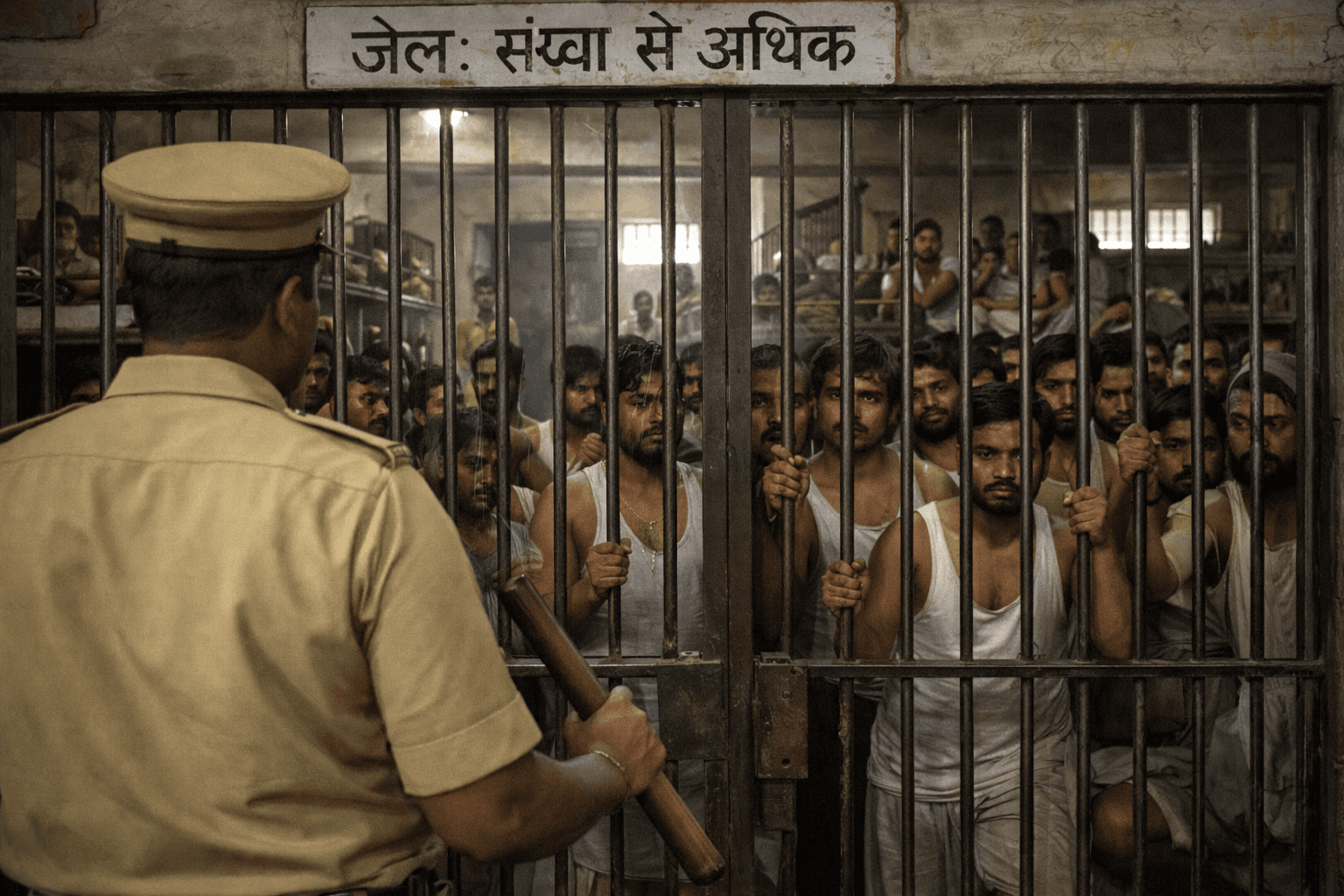
Some books are written with ink. Others are written with time — measured in locked doors, roll-calls, and the quiet cruelty of years that do not end. Selvam’s prison memoir, launched with special permission after more than three decades inside, is powerful not because it asks for pity, but because it forces a public question India keeps postponing: what is a prison for?
If a prison is only a warehouse for human beings, it will produce two things in abundance: bitterness and repetition. If it is a reformative institution, it can produce what Selvam’s story hints at — a person who reads, reflects, learns rules better than the system that cages him, and tries to become something more than his worst act.
But India’s prisons are still built around an old instinct: control first, reform later — and “later” rarely arrives.
What’s in the news
-
Selvam, once sentenced to death and later given life imprisonment with a condition of spending the rest of his life in prison, attended the launch of his prison memoir with special permission.
-
Justice K. Chandru, known for judgments on jail reforms, endorsed the book and underlined that prisons must be reformative, not retributive.
-
The book records uncomfortable realities, including how inmates can be segregated and housed by caste, and it portrays the deep, intergenerational cost borne by families.
Background and context
India’s prisons sit at the junction of three contradictions:
-
They are meant to be correctional spaces, but are run like custodial fortresses.
-
They are overcrowded with undertrials, yet the public imagination sees them as places for “convicts”.
-
They are administered by States, but the national consequences — human rights, law-and-order, radicalisation, public health — spill across the country.
This is why prison reform is not a sentimental cause. It is hard governance.
Selvam’s narrative matters because it shows the prison not as an abstract institution, but as a living social world: hierarchies, factions, informal power, and the subtle punishments that exceed the court’s sentence — including the punishment of the prisoner’s family through stigma, poverty, and prolonged uncertainty.
The big argument Selvam’s story makes — without preaching
1) Prison adds “extra punishment” that the law never sentenced
The court punishes a person; the prison often punishes personhood: dignity, contact with family, mental health, and the possibility of redemption. When the state casually adds informal suffering, it undermines the legitimacy of lawful punishment itself.
2) “Life till last breath” raises a moral and policy question
A commuted death sentence with a condition of never being released may satisfy society’s demand for severity — but it also raises a deeper question:
If reform is impossible by definition, what incentive remains for transformation?
A system that says “you can improve, but it won’t matter” quietly kills rehabilitation.
3) Segregation and social ordering reproduce society’s worst divides
The mention of caste-based segregation is not just a scandal; it reveals how prisons often replicate social stratification rather than dismantle it. When the state’s most controlled institutions reflect social bias, reform becomes performative and violence becomes structural.
What the world has tried — and what India can realistically borrow
India does not need to copy any one model. But global practice offers principles worth adopting.
1) Norway: “Normalization” as security strategy
Nordic prison thinking treats incarceration as loss of liberty, not loss of dignity. Education, work, mental-health support, and humane facilities are not “luxuries” — they are tools to reduce reoffending and keep society safer after release. The most useful lesson for India is not architecture; it is philosophy: prison staff trained as professional correctional officers, not merely guards.
Practical takeaway for India: Invest in staff training, counselling capacity, education tie-ups, and structured daily routines that reduce violence and idleness — even in older prison buildings.
2) Germany: resocialisation as a guiding constitutional idea
Several European systems treat rehabilitation as a foundational objective of punishment. The prison is expected to prepare the person for lawful life outside, not to keep him permanently damaged within.
Practical takeaway for India: Make rehabilitation measurable: literacy, skill certification, addiction treatment completion, behavioural assessments, and family-contact continuity — instead of vague claims of “reform”.
3) UK-style oversight: independent inspection culture
Some democracies rely on external inspection and monitoring bodies that routinely visit prisons, publish findings, and force administrative accountability.
Practical takeaway for India: Create credible, independent prison oversight with real access, regular reporting, and enforceable follow-up — not occasional committees after a tragedy.
4) The UN “minimum rules” approach
Global frameworks emphasise dignity, healthcare equivalence, protection from torture and degrading treatment, and the idea that imprisonment should be compatible with human rights.
Practical takeaway for India: Use these benchmarks to modernise prison manuals, upgrade medical and mental-health services, and standardise grievance redress.
Why it matters
1) Overcrowding turns prisons into crime schools
When prisons are packed, classification collapses. First-time offenders mix with hardened criminals, and survival becomes a lesson in aggression, not reform. This is a direct public safety risk.
2) Undertrials are the silent majority in distress
A prison system that holds too many undertrials for too long is not merely inefficient — it is unjust. The longer an undertrial stays inside, the more punishment occurs without conviction.
3) Prisons shape the moral authority of the state
A state cannot preach rule of law outside while violating dignity inside. When prison conditions are degrading, citizens lose faith not only in prisons, but in justice itself.
4) Families become collateral victims
Selvam’s reflections on his wife and child are the hidden ledger. A prison sentence often becomes a poverty sentence for the family. If India wants rehabilitation, it must stop treating families as irrelevant bystanders.
What India should do — and what will be hard
What is practical in India
1) End social segregation and build scientific classification
Classification must be based on risk, vulnerability, health needs, and behavioural profile — not caste, community, or informal power structures.
2) Make prisons education-first institutions
-
Expand prison libraries and structured learning.
-
Partner with open schooling, skill councils, and credible vocational certification.
-
Recognise prison-acquired skills for post-release employability.
3) Fix wages, work, and dignity inside
If prisoners work, their labour must not be treated as token activity. Fairly structured work, savings mechanisms, and family support reduce desperation and improve reintegration.
4) Strengthen mental health and addiction services
Many inmates are battling trauma, substance dependence, or untreated mental illness. Reform without clinical capacity is just moral talk.
5) Professionalise prison staff
The staff are the system. Training in de-escalation, rights-compliant searches, mental health first aid, and grievance handling reduces violence and corruption.
6) Tighten accountability through transparency
Digitised records, CCTV with safeguards, audit trails for punishments, and accessible grievance mechanisms reduce abuse and arbitrariness.
7) Expand “release preparedness”
Halfway homes, employer partnerships, identity documents, and community support reduce the cliff-edge shock of release — and lower reoffending.
The hard challenges India must confront
1) Federal complexity
Prisons are largely a State subject, with uneven capacity and political will. A reformist state can progress; a reluctant one can stagnate.
2) Budget realism
Humane prisons require money — but more importantly, they require prioritisation. India often finds funds for hardware; it must also fund people: doctors, psychologists, teachers, and trained staff.
3) Public opinion and political incentives
Reform is routinely attacked as being “soft on crime.” This is where leadership matters: the argument must be framed as safety through rehabilitation, not sympathy.
4) Life sentences without release pathways
A system that forecloses hope can incubate rage. India must debate whether long sentences can include structured review mechanisms without undermining deterrence — because hopeless incarceration is not automatically safer incarceration.
Constitutional and legal angle
India’s constitutional promise of life and dignity does not stop at the prison gate. Courts have repeatedly recognised that prisoners retain fundamental rights, except where curtailed by lawful incarceration. The challenge is implementation: prison manuals, disciplinary practices, and administrative discretion often operate in a grey zone where rights become conditional on power.
A serious reform agenda must therefore include:
-
due process in prison punishments,
-
accessible legal aid and review,
-
independent oversight mechanisms,
-
and clear standards on isolation, medical care, and family access.
Implications
-
Better prisons can reduce reoffending, improving long-term public safety.
-
Transparent prisons reduce institutional violence, protecting both inmates and staff.
-
Fair classification and oversight reduce radicalisation and gang consolidation inside prisons.
-
A reformative approach strengthens the legitimacy of punishment — crucial in a democracy that must punish without becoming cruel.
Way ahead
Selvam’s book should not become a sentimental headline that fades by next week. It should become a policy trigger.
India should aim for a prison system that is:
-
strict on violence and coercion,
-
uncompromising on dignity and due process,
-
relentless about education, skills, and mental health,
-
and transparent enough that the public can trust it.
A prison that reforms is not indulgent. It is intelligent. Because the prisoner will either return to society — or be kept within society’s moral responsibility for life. In either case, India has to decide what it wants its prisons to manufacture: more brokenness, or safer futures.
Source credits : The Hindu report on the book launch; public domain judicial observations on prison reform; international prison standards and comparative correctional best practices.