

Thailand’s decision to impose a curfew in coastal Trat province signals a shift in the conflict’s geography and risk profile. What began as border friction has widened into a multi-front security situation—on land and now along the coast—raising concerns over civilian safety, trade-route stability, and the credibility of ceasefire diplomacy.
What’s in the news
Curfew imposed in Trat province
Thailand announced a curfew covering five districts of Trat province that border Cambodia’s Koh Kong, while excluding key tourist islands such as Koh Chang and Koh Kood.
Fighting persists despite ceasefire talk
Clashes have continued even after Trump publicly said Thailand and Cambodia had agreed to cease shooting, with both sides accusing the other of ongoing aggression.
First civilian death reported in Thailand in the latest spell
Thai authorities reported a civilian death from a Cambodian rocket strike in a residential area, describing it as the first civilian fatality in Thailand directly linked to the recent combat.
Background and context
A dispute that repeatedly reignites
Thailand and Cambodia share a long, contested frontier, and sporadic clashes have resurfaced multiple times in 2025. Reuters links the current escalation to a May skirmish in which a Cambodian soldier was killed, triggering renewed conflict dynamics and large-scale displacement.
Why the coastal expansion is significant
Coastal spread changes the playbook: it introduces maritime security risks, complicates de-escalation, and increases the chance of miscalculation. Reports describe exchanges and operations around Cambodia’s Koh Kong province and adjacent Thai areas, indicating a broader theatre than a purely land-border standoff.
What is happening on the ground
Thailand’s stated posture
Thailand’s Defence Ministry has said it is open to a diplomatic solution, but that negotiations require Cambodia to cease hostilities first.
Military actions and accusations
Thai forces have described operations targeting Cambodian military logistics and artillery positioning, including the destruction of a bridge allegedly used for moving heavy weapons, while Cambodia has accused Thailand of striking civilian infrastructure.
Curfews as a civilian-protection and control measure
Beyond the security rationale, curfews also help authorities manage movement, reduce exposure to stray fire, and maintain clearer identification of civilians versus combat-linked movement in high-risk districts. Reported curfew hours include night-time restrictions (for example, 7 pm to 5 am in some accounts).
The diplomacy track and the “ceasefire gap”
Trump’s public claim versus battlefield reality
Reuters reported Trump stating both sides had agreed to cease shooting, but subsequent reporting and official statements show clashes continued, underlining how ceasefire announcements can fail when enforcement mechanisms and sequencing (who stops first, and how verification happens) remain contested.
Talks delayed, pressure tools widen
Reuters also reports Thailand considering tightening economic and logistical pressure—such as fuel-related restrictions—illustrating that the conflict is not only military but also increasingly economic.
Why it matters
Regional stability and trade-route confidence
Any escalation near coastal corridors and cross-border logistics nodes can unsettle commercial confidence, insurance costs, and movement advisories—especially when the conflict footprint widens beyond a single border pocket.
Humanitarian scale and political temperature
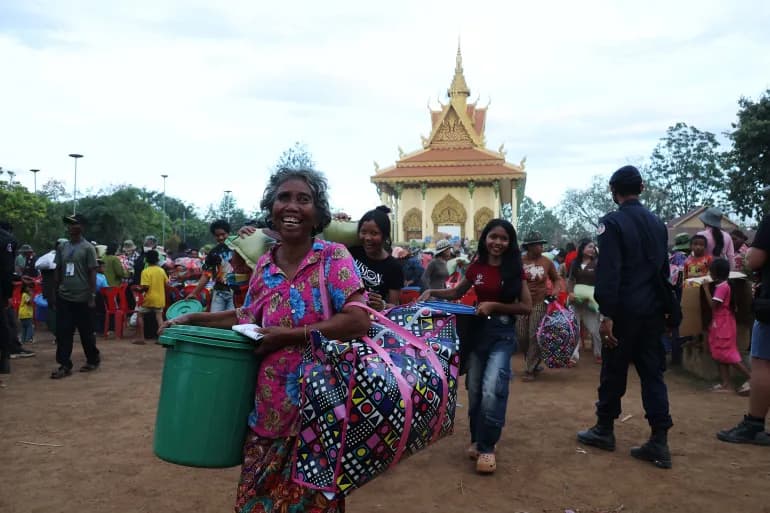
Reuters reports very large displacement figures on both sides, indicating the conflict has already crossed into a sustained humanitarian and governance challenge, not a limited skirmish.
Implications for India’s neighbourhood and Act East connectivity
For India, stability in mainland Southeast Asia matters for wider Indo-Pacific trade, ASEAN engagement, and the credibility of regional de-escalation norms. Even when India is not a party, repeated flare-ups stress the cooperative security environment that cross-border connectivity depends on.
What to watch next
Whether curfews expand or roll back
Curfew geography and duration will serve as a near-term indicator of whether authorities expect escalation or stabilisation.
Verification mechanisms
A durable ceasefire will likely hinge on monitoring arrangements and agreed sequencing, not only political statements.
Economic levers and maritime cautioning
If fuel, port-risk labeling, or maritime vigilance measures tighten further, the conflict may start shaping regional commerce more visibly.