

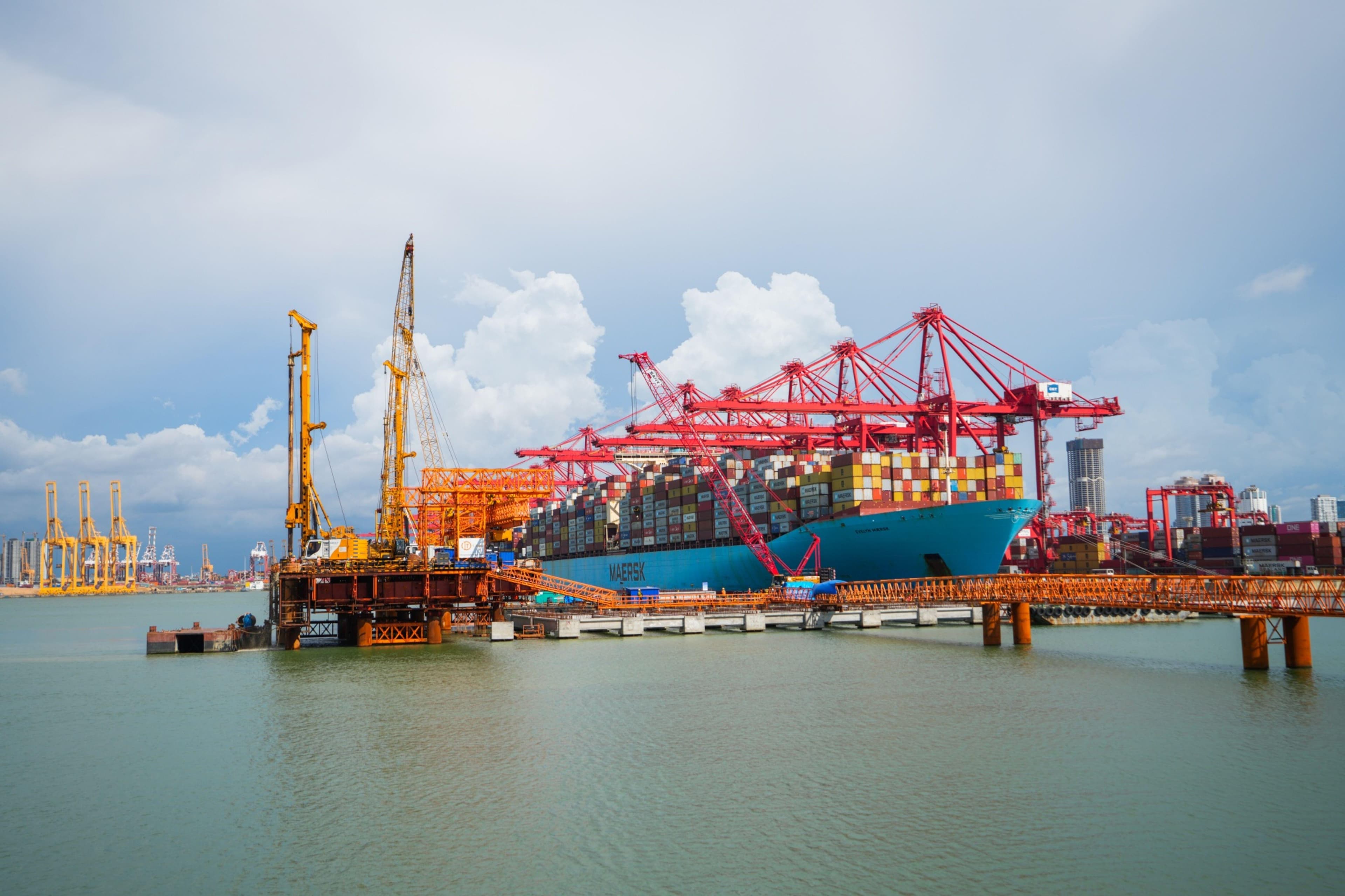
Backers of a transshipment hub at Galathea Bay argue it will vault India into a new league of maritime power and trade. A closer look, however, shows thin hinterland economics, fragile carrier loyalty, high operating costs, and major ecological and social risks. Port capacity alone doesn’t create traffic; networks do. Without them, the project risks becoming a costly symbol rather than a functional hub.
1) The commercial case — where it breaks
Capacity ≠ demand
Transshipment hubs grow on network effects: entrenched carrier contracts, dense feeder loops, steady cargo base, and quick turnarounds. Building quay length and depth is the easy part; winning sticky sailings is hard.
No natural hinterland
Great Nicobar is ~1,200 km from the Indian mainland with no proximate urban/industrial base. Every box must be shipped in and out. That raises per-move costs, complicates rotations, and weakens the value proposition versus Colombo/Singapore.
Feeder fragility
Feeder networks don’t appear overnight. Liner companies need reliable short-haul loops and guaranteed volumes to redeploy tonnage. Subsidising feeders for years invites moral hazard without ensuring permanence.
Carrier stickiness
Lines remain loyal to hubs that offer predictable rebates, integrated logistics, and bundled services. Even mainland Indian ports have struggled to shift contracts from Colombo; doing so from a remote island is harder.
Comparative scale reality
Mature hubs with long relationships move big volumes because the network wants to be there. Expecting a new, remote node to “double” such throughputs without committed lines and cargo anchors strains credibility.
2) The strategic claim — what actually helps security
Military ≠ commercial port
A stronger security posture in the eastern Indian Ocean can be pursued through naval/air assets, surveillance, and dual-use infrastructure (e.g., INS Baaz), without presuming a large commercial transshipment terminal.
Transparent rationale
If strategic factors drive the build, state that clearly and plan accordingly: limited dual-use jetties, logistics fuel farms, and airstrip upgrades—not a full commercial hub whose economics may not clear.
3) The “arc of ports” narrative — why one size won’t fit all
Vizhinjam vs Vadhavan vs Nicobar
-
Vizhinjam (Kerala): close to east–west trunk lanes; plausible Colombo challenger if it delivers time certainty + regulatory ease.
-
Vadhavan (Maharashtra): separate west-coast logic tied to western industrial corridors.
-
Great Nicobar: geographically isolated from cargo sources; treating it as the “linchpin” of a seamless arc ignores distinct theatres and economics.
4) Logistics and cost truthsIsland penalty
All inputs—containers, provisions, fuel, spares, personnel—must be shipped in. Weather windows and longer supply chains mean higher opex and schedule risk.
Precedent caution
Indian terminals that couldn’t align cost structures and network integration have seen liner withdrawals or pivoted to bulk. The lesson: port–shipping relationships drive traffic, not optimistic projections.
5) Ecology, tribes, and law — risks that can’t be waived
Biodiversity hotspot
Great Nicobar’s rainforests, coral systems, and nesting beaches (e.g., leatherback turtles) heighten mitigation and monitoring costs and raise the threshold for proving “no significant impact”.
Indigenous rights
Any plan must avoid dispossession and ensure free, prior, informed consent, livelihood security, and culturally appropriate rehabilitation—not just compensation tables.
Regulatory credibility
Staggered, transparent clearances; public environmental baselines; independent audits; and a no-go trigger if thresholds are breached are essential to maintain legitimacy.
6) What a realistic plan would do (if the project proceeds at all)
A. Start with function, not monumentality
-
Build dual-use naval/logistics capability sized to actual demand.
-
Limit commercial ambition to niche services (emergency calls, limited feeder support, cold-ironing, bunkering), then scale only against signed volumes.
B. Make traffic sticky before pouring concrete
-
Pre-commitments: binding slot and call-frequency agreements with multiple carriers.
-
Feeder underwriting: time-bound, declining subsidies with performance gates (on-time reliability, minimum TEUs).
-
Tariff discipline: predictable port dues, fast landside moves, and integrated services (pilotage, towage, bunkers) in one window.
C. Price the true externalities
-
Full-cost accounting for habitat loss, carbon, and disaster risk.
-
Biodiversity offsets funded upfront; turtle-safe lighting, turbidity controls, dredge windows, coral relocation plans with independent verification.
D. Social compact
-
FPIC processes, community monitoring committees, benefit-sharing (royalty-style funds), health and education investments tailored to tribal needs, not generic CSR.
E. Kill-switches
-
Predefined go/no-go milestones: if carrier uptake, feeder reliability, or environmental triggers miss thresholds, pause or pivot.
7) Alternatives that hit the same goals with less risk
-
Super-charge mainland hubs (Vizhinjam/JNPA/Vadhavan): one-stop clearance, guaranteed crane intensity, green corridors to ICDs.
-
Network, not monuments: Indian Ocean transshipment partnerships (Sri Lanka, Oman, East Africa) to co-create schedules, not cannibalise.
-
Maritime security by design: expand MDA, UAVs, P-8I sorties, submarine basing logistics, and cooperative patrols—without tying outcomes to a remote commercial port.
The bottom line
Ports don’t become hubs because they are deep; they become hubs because networks need them. Great Nicobar’s current logic—thin hinterland, heavy ecological costs, uncertain feeders, and speculative traffic—looks more like wishful transshipment than a bankable plan. If strategy is the driver, say so and design mission-fit infrastructure. If commerce is the aim, win the network first—or rethink the bet.
UPSC angle (quick recall)
-
Themes: Infrastructure economics, maritime strategy, island ecology, indigenous rights, Centre–State/environmental clearances.
-
Key ideas: Network effects in shipping; hinterland vs hub logic; FPIC; full-cost externalities; dual-use infrastructure.
Credits: The UPSC Times analysis desk, drawing on the arguments outlined by Abhijit Singh and standard maritime economics/ecology frameworks.