

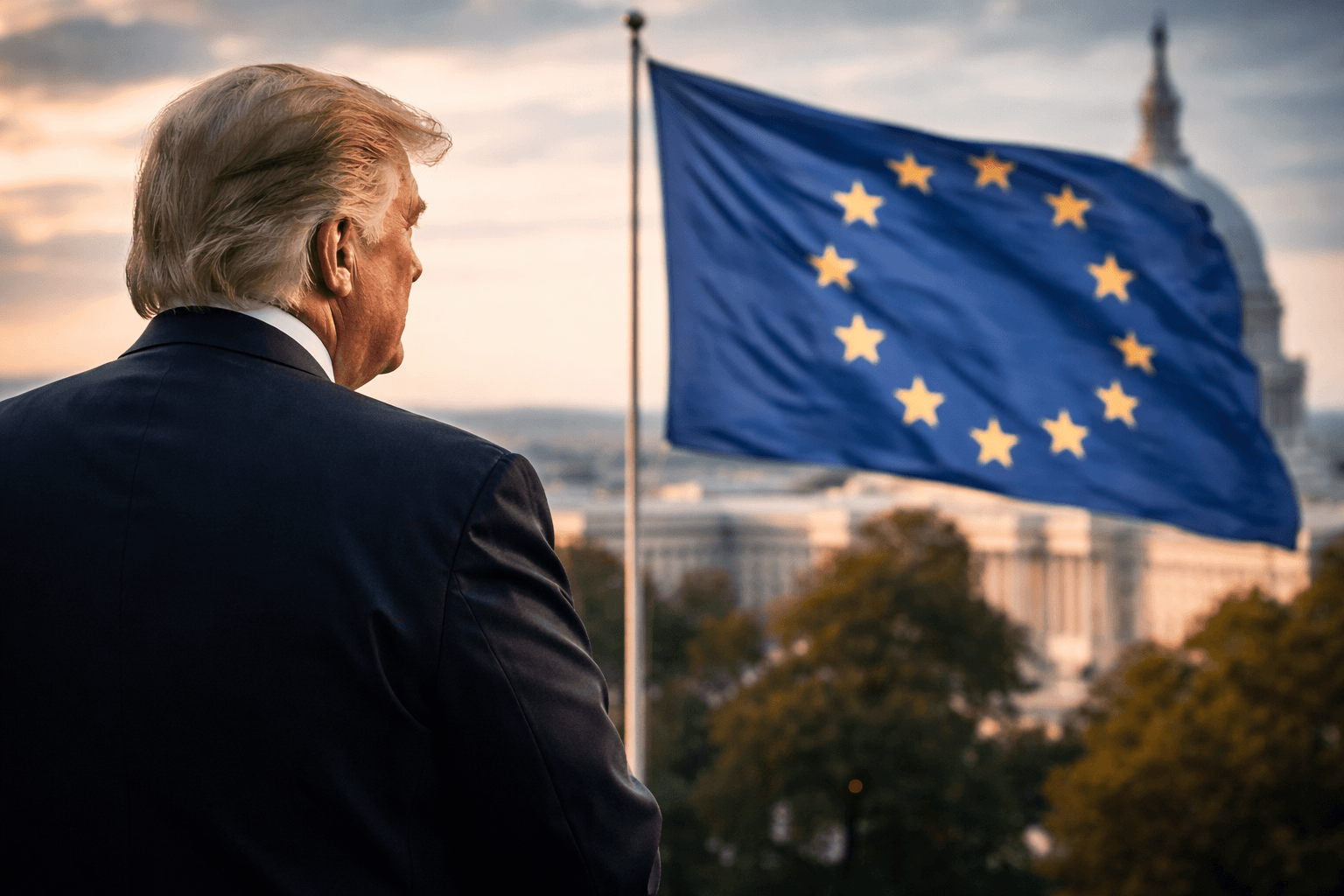
Europe has lived for decades with a comforting strategic assumption: that however noisy American politics becomes, the United States will ultimately stand behind the transatlantic bargain—security guarantees in exchange for alignment. The newest U.S. National Security Strategy (NSS) under President Donald Trump tests that assumption at its core. It does not merely ask Europe to spend more or do more. It redraws the moral map of what Europe represents, reframes what the U.S. considers “threat,” and signals a more selective, transactional American posture. The immediate consequence is not a tank on the Rhine or an order withdrawing troops overnight. The deeper consequence is psychological and structural: Europe is being nudged—some would say pushed—towards a future where it must defend itself, define its own strategic priorities, and absorb the costs of sovereignty.
What’s in the news
The Trump administration’s National Security Strategy sets out an “America First” worldview that places heavy emphasis on sovereignty, trade balances, and tighter borders, while portraying Europe’s troubles as rooted as much in cultural and political choices as in external threats. The document urges Europe to assume primary responsibility for its defence and gestures towards a recalibrated posture on NATO’s expansion and European security arrangements.
Background and context
What an NSS does in practice
A National Security Strategy is not an operational war plan, but it is not decorative either. It signals how an administration wants agencies to think—on alliances, threat perceptions, military posture, economic statecraft, and diplomacy. Even when events force improvisation, the NSS becomes the interpretive lens through which friends and rivals read intent.
Why Europe is unusually exposed
Europe’s modern security architecture rests on three pillars: U.S. power, NATO interoperability, and American intelligence and logistics. Europe does spend on defence, but it remains uneven across countries and often fragmented across procurement systems. The moment Washington’s reliability is questioned, European vulnerabilities become visible—capabilities, manpower, industrial depth, and decision-making unity.
Key provisions
Europe framed as cultural decline, not just strategic theatre
A striking feature is the framing of Europe’s risk as “civilizational” rather than purely military. The emphasis on migration, internal political cohesion, and social identity disputes signals that Washington is reading European stability through a domestic-culture lens, not simply deterrence arithmetic.
A harder line on NATO’s growth narrative
The strategy’s messaging implies that NATO cannot be treated as endlessly expandable. This matters not just for aspirant partners, but also for how Europe interprets U.S. appetite to underwrite an open-ended European security perimeter.
Burden shifting as a doctrine, not a complaint
All U.S. administrations pressure Europe to spend more. This document treats European self-reliance as a principle. That shift—tone becoming doctrine—changes how European capitals model future risk.
A more skeptical view of transnational institutions
The NSS places sharper suspicion on global institutions, suggesting they can dilute sovereignty. For Europe, which often leans on rules, institutions, and process as strategic tools, this is a direct hit on its preferred operating system.
Why it matters
Alliance credibility is built on expectation, not paperwork
Treaties matter, but deterrence rests on belief—belief that a crisis will trigger coordinated action. If belief weakens, adversaries probe, partners hedge, and domestic politics in allied countries become more anxious and polarised.
Europe’s challenge is capability plus cohesion
Even if Europe decides to step up, it must also decide together. Strategic autonomy is not only a budget problem; it is a politics problem. Different threat perceptions—Baltic states versus southern Europe, for instance—complicate a single European posture.
Russia becomes a test case of European agency
If the American line becomes more ambivalent, Europe must answer uncomfortable questions: what “security guarantees” mean in practice, what a sustainable Ukraine settlement looks like, and how to deter without escalating uncontrollably.
Arguments for and against
The case made by supporters
-
Forcing realism: Europe has had years of warning; stronger European defence could be healthier for long-term stability.
-
Reducing moral hazard: If allies assume Washington will always rescue them, they may underinvest or delay reform.
-
Sharper prioritisation: The U.S. can focus resources on what it defines as core interests, including industrial resilience and border security.
The case made by critics
-
Undermining deterrence: Public doubt about alliance guarantees can invite adventurism from adversaries.
-
Political interference risk: Any signal of favouring certain parties inside allied democracies can be read as meddling.
-
Normalising civilizational language: Framing security through identity creates space for discrimination and radicalisation, and can legitimise extremes.
-
Institutional damage: If rules-based mechanisms weaken, power politics returns as the default currency.
Legal and institutional angle
NATO commitments and the politics of enforcement
NATO is grounded in collective defence commitments, but the credibility of those commitments depends on political will in real time. National legislatures, public opinion, and executive choices shape outcomes as much as treaty text.
Sovereignty and non-interference norms
When major powers signal support for preferred political forces inside other democracies, it tests the boundary between public diplomacy and interference. Even without formal illegality, the reputational cost is high—and the backlash can be severe.
The future of multilateralism
Europe’s strategic tradition relies on institutions—trade rules, security forums, standards bodies. A U.S. shift towards unilateral or transactional bargaining raises the premium on Europe’s ability to defend institutional arrangements or redesign them.
Implications beyond Europe
What it could mean for global order
If the U.S. signals a narrower conception of responsibility, other regions may also recalibrate. Middle powers may hedge more aggressively; regional blocs may intensify self-help; and great-power spheres of influence could become more openly contested.
What it could mean for India
India benefits from a stable Europe and predictable global rules, especially on trade, technology standards, maritime security, and supply chains. A more inward-looking or transactional West can create openings—strategic partnerships, defence exports, deeper tech cooperation—but it also raises uncertainty around sanctions regimes, energy markets, and conflict management. The prudent approach for India is steady multi-alignment: deepen ties with Europe where interests converge, while maintaining room for independent decision-making in a more fractured order.
Implications and way forward
Europe’s choices narrow to capability, credibility, and consensus
Europe’s response is likely to be judged on three fronts:
-
Capability: not only spending, but interoperable forces, air defence, ammunition stockpiles, cyber resilience, and rapid mobility.
-
Credibility: a shared political signal that Europe can hold the line in a crisis without waiting for Washington.
-
Consensus: stronger coordination on procurement, doctrine, and intelligence-sharing, reducing duplication and dependence.
A pragmatic transatlantic reset may be the best-case scenario
Even under pressure, the U.S.–Europe relationship is too integrated to collapse neatly. The most realistic scenario is a reset: Europe doing more, the U.S. doing less—but both keeping enough alignment to deter adversaries and manage crises.
Source credits
U.S. National Security Strategy (Trump administration); NATO official declarations and summit statements; reporting and analysis by international affairs journals and global media outlets.