

The Site in Context
-
Location: ~10 km NW of present-day Thirumalapuram village (Tenkasi), in a low interfluve between two seasonal streams that descend from the Western Ghats near the Kulasegarapereri tank.
-
Extent: A large ~35-acre funerary field, suggesting a long-lived cemetery used by multiple generations/lineages.
-
Excavation (Season 1): 37 trenches; strategy focused on burial superstructures and associated grave goods to establish cultural markers before broader habitation surveys.
Headline Finds
-
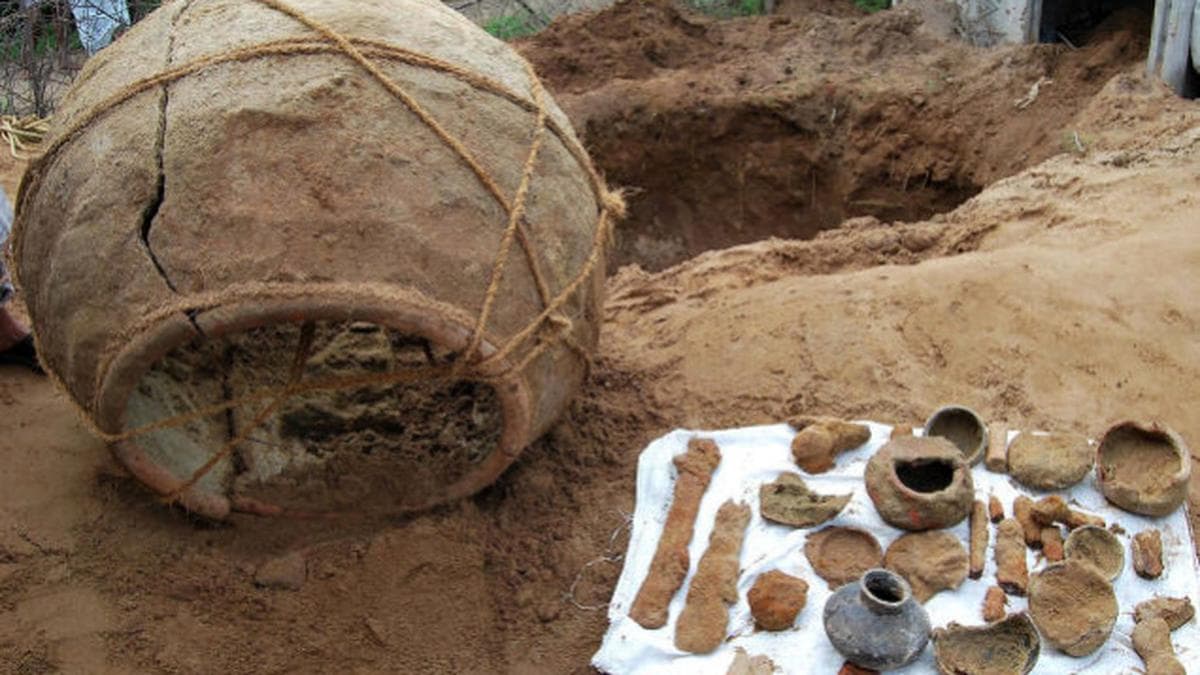
Stone-slab chamber with urn burials (first-of-its-kind in TN): A rectangular cist-like chamber of ~35 slabs, packed with cobbles to ~1.5 m depth, containing urns placed within—a hybrid of cist engineering and urn-burial practice.
-
Ceramic repertoire:
-
Black-and-red ware (BRW), black ware, black-slipped ware, red ware, red-slipped ware, coarse red ware.
-
White-painted designs on BRW/black ware/black-slipped ware—a distinctive decorative tradition earlier reported at T. Kallupatti, Adichanallur, Sivagalai, Thulukkarpatti, Korkai—now firmly present at Thirumalapuram.
-
-
Iconic motif pot: A red-slipped vessel painted with human figure, mountain, deer, and tortoise—a rare narrative/landscape composition, potentially encoding identity, clan totems, or cosmological themes.
-
Metals & bone artefacts (n=78): Iron sword, spearhead, axe, dagger, chisel; bronze items; bone points/heads; and three micro-gold rings (~4.8 mm diameter; <1 mg each) recovered from an urn at ~0.49 m—likely ornaments signifying age/ritual status.
Why this matters: The combination of iron weaponry, urn burials, engineered stone architecture, and painted wares is a classic Iron Age signature in peninsular India. The elaboration of mortuary architecture hints at social ranking and specialist craftsmanship.
Dating: What We Know (and Don’t)
-
Working hypothesis: The report tentatively places Thirumalapuram in the early–mid 3rd millennium BCE, aligning it with recent (and debated) early dates from Sivagalai and Adichanallur.
-
Important caveat: In South Asia, the term “Iron Age” is commonly tied to the regular use of iron (often later than 2000 BCE). If lab dating confirms 3rd-millennium BCE, it would push back local iron-using or proto-iron cultural phases—or indicate cultural continuity where burial forms and ceramic styles precede or overlap with sustained iron metallurgy.
-
Next steps in dating: Expect a mix of AMS radiocarbon (charred organics), OSL/TL (sediment/pottery firing), metallography (smelting/forging evidence), residue and microcharcoal analysis from urn fills and cobble packing.
Reading the Material Culture
-
Mortuary engineering: The slab-chamber-with-urns design suggests intent to segregate and protect select burials, possibly elite/ritual specialists. Cobble infill may stabilize the chamber and mark the grave surface.
-
Ceramics as social code: White-painted motifs on dark slips are not merely decorative; they likely encode group identity, rites of passage, or territorial claims. Cross-site recurrence argues for a shared cultural koine across the Tirunelveli–Thoothukudi–Tenkasi zone.
-
Metals and status: Iron weapons and tools in graves often correlate with warrior/producer identities and craft specialization. The micro-gold rings—so delicate as to be symbolic—may mark infancy/child burials, initiation tokens, or protective amulets.
Landscape & Economy
-
Western Ghats hinterland: Proximity to hill passes, streams, and laterite/ironstone sources—ideal for seasonal agropastoralism, iron ore collection, and exchange with coastal nodes like Korkai.
-
Faunal motifs (deer, tortoise): Paired with mountain imagery, they hint at ritual ties to upland ecology, hunting symbolism, or clan emblems tied to landscape features.
-
Regional network: The repeating painted-ware tradition from interior to coast suggests exchange routes bridging Ghats–plains–delta systems, potentially feeding into pearling/fishing and early metal trade corridors.
How It Compares (Indicative)
-
Adichanallur: Large urn-burial complex with rich grave goods; emerging early dates.
-
Sivagalai: Urn burials with painted wares and claims of very early horizons.
-
Thirumalapuram: Adds a unique slab-chamber + urn configuration and miniature gold rings to the corpus, tightening stylistic and ritual links across south TN.
Methods & What to Watch in Season 2
-
High-resolution recording: Photogrammetry/LiDAR, micro-stratigraphic sampling of urn fills, micromorphology of cobble packing.
-
Provenance studies: Petrography/portable XRF on ceramics and iron to map clay/ore sources; lead-isotope where feasible.
-
Bioarchaeology: If cremation residues or bone fragments are recoverable, pursue aDNA/isotopes (Sr/O/C/N) for mobility, diet (C3/C4), and kinship.
-
Conservation: Micro-rings and painted surfaces require humidity-controlled storage and non-invasive imaging (RTI, multispectral) before cleaning.
Big Takeaways
-
A complex Iron Age mortuary landscape near the Ghats, with architecture and artefacts pointing to rank, specialization, and wide cultural linkages.
-
Painted-ware tradition appears regionally coherent, offering a strong stylistic bridge among sites from the hinterland to the coast.
-
Chronology is decisive: If lab dates uphold the 3rd-millennium BCE horizon, South Indian metal/ceramic sequences will need refining, potentially revealing deep local roots to later Early Historic polities.
Sensible Caution for Readers
“Iron Age” here is a cultural shorthand based on material traits (urn burials, irons, painted wares). The absolute dates are provisional until peer-reviewed lab results are published. Expect refinement—and possibly debate—over the next seasons.
What This Could Mean for Heritage & Tourism
-
Mapping a Ghats-to-Gulf archaeology trail (Thirumalapuram–Adichanallur–Korkai) with site museums, replicas, and AR reconstructions could anchor education and local livelihoods—provided conservation and community rights are prioritized.