

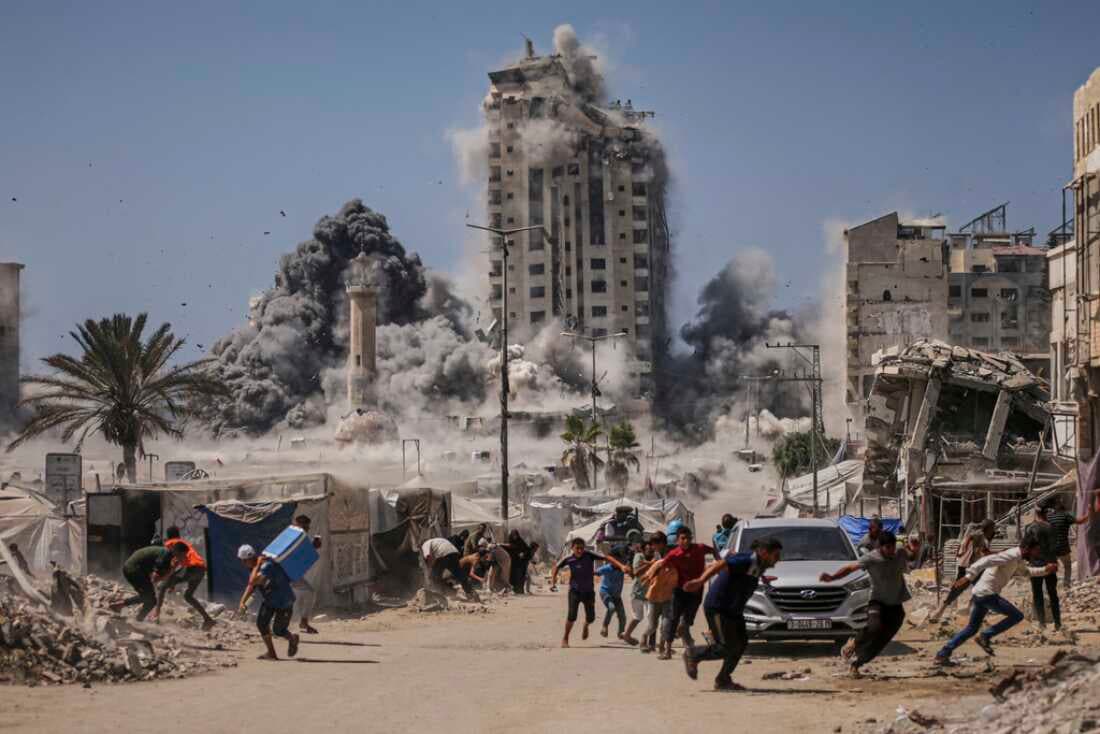
The UN Independent International Commission of Inquiry on the Occupied Palestinian Territory, chaired by former UN High Commissioner for Human Rights Navi Pillay, released a report on September 16, 2025, concluding that Israel’s military operations in Gaza amount to genocide.
The Commission’s findings come after two years of evidence collection, satellite analysis, and testimonies documenting over 60,000 Palestinian deaths, including 18,000 children and 10,000 women, alongside the destruction of Gaza’s health, food, and reproductive systems.
In an interview, Pillay underlined that the international community’s duty to prevent genocide has already been triggered by the International Court of Justice’s (ICJ) provisional measures earlier in 2024. She added that states “must act now” — ceasing arms transfers, ensuring humanitarian access, and holding perpetrators accountable.
1. The Legal Basis: What Constitutes Genocide
Definition under the Genocide Convention (1948)
Article II of the UN Convention on the Prevention and Punishment of the Crime of Genocide defines genocide as any of the following acts committed with intent to destroy, in whole or in part, a national, ethnic, racial, or religious group:
-
Killing members of the group;
-
Causing serious bodily or mental harm;
-
Inflicting conditions calculated to bring about physical destruction;
-
Imposing measures intended to prevent births;
-
Forcibly transferring children of the group.
What the Commission Found
-
Mass killing of civilians: Over half the victims were women, children, and elderly non-combatants.
-
Systematic starvation: Over 1,300 people reportedly killed while seeking food at aid sites.
-
Destruction of healthcare infrastructure: Hospitals and clinics deliberately targeted.
-
Prevention of births: The deliberate bombing of Gaza’s largest IVF clinic, destroying 4,000 embryos, was cited as intent to diminish future population.
-
Collapse of life expectancy: Gaza’s average life span fell from 75.5 years to 40.5 years within a year — a demographic decline the report calls “unprecedented in modern history.”
According to Pillay, these acts collectively demonstrate specific intent to destroy a population, fulfilling the legal definition of genocide.
2. International Law: Obligations of States
Duties Under the Genocide Convention
-
Prevention: States must act immediately upon knowledge of a serious risk of genocide.
-
Non-complicity: Supplying arms or financial support to parties committing genocide violates the Convention.
-
Accountability: States are required to prosecute or extradite individuals responsible.
The ICJ’s Role
The International Court of Justice (ICJ) had earlier, in provisional orders (January 2024), instructed Israel to take steps to prevent genocidal acts and allow humanitarian aid. Failure to comply could lead to state accountability proceedings.
Pillay’s Commission now argues that continued arms transfers or political support to Israel may constitute “complicity in genocide” under international law — a principle that binds all UN member states.
3. India’s Position and Diplomatic Dilemma
India has historically supported the Palestinian cause while maintaining a deep strategic partnership with Israel in defence, agriculture, and technology. After the 1992 normalisation of ties, India–Israel cooperation expanded to include missile systems, drones, and cyber-defence.
However, the UN report raises a potential legal and moral dilemma:
-
If India is found to be exporting arms or defence components used in Gaza, it could face questions under the Genocide Convention’s Article III (complicity clause).
-
Navi Pillay explicitly said it would be a “matter of shame” if India — home to an ICJ judge and a founding signatory to the Convention — were seen aiding or ignoring acts meeting the genocide threshold.
Balancing Act
India’s official position has remained consistent: support for a two-state solution, humanitarian aid to Gaza through UNRWA, and condemnation of civilian casualties. But the growing strategic and intelligence ties with Israel complicate this balance. New Delhi must navigate carefully between its principled non-alignment and realpolitik partnerships.
4. The Broader Diplomatic Landscape
Western Divisions and Global South Unity
-
The United States and several Western allies continue to back Israel diplomatically while questioning the UN report’s findings.
-
The Global South, led by South Africa, Brazil, and several Arab and African states, has rallied for accountability and sanctions. South Africa was the first to bring the genocide complaint against Israel to the ICJ in 2023.
-
China and Russia have used the issue to criticise U.S. hegemony and call for UN reforms, aligning themselves with developing nations demanding a ceasefire.
Geopolitical Stakes
The Gaza conflict has evolved into a litmus test for the credibility of the international legal system. If a permanent member of the UN or its allies are seen obstructing justice, it could deepen the perception that global governance favours the powerful over the lawful.
5. The Humanitarian and Ethical Dimension
The report’s statistics show not only casualties but systemic collapse:
-
Health system: 90% of hospitals destroyed or non-functional.
-
Education: More than 400 schools flattened.
-
Food and water: 2 million people on the brink of famine.
The destruction of Gaza’s reproductive health infrastructure, Pillay argues, goes beyond collateral damage — it’s an assault on the community’s capacity to survive. The deliberate targeting of hospitals, journalists, and aid convoys reinforces the report’s conclusion of intent to annihilate.
6. What Happens Next
Possible International Actions
-
The UN Security Council may face renewed calls for sanctions or an arms embargo — though veto politics may block consensus.
-
ICC Prosecutors could pursue war-crimes indictments against senior Israeli officials if sufficient evidence is found.
-
States supplying arms or technology may face litigation under universal jurisdiction, as seen in past genocide cases.
For India and Other Democracies
-
Review all defence export licences linked to conflict zones.
-
Strengthen adherence to international humanitarian law in procurement and trade.
-
Increase diplomatic support for ceasefire and humanitarian access while maintaining strategic neutrality.
7. The Larger Question: Justice and Credibility
The Gaza genocide report tests not just Israel’s conduct but the integrity of the international legal system itself. If states fail to uphold the Genocide Convention, it undermines decades of post-World War II consensus that “never again” would such atrocities be tolerated.
For emerging powers like India, which seek a seat at the global governance table, credibility on human rights and humanitarian law will be central to their diplomatic legitimacy.
Conclusion
The UN Commission’s findings on Gaza mark one of the gravest indictments in international law since Rwanda and Srebrenica. Navi Pillay’s warning is unambiguous: states cannot remain neutral when the evidence of genocide is before them.
India’s challenge will be to reconcile its historical moral stance with its modern strategic interests — ensuring that its choices uphold both the rule of law and its global conscience. The Gaza tragedy, beyond politics, is a test of humanity’s collective resolve to prevent annihilation masquerading as security.