

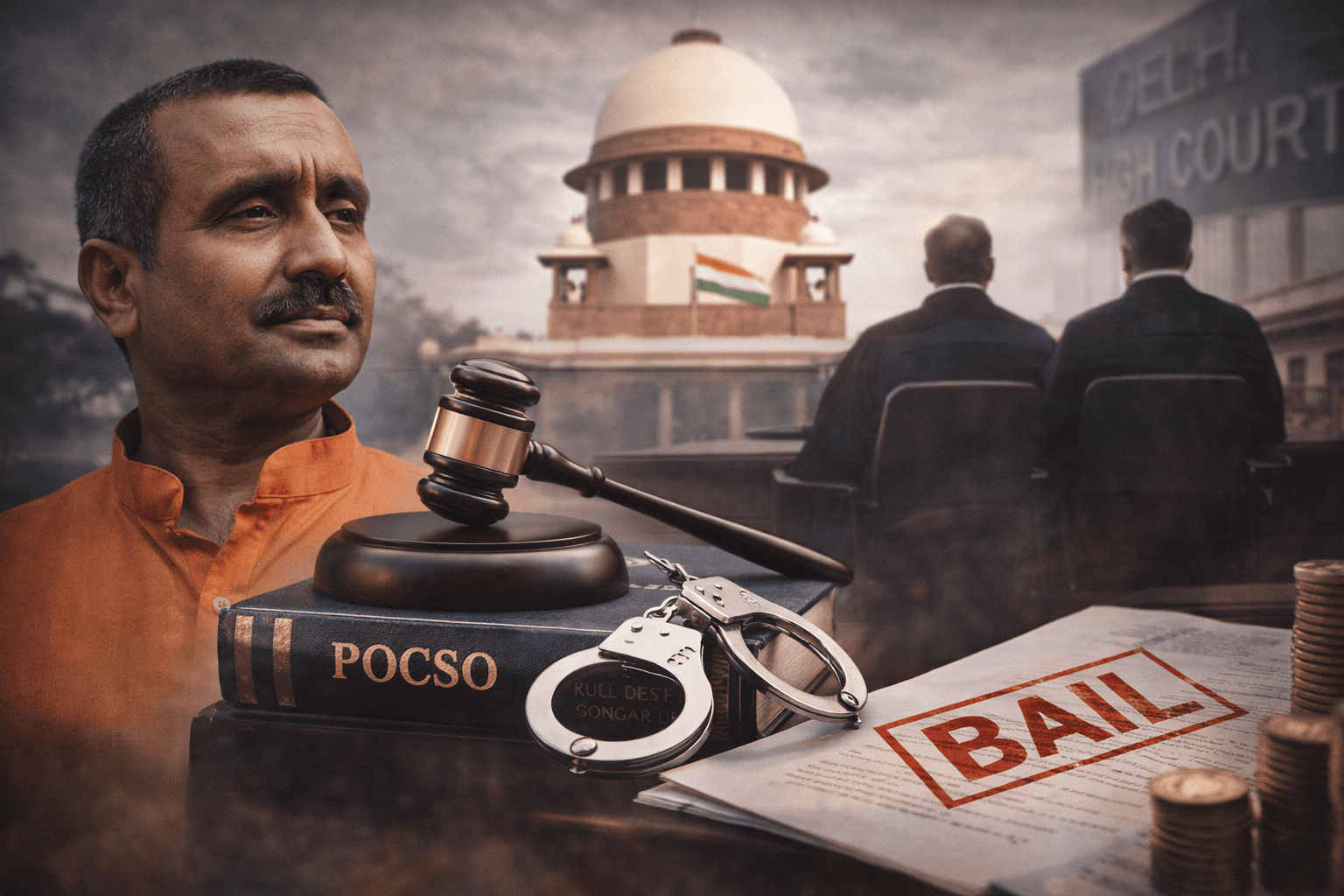
Some criminal appeals are fought on evidence. Others turn on a larger question: how the law treats power. The Supreme Court’s decision to stay the Delhi High Court order granting bail to Kuldeep Singh Sengar belongs to the second category. The Court has effectively paused a route to release that was opened by a narrow reading of “public servant” under the POCSO Act, and it has done so while keeping an eye on the “real-world consequence” of parallel proceedings that could have resulted in the convict walking out.
What’s in the news
The Supreme Court has stayed the operation of the Delhi High Court order that suspended Sengar’s prison sentence and granted him bail in the Unnao case. The case relates to the kidnapping and rape of a minor in 2017, allegedly induced to come to his residence on the false pretext of a job.
The CBI opposed the relief, stressing accountability to the survivor. The Supreme Court noted that the High Court had disagreed with the trial court on the application of Section 5(c) of POCSO—the “public servant” clause that makes the offence an aggravated form with higher punishment. The Supreme Court has listed the matter for hearing on 20 January 2026.
Background and context
The Unnao case has long been a landmark in how criminal justice intersects with political power, community influence, and victim vulnerability. In such cases, bail is never just a routine procedural question; it becomes a statement about risk, deterrence, and public confidence.
Two timelines matter here.
First, the Delhi High Court’s 23 November 2025 order, which suspended sentence and granted bail, appears to have been influenced by the view that an MLA does not qualify as a “public servant” for the purpose of Section 5(c), based on importing an older IPC-era meaning.
Second, the Supreme Court’s 29 December 2025 intervention, which did not merely disagree in principle but also highlighted a practical concern: Sengar has been convicted in a related case concerning the survivor’s father’s custodial death, and a bail plea in that case is at an advanced stage. If bail were granted there, the High Court order could have enabled actual release. The Supreme Court described this combination as “unique facts and circumstances”.
Key provisions / key details
Section 5(c) of the POCSO Act treats penetrative sexual assault committed by a “public servant” as an aggravated form, attracting a much harsher sentencing framework.
The legal fault-line is the meaning of “public servant” in this context. The High Court’s approach, as indicated in court submissions, was to draw from an older IPC-defined understanding that did not include an MLA. The Union, through the Solicitor-General, has urged a broader and more purposive reading: if a person is in a dominant position that enables exploitation—particularly a politically powerful local figure—then the law should recognise that as aggravated assault because the abuse is compounded by authority and influence.
The Supreme Court’s stay does not finally decide the issue today, but it clearly indicates that the definitional question is substantial enough that release should not be allowed to ride on a contested interpretation.
Why it matters
This order matters on four levels.
First, the idea of “power” as an aggravating factor.
Child-protection law is built on the understanding that harm is amplified when the accused holds authority, trust, or dominance. If elected representatives can be treated as outside that frame due to narrow definitional borrowing, the statute’s moral core weakens.
Second, it strengthens victim-centric criminal justice.
The CBI’s submission—answerability to a survivor who was 15—captures a shift in the judiciary’s approach over time: bail in serious sexual offences, especially involving minors, is increasingly assessed with a sharper lens on intimidation risk, public confidence, and the survivor’s right to dignified justice.
Third, it prevents “procedural escape routes”.
The Supreme Court’s reasoning is practical: even if one case is stayed or debated, parallel proceedings can create a release pathway. Courts are increasingly alert to such “combined-effect” situations.
Fourth, it sets the stage for a precedent on statutory interpretation.
If the Supreme Court ultimately reads “public servant” under POCSO purposively to include public authority figures in dominant positions, it can reshape how aggravated sexual assault is applied in cases involving political or institutional power.
Arguments for and against
The argument supporting the High Court’s approach is classical legality: penal statutes must be interpreted strictly; definitions should not be expanded casually; courts should not create categories that Parliament did not expressly name.
The argument supporting a broader reading is classical protection: POCSO is a child-protection statute with an unmistakable intent—recognise the enhanced vulnerability of a child when the offender carries authority. If the law punishes “public servant” abuse more severely, it is because the offender’s status increases coercion, reduces reporting, and distorts consent and choice. In that sense, treating an MLA’s dominance as outside the aggravated framework risks turning the law into a technical shield for precisely the kind of power-driven abuse it was designed to address.
The Supreme Court’s stay suggests it is taking the second argument seriously—without yet pronouncing final word.
Constitutional / legal angle
At its core, this is a collision between two legal impulses:
-
Strict construction of criminal law to protect against judicial overreach in defining offences and punishments.
-
Purposive interpretation of welfare legislation where the objective is protection of vulnerable groups, especially children.
Alongside interpretation sits a constitutional undercurrent: Article 21, understood through the lens of dignity, protection, and fair criminal process. In cases of sexual violence involving minors, courts have increasingly treated the survivor’s rights—safety, dignity, and meaningful access to justice—as central, not collateral.
The bail dimension also speaks to criminal procedure norms. The Supreme Court explicitly noted that it generally does not interfere with bail orders, which underscores that the intervention is meant to prevent irreversible consequences while a serious question of law is tested.
Implications
Short-range: Sengar remains in custody, and lower courts and agencies will likely treat the matter with heightened caution given the Supreme Court’s direct stay and the upcoming hearing date.
Medium-range: The Court’s eventual view on “public servant” under POCSO could influence how aggravated categories are invoked in cases involving power asymmetries—political, institutional, or otherwise.
Long-range: If the Court anchors aggravation not only in formal job designation but also in dominance and authority over the child, it could strengthen deterrence and close interpretive gaps that undermine child-protection goals.
Way ahead
The most credible outcome will be one that balances legal discipline with legislative purpose.
The Court will need to give a clear, workable test: whether “public servant” in Section 5(c) should be read narrowly by borrowing older definitions, or read in a manner that reflects how authority operates on the ground—especially in small-town and rural contexts where political dominance can be as coercive as formal official power.
Equally, the final decision should provide guidance on bail in cases where multiple convictions and pending bail pleas can combine to create unintended release outcomes. Clarity here will help trial courts, high courts, and investigating agencies avoid inconsistent outcomes in cases that are deeply sensitive and socially consequential.
Source credits
The Hindu; Supreme Court proceedings; Central Bureau of Investigation submissions; Protection of Children from Sexual Offences Act, 2012