

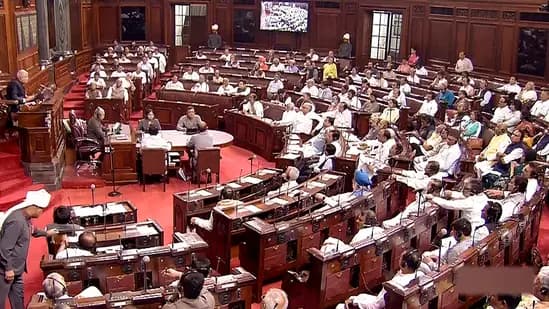
Vande Mataram was born as a song of resistance and unity, not as a test of loyalty. One hundred and fifty years after Bankim Chandra Chattopadhyay wrote it into Anandamath, Parliament’s commemoration of vande mataram 150 years became yet another flashpoint. The parliament debate on vande mataram saw the ruling side link the Congress decision to adopt only the first two stanzas to the seeds of Partition, while the Opposition asked why old wounds were being reopened when India faces urgent contemporary challenges. Beneath the noise lies a deeper question: will we use the song to strengthen secular nationalism and social harmony in india, or to relitigate history through a partisan lens?
Vande Mataram: History and accommodation
The vande mataram history and controversy is more complex than today’s slogans.
-
Written in the early 1880s, Vande Mataram quickly became a rallying cry of the national movement, cutting across regions and communities.
-
In 1937, the Indian National Congress decided to use only the first two stanzas at its sessions, recognising both the emotional power of the song and the concerns of some Muslim leaders over its later, explicitly devotional imagery.
-
After Independence, the Constitution recognised it as the national song, while Jana Gana Mana was adopted as the national anthem.
This was not an act of rejection, but a political compromise to preserve unity: leaders chose to protect the emotional core of Vande Mataram while still signalling respect for minority sensitivities.
The 150-year moment and Parliament’s missed opportunity
The anniversary could have been framed as vande mataram 150 years of shared sacrifice and cultural synthesis. Instead, the parliament debate on vande mataram became a sharp bjp congress clash over vande mataram:
-
The Prime Minister and the Home Minister argued that limiting the song to two stanzas encouraged the Muslim League and contributed to Partition.
-
Priyanka Gandhi Vadra and Mallikarjun Kharge responded by recalling the historical context in which millions of Muslims had also shouted Vande Mataram in processions, and questioned the utility of such a debate when unemployment, price rise and social distress demand attention.
The real loss here is that Parliament used a powerful symbol of unity to score political points, instead of using it to rebuild social cohesion in a polarised time.
Harmony, secular nationalism and the lesson of Partition
The national movement’s most important achievement was to expand a shared political space where Hindus, Muslims, Sikhs, Christians and others could see themselves as part of a common project. Vande Mataram lived in that space:
-
Many Muslims of that era did join in the chant, not as a religious act but as a political pledge to the motherland.
-
The Congress decision of 1937 reflected a willingness to accommodate multiple faiths within one freedom struggle, not to erase any one community.
Partition is a reminder of how fragile that unity can be when identity hardens. The lesson is not that symbols like Vande Mataram are dangerous, but that elevating any religious or cultural identity above the constitutional idea of India can become combustible.
True secular nationalism and social harmony in india rest on a simple principle: the State honours all faiths but privileges none; citizenship and belonging are not graded by language, religion or lineage.
Using memory to build, not break
The editorial’s core warning is about the misuse of memory:
-
History as weapon: To claim that the Congress’s treatment of Vande Mataram directly “caused” Partition is to compress a vast and painful story into a convenient blame-game.
-
History as mirror: A more honest use of the past would recognise that national symbols have always been negotiated, adapted and sometimes limited in order to hold together a vast and diverse society.
If we invert a symbol of harmony into a symbol of exclusion, we hollow it out. The best tribute to Vande Mataram is not to shout it louder, but to live its spirit more deeply — through justice, fraternity and everyday respect across communities.
The way forward: A note of harmony
For a forward-looking Republic, the way to honour Vande Mataram is clear:
-
Re-centre constitutional patriotism – locate love for the motherland in the Preamble’s values: justice, liberty, equality and fraternity.
-
Depoliticise culture in law-making spaces – Parliament can celebrate cultural icons without turning them into partisan litmus tests.
-
Invest in social cohesion – through inclusive policies, fair policing, and development that carries all regions and communities along.
-
Teach history with nuance – highlight how leaders balanced faith, culture and politics rather than presenting one-dimensional narratives.
India’s strength has always been its ability to carry many songs, many languages and many memories within one national story. To keep that story credible, the invocation of “Mother India” must unite, not divide. That, more than anything else, would be the truest note of harmony.