

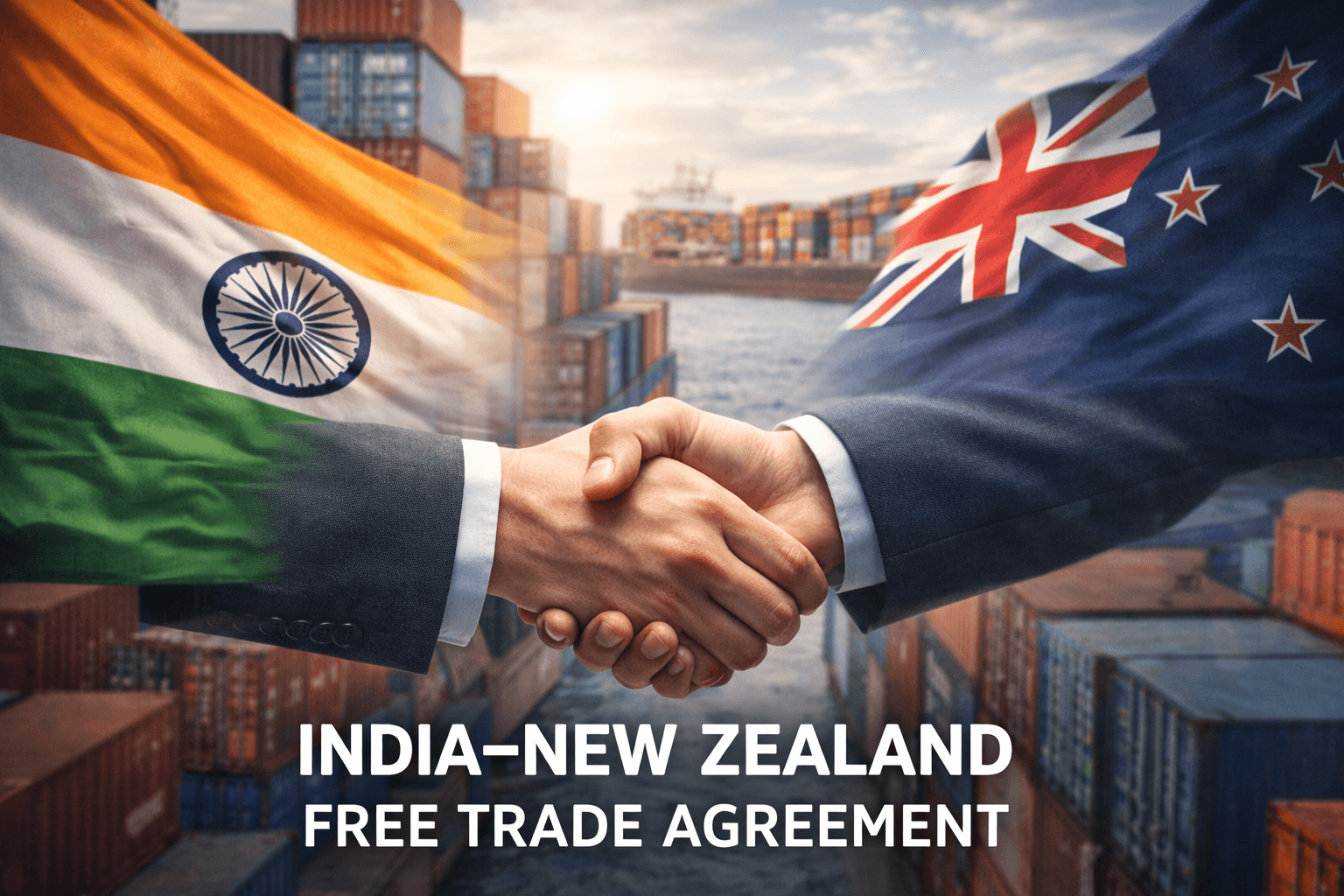
What is the India–New Zealand Free Trade Agreement (FTA)?
It is a comprehensive trade pact concluded on 22 December 2025 that lowers tariffs, opens selected services and mobility pathways, and creates a structured framework for investment and regulatory cooperation. For India, the headline gain is full duty-free entry into New Zealand for Indian goods; for New Zealand, the key gain is preferential access into India across most of its export basket—without India opening its most sensitive farm and dairy lines.
What zero-duty access will India get?
New Zealand will apply zero import duty on 100% of its tariff lines for Indian goods from the agreement’s Entry-Into-Force (EIF).
In practical terms, this means products that earlier faced low average tariffs (and some meaningful “nuisance tariffs”) move to zero, improving landed-price competitiveness for Indian exporters.
A useful detail: New Zealand had tariffs around ~10% on about 450 lines of key Indian exports (including textiles/apparel and leather among others). These are precisely the kinds of lines where “zero duty” changes the game for price-sensitive, labour-heavy exports.
How much FDI is New Zealand committing to by 2030?
Here’s the important correction: the official framing is USD 20 billion investment commitment over 15 years, linked to a timeline and “clawback” style enforcement mechanisms mentioned in Indian briefings. It is not consistently described as “by 2030” in the most authoritative summaries—rather, it is spread over 15 years from EIF (which, if EIF is in 2026 after ratification, broadly takes the commitment window into the late-2030s/early-2040s).
If you want, I can also break this into a clean one-line clarification you can use in your write-up: “USD 20 billion over 15 years (not ‘by 2030’).”
Which sectors in New Zealand have criticised the deal?
The sharpest criticism in New Zealand has come from dairy and broader farm-linked interests, because India has not opened market access for major dairy products—a core export pillar for New Zealand. Politically, the loudest institutional opposition has been from New Zealand First (NZ First), a coalition partner, arguing the pact is “neither free nor fair” due to limited dairy outcomes and concerns around concessions linked to mobility/immigration.
Why is India accelerating FTAs with countries?
India’s FTA acceleration is driven by hard-headed economics and strategic timing:
-
Trade diversification under tariff uncertainty: With heightened volatility in major markets (especially the U.S. tariff environment), India is reducing over-dependence on a few destinations and building alternative demand corridors.
-
Getting a better seat in global value chains: Tariff preferences matter most when firms are deciding where to source, assemble, and ship from. FTAs can convert “India as an option” into “India as a default”.
-
Services and mobility are now central: Modern FTAs are as much about professionals, standards, and digital rails as about goods. India’s comparative advantage in talent makes mobility provisions commercially valuable.
How will labour-intensive sectors benefit (textiles, leather, gems, processed foods)?
The benefit is not just “more exports” in theory; it is cleaner price competitiveness + simpler market entry in a high-income market:
Textiles & apparel: Duty-free access removes the final price disadvantage versus competitors who already enjoy preferential access in similar markets. For many SKUs, even a 5–10% duty difference decides the order.
Leather & footwear: Similar logic—these are margin-sensitive categories. Zero duty improves competitiveness for Indian MSME clusters and supports scale-up through repeat orders.
Gems & jewellery: Faster acceptance in overseas retail channels depends heavily on landed price, compliance predictability, and buyer confidence. Tariff elimination supports higher-value product mixes and stable demand planning.
Processed foods: For processed items, duty-free access can help Indian brands move from diaspora-only demand to mainstream shelves—provided India upgrades packaging, traceability, SPS compliance, and consistent supply. The FTA advantage is strongest when the exporter is “standards-ready”.
A quiet but significant point: New Zealand’s zero-duty coverage is across all tariff lines—so once Indian exporters meet quality and standards, the tariff barrier is essentially removed as a competitive constraint.
Source credits
Press Information Bureau (Government of India); Ministry of Commerce & Industry (fact sheet); New Zealand Government (Beehive); New Zealand Ministry of Foreign Affairs and Trade (MFAT); Reuters; RNZ; The Economic Times; Times of India; Al Jazeera.