

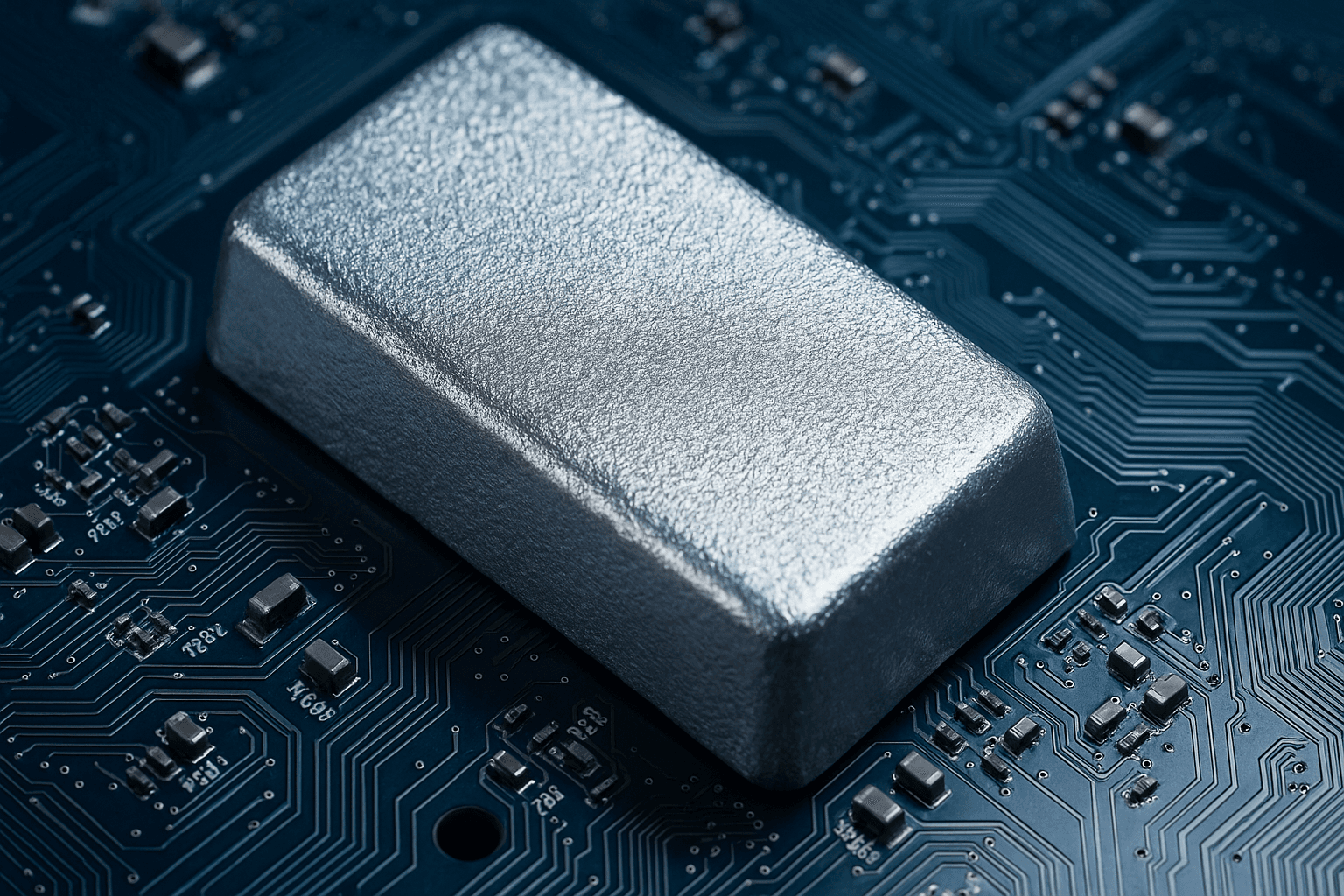
Silver’s shine in 2025 isn’t coming from jewelry counters — it’s coming from circuit boards and battery packs.
The metal’s price has climbed over 30 percent this year, breaching $44 per ounce, as manufacturers in AI, automotive, and renewable energy compete for limited supply.
Once prized purely as a store of value, silver has transformed into a strategic industrial metal. Its exceptional conductivity, durability, and chemical stability make it indispensable in the world’s most advanced technologies. But with global mines unable to ramp up production fast enough, the result is a perfect storm: high demand, low supply, and a market finally realizing silver’s new importance.
The Story
Silver’s Industrial Makeover
For most of human history, silver’s value was ornamental — coins, cutlery, and luxury. Today, over half of global silver demand comes from industry, not investment.
Its greatest strength lies in physics: silver is the best conductor of electricity of all metals. That means faster signal transmission, less energy loss, and greater efficiency — traits vital for electronics, data centers, and renewable systems.
Where Silver Works Hardest
-
GPUs and Semiconductors:
AI chips and high-performance processors use silver in wiring and interconnect layers to minimize resistance. As the GPU market expands with generative AI and data centers, each wafer consumes more silver than ever before. -
Electric Vehicles:
Every electric car contains up to 50 grams of silver, spread across connectors, switches, sensors, and battery control modules. As EV production accelerates globally, this adds thousands of tonnes to annual demand. -
Solar Panels:
Each photovoltaic (PV) cell uses silver paste to collect electrons from sunlight. Solar power already accounts for around 15% of total silver use, and installations are expected to rise another 20% this year. -
5G, Robotics, and Consumer Electronics:
The rollout of high-frequency networks and smart automation systems has expanded silver’s footprint in sensors, printed circuits, and flexible electronics.
Together, these uses have made silver the quiet backbone of the digital and green economy.
Why Prices Are Rising
1. Demand Growth Outpacing Supply
According to multiple industry trackers, global industrial silver demand hit a record 550 million ounces in 2024 and continues climbing in 2025. Most of it comes from renewable energy and electronics manufacturing.
But silver supply hasn’t kept pace — because 70% of silver is mined as a byproduct of other metals like copper and zinc. That makes it difficult for producers to expand output even when prices surge.
2. Global Supply Deficit
Analysts estimate a silver deficit of nearly 200 million ounces this year — one of the largest in modern history. Inventories in London and Shanghai exchanges are shrinking, while recycling contributes only a limited buffer.
3. Investment and Geopolitical Factors
With inflation concerns and currency volatility, investors are rediscovering silver as the “affordable gold” — a hedge with industrial muscle. ETF inflows have doubled since April 2025, amplifying the rally.
4. Green Energy and AI Boom
Unlike speculative metals, silver’s strength lies in structural change. The electrification of transport, expansion of renewable power, and AI hardware revolution are all long-term demand drivers. Every EV factory or data center built today locks in years of future silver use.
Background / Context
Historical Perspective
In the early 2000s, jewelry and photography dominated silver demand. The transition began when solar power scaled up in the 2010s and electronics miniaturized in the 2020s.
By 2025, technology alone accounted for more than half of all silver consumed worldwide. The market is shifting from decorative to strategic.
The Science Behind the Shine
Silver conducts electricity about 6% better than copper and withstands oxidation better than aluminum. These microscopic advantages make massive differences in energy-intensive devices — reducing heat, extending lifespan, and improving performance.
In GPUs or EV inverters where nanoseconds and millivolts matter, nothing replaces silver efficiently. That makes it a “non-substitutable” input for premium electronics.
Implications
1. Price Volatility and Tech Costs
As prices rise, manufacturers feel the squeeze. GPU producers, solar firms, and EV suppliers are exploring ways to “thrift” silver content — using less per unit. But efficiency has limits; remove too much silver and performance drops.
2. Strategic Resource Risk
If supply constraints persist, silver could join lithium and cobalt as a critical mineral for energy transition. Policymakers are already debating whether to stockpile it for future industrial stability.
3. Push for Recycling and Substitutes
Recycling from electronics and old solar panels is improving, but high purity requirements limit yields. Researchers are testing copper-silver hybrids and conductive polymers, yet no real substitute matches silver’s conductivity so far.
4. Emerging Market Opportunities
For silver-producing countries — Mexico, China, Peru, and India — this surge may reshape export strategies. India, for example, has seen a silver shortage this festive season due to industrial imports and investment demand colliding.
The Future Outlook
The convergence of technology and sustainability means silver’s industrial phase is just beginning.
-
AI and data infrastructure will require faster, more efficient circuits.
-
EV adoption will multiply automotive silver consumption.
-
Solar and hydrogen technologies will sustain baseline demand for decades.
At the same time, the low elasticity of supply — few new mines, slow permitting, byproduct constraints — ensures the market stays tight. Analysts from major banks now predict silver could reach $60–65 per ounce within a year if current trends persist.
Even if prices cool temporarily, the underlying drivers remain structural, not speculative. The world’s hunger for clean energy and computation virtually guarantees silver’s central role in the global economy.
Conclusion
Silver has moved from the vault to the factory floor. It’s the metal that connects electrons, data, and sunlight, quietly binding together the technologies shaping the 21st century.
The price surge of 2025 isn’t just a financial story — it’s a reflection of how deeply our world depends on materials that conduct not just electricity, but progress itself.
For investors, engineers, and policymakers alike, silver’s rise is a signal: the future of value is measured not in ounces of gold, but in the atoms that make technology work.