

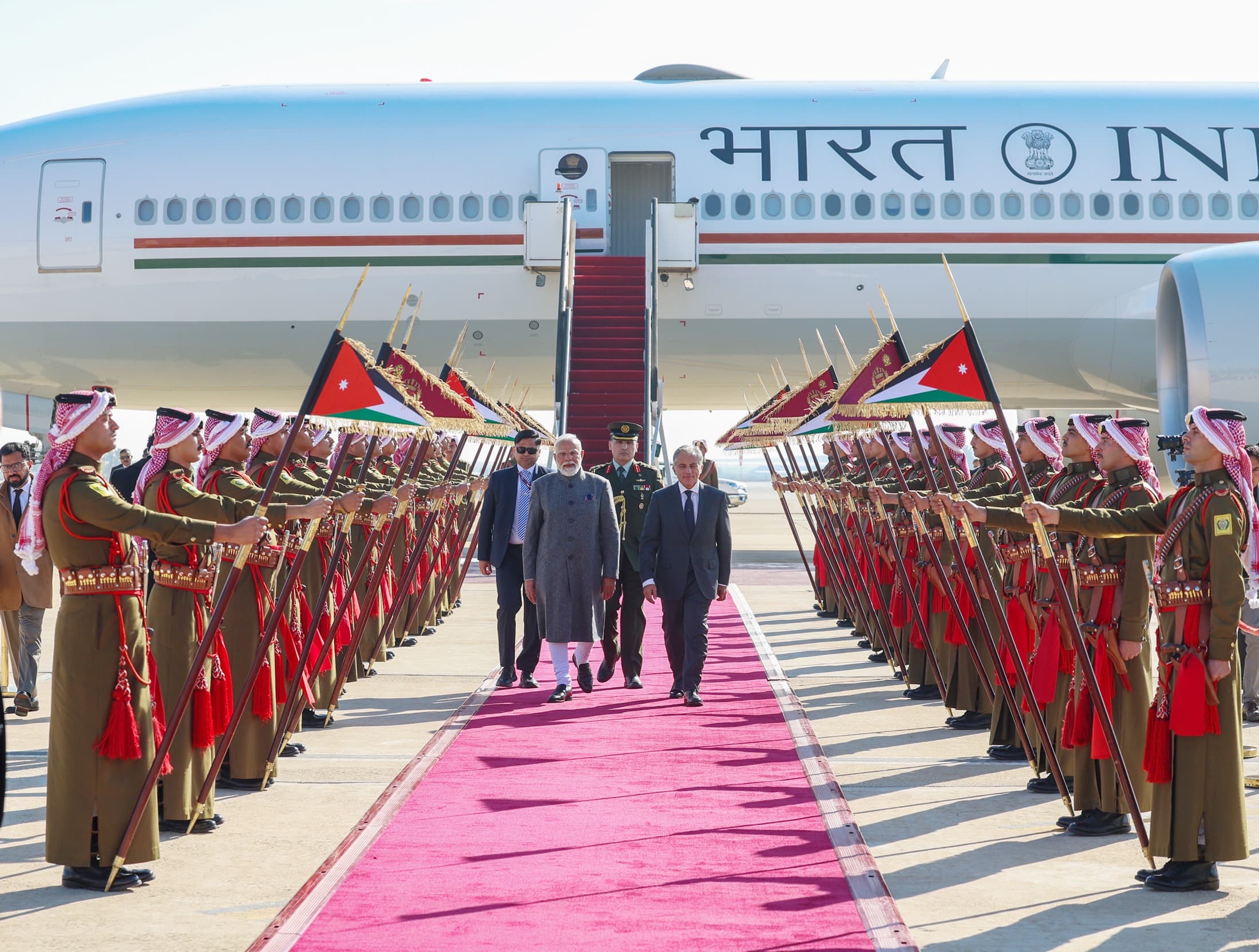
India’s West Asia diplomacy is increasingly being conducted in parallel tracks—security with key partners, economic engagement through infrastructure and trade, and political messaging that seeks “durable peace” without becoming captive to any one camp. With the Prime Minister in Amman and the External Affairs Minister in Tel Aviv on the same day, New Delhi used high-visibility platforms to underline that it wants to be a constructive stakeholder in the region’s next phase—whether that is post-war reconstruction, a negotiated settlement in Gaza, or counter-terror cooperation.
What’s in the news
India on Tuesday reiterated its willingness to play an active role in West Asia’s evolving scenario through:
-
a proposal for India–Jordan collaboration in Syria’s reconstruction, voiced by Prime Minister Narendra Modi in Amman, and
-
a statement of support by External Affairs Minister S. Jaishankar in Tel Aviv for the U.S. “peace plan” for Gaza, coupled with a renewed emphasis on zero tolerance towards terrorism.
Key developments
Jordan leg: reconstruction and infrastructure partnership
At the India–Jordan Business Forum, the Prime Minister referred to Jordan’s interest in developing railways and next-generation infrastructure, and highlighted that Indian and Jordanian companies could collaborate on reconstruction needs in Syria, as discussed with King Abdullah II.
The Prime Minister also noted shared resolve with Jordan to fight terrorism, extremism and radicalisation, while reaffirming India’s support for efforts aimed at durable peace in the region.
Israel leg: peace-plan endorsement and counter-terror messaging
In Tel Aviv, the External Affairs Minister:
-
condemned the Bondi Beach attack in Sydney, and framed India and Israel as partners with a zero-tolerance policy towards terrorism; and
-
stated that India supports the U.S. Gaza peace plan and hopes it leads to a lasting and durable solution.
The visit has drawn attention given developments in Israel’s domestic legal steps affecting the UN Relief and Works Agency (UNRWA)—an organisation that India has historically supported through assistance.
Background and context
West Asia is simultaneously facing:
-
active and post-active conflict theatres,
-
uncertain ceasefire dynamics,
-
sharp political contestation around humanitarian architecture, and
-
a renewed focus on infrastructure-led connectivity and reconstruction.
In such an environment, India’s strategic interests cluster around:
-
energy security and stable shipping lanes,
-
diaspora safety and remittance corridors,
-
counter-terror cooperation,
-
trade and investment expansion, and
-
preserving diplomatic space with multiple regional actors.
Why it matters
A bid to be useful, not just present
By bringing Syria’s reconstruction into a business forum setting, India is signalling that its engagement is not limited to statements. Reconstruction diplomacy creates a pathway for:
-
Indian companies and project expertise,
-
development partnerships with trusted regional anchors like Jordan,
-
and soft power credibility when humanitarian and infrastructure needs converge.
A careful positioning on Gaza
Publicly supporting a “peace plan” is a diplomatic signal, but the language used—hope for a durable solution—also leaves room for evolving negotiations. It reflects an attempt to align with a major international initiative while remaining cautious in a highly polarised theatre.
The UNRWA question complicates the optics
Any policy move that touches UNRWA becomes politically charged because it sits at the intersection of:
-
humanitarian delivery,
-
refugee protection architecture,
-
and competing narratives about legitimacy and security.
For India, which has historically supported Palestinian humanitarian needs while maintaining strong ties with Israel, this is a sensitive arena where balance is not optional.
Competing pulls in India’s West Asia approach
Security alignment vs humanitarian expectations
Counter-terror cooperation with Israel and regional partners is a consistent pillar. But the Gaza discourse is also shaped by humanitarian expectations and public diplomacy, especially in a region where perceptions travel faster than policy nuance.
Reconstruction opportunities vs conflict volatility
Reconstruction proposals can open economic doors, but in conflict-adjacent zones, projects face:
-
funding uncertainty,
-
security risk,
-
and political contestation over who leads rebuilding and on what terms.
Multiple relationships, one narrative
India’s challenge is to keep a single coherent narrative—peace, stability, connectivity, development—while operating across partners who often disagree fundamentally with each other.
What to watch next
The substance behind reconstruction talk
Whether India–Jordan engagement produces workable frameworks for participation in Syria-related reconstruction requirements, including the role of private sector players and project feasibility.
How India navigates humanitarian architecture debates
How New Delhi positions itself as Israel’s policy choices regarding UNRWA attract wider international scrutiny, while India maintains its long-standing humanitarian commitments.
Whether parallel visits translate into diplomatic leverage
The real test is whether India’s “in both rooms” posture helps it contribute to de-escalation, economic stabilisation, and protection of civilians—without diluting its strategic partnerships.
Source credits
The Hindu report; statements attributed to the Prime Minister’s remarks at the India–Jordan Business Forum; Ministry of External Affairs remarks as reported; External Affairs Minister’s statements in Tel Aviv as reported.