

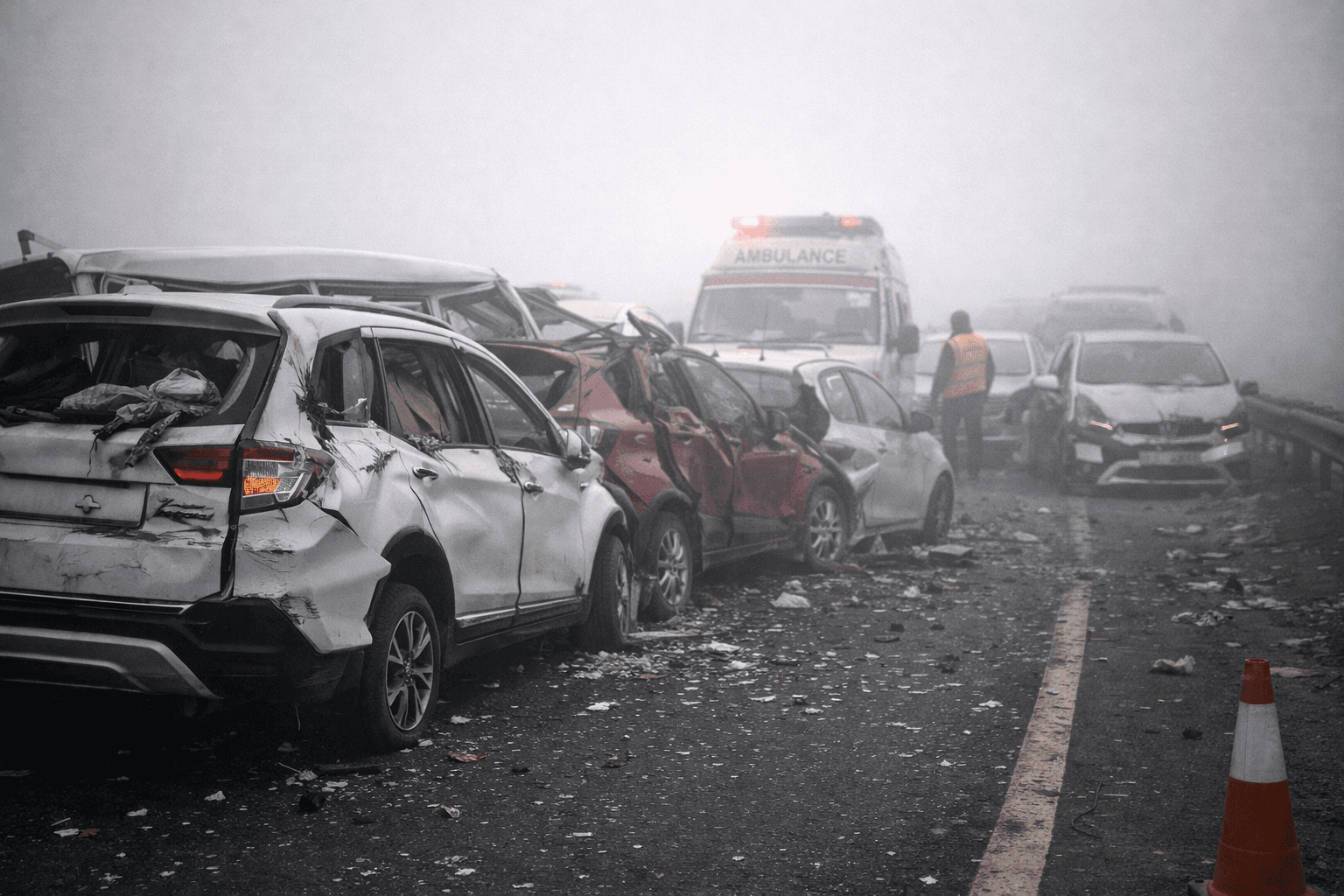
In the early hours of Tuesday, the Yamuna Expressway—built for speed and smooth travel—became a corridor of chaos. A pile-up involving multiple buses and smaller vehicles near Mathura killed at least 13 people and injured 60. The most haunting detail was not only the collision, but what followed: vehicles caught fire within minutes, and preliminary accounts suggest many of the deaths occurred due to burns. The incident underlines a recurring winter pattern across north India: dense fog collapses visibility, drivers fail to recalibrate speed and distance, and expressways—designed to reduce friction—suddenly magnify risk when one error triggers a chain reaction.
What’s in the news
-
At least 13 people died and 60 were injured in a major pile-up on the Agra–Lucknow Yamuna Expressway in Mathura district.
-
Eight buses and three smaller vehicles were involved.
-
Dense fog and poor visibility were cited as immediate triggers; preliminary assessment also points to high speed as a contributing factor.
-
A magisterial inquiry has been ordered and a four-member committee is to submit a report within 48 hours.
-
Compensation was announced by the Prime Minister and the Uttar Pradesh Chief Minister for the deceased and injured.
What likely caused the scale of fatalities
Fog is the trigger, speed is the multiplier
Fog reduces the “time to react” to near-zero. But the real danger comes when drivers maintain expressway speeds while visibility collapses. In such conditions, braking distance expands, the following gap shrinks, and one impact becomes a domino crash.
Fire turns a crash into a mass-casualty event
Eyewitnesses reported hearing a blast, and officials said an AC duct caught fire after collision. When large vehicles collide, fires can spread rapidly due to combustible interiors, plastics, and fuel-related risks. Even when tanks remain intact, heat and electrical faults can ignite material fast enough to trap passengers.
“Annual pile-ups” point to a systemic, not seasonal, gap
When a pattern repeats every winter, it stops being an “unpredictable weather event” and starts looking like an engineering-and-enforcement problem: how the corridor is managed during low visibility, how drivers are warned, and how quickly the system forces behaviour change.
The hidden fault line: fog-season safety architecture
Visibility management is not only about headlights
Headlights help, but fog scatters light and creates glare, often worsening depth perception. This is why expressways in dense-fog zones increasingly need layered controls:
-
variable speed limits based on visibility
-
automated fog sensors and warning boards
-
reflective lane markers and cat’s eyes that remain readable in haze
-
controlled entry or temporary halts when visibility falls below threshold
Lighting debate misses the bigger question
Survivors flagged lack of lighting, while police pointed out that headlights are standard for navigation. Both views can be true: lighting alone does not prevent pile-ups, but poor illumination can worsen orientation at critical seconds—especially when fog, glare, and high-speed traffic interact.
Enforcement must shift from “after the crash” to “before the crash”
In fog, enforcement cannot be only about post-incident FIRs. It must be proactive:
-
speed control through camera enforcement and patrol intensification
-
hard messaging that forces a behavioural reset
-
penalties that deter “visibility-blind speeding”
Rescue response: what worked, what this reveals
A six-hour rescue operation involving police from multiple stations, fire services and SDRF highlights two realities:
-
Strength: multi-agency mobilisation happened at scale.
-
Concern: if vehicles were “gutted within minutes”, then survivability depends heavily on prevention, not response.
Locals being first responders again shows the most consistent truth of Indian disasters: community reflex often arrives before formal systems.
Why this matters beyond Mathura
A wider fog-crash wave is unfolding
The report notes multiple major accidents across Uttar Pradesh over recent days, with nearly 100 vehicles involved in fog-related incidents. This indicates a statewide risk window where traffic volume, winter haze and speed converge.
Expressways are high-benefit, high-stakes infrastructure
Access-controlled roads reduce random conflicts, but when they fail, they fail at high energy. That is why expressway safety must be treated like aviation safety: the design must assume human error will occur, and build layers that prevent one error from escalating.
What should be examined in the 48-hour committee report
Immediate operational questions
-
What was the visibility level, and were fog warnings issued in real time?
-
Was any speed restriction enforced or displayed?
-
Were emergency response points (ambulance/fire) positioned for fog season?
Engineering and design questions
-
adequacy of reflective signage and lane marking
-
presence and functioning of crash barriers
-
spacing and preparedness of rescue access points
Accountability and compliance questions
-
whether speed monitoring systems recorded overspeeding
-
whether drivers adhered to safe following distance norms
-
whether any bus operator violated fatigue or maintenance standards
Source credits
The Hindu report from Ghaziabad bureau; statements attributed to district and police officials; government announcements on compensation and inquiry.