

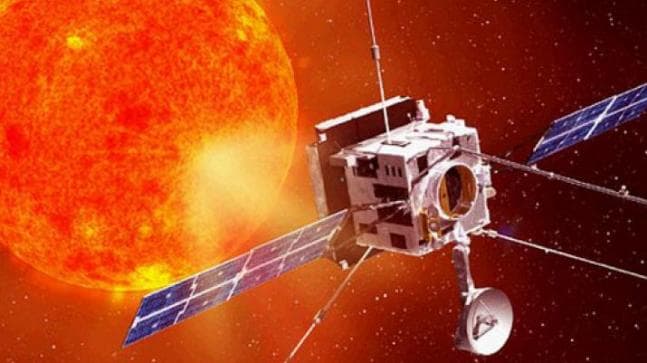
India’s first dedicated solar observatory, Aditya-L1, has delivered its first big global science headline. By teaming up with six U.S. satellites, the mission has helped explain why the May 2024 solar storm, also known as Gannon’s storm, behaved in such an unusually intense manner. What initially looked like a “normal” coronal mass ejection turned into a far more disruptive solar storm once two CMEs collided in space, triggering an enormous internal magnetic breakdown and rejoining. For India, this is not just a scientific milestone; it marks a confident entry into the front rank of space-weather research, an area with direct implications for national security, telecom, GPS, aviation and the power sector.
The Story
What is a solar storm and a CME?
A solar storm is a disturbance in space caused by explosive activity on the Sun. The main driver is a coronal mass ejection (CME) — a giant bubble of hot plasma and magnetic energy hurled into space from the Sun’s corona.
When a CME reaches Earth, it can:
-
Disturb our magnetosphere (the planet’s magnetic shield),
-
Disrupt satellites and communication systems,
-
Affect GPS navigation,
-
And in extreme cases, damage power grids and transformers.
What was unusual about the May 2024 “Gannon’s storm”?
According to ISRO, Gannon’s storm was not just one CME travelling from the Sun to Earth. Instead:
-
Two CMEs collided in space,
-
They compressed and squeezed each other tightly,
-
Inside one CME, the internal magnetic field lines snapped and rejoined in new configurations.
This process, known as magnetic reconnection, is like twisted magnetic ropes breaking and retying themselves, releasing energy and changing the orientation of the field.
Normally, a CME carries a stable, twisted “magnetic rope” that interacts with Earth’s magnetic field in a predictable way. In this case, the violent internal reconnection reoriented the magnetic field inside the CME in a way that increased its coupling with Earth’s magnetosphere, making the storm’s impact stronger than models expected.
Aditya-L1’s role and the global collaboration
The heart of the discovery is the multi-mission cooperation between:
-
Aditya-L1 (India’s first solar observatory), and
-
Six U.S. missions: Wind, ACE, THEMIS-C, STEREO-A, MMS, and the NASA–NOAA DSCOVR satellite.
Aditya-L1 contributed high-precision magnetic field measurements that allowed scientists to:
-
Map the reconnection region inside the CME,
-
Show that the area of tearing and rejoining was about 1.3 million km across – nearly 100 times the size of Earth,
-
Demonstrate, for the first time, such a giant magnetic breakup and rejoining inside a CME.
This is a major observational breakthrough: until now, magnetic reconnection was widely studied in Earth’s magnetosphere and in the solar corona, but not directly mapped at this scale inside a travelling CME.
Why this matters for India and the world
1. Better understanding of space weather
Solar storms are not just pretty auroras; they are a strategic risk:
-
Satellites (communication, weather, navigation) can suffer damage or failure,
-
Aviation routes at high latitudes can face radio blackouts,
-
Power grids can experience geomagnetically induced currents, risking large-scale outages.
By understanding how CMEs can collide and undergo internal reconnection, scientists can:
-
Improve forecast models of storm intensity,
-
Refine warning systems for satellite operators and grid managers,
-
Better predict which storms will remain mild and which can become disruptive.
2. Aditya-L1 as a strategic asset
For India, Aditya-L1:
-
Demonstrates indigenous capability in advanced heliophysics,
-
Strengthens India’s role in global scientific collaborations,
-
Directly supports ISRO, Defence, telecom and power utilities through improved space-weather inputs.
This is important as India expands its own satellite constellations, regional navigation systems and deep-space missions.
3. Science, soft power and leadership
Participating in a frontline discovery about the Sun’s behaviour — together with leading U.S. missions — enhances India’s science diplomacy and soft power. It signals that India is not just a launch-service provider but a knowledge producer in high-end space science.
Broader implications for UPSC and public policy
-
Science & Tech: Aditya-L1 becomes a key case-study under space missions, indigenous technology, and India’s contribution to global science.
-
Disaster Management: Space weather now fits into broader risk management frameworks alongside cyclones, earthquakes and cyber threats.
-
International Relations: The mission exemplifies India–U.S. cooperation in space, complementing commercial and strategic partnerships.
Conclusion
Gannon’s storm in May 2024 looked, at first, like just another solar event. Aditya-L1 has now shown that it was anything but routine. By helping uncover a massive episode of magnetic reconnection inside colliding CMEs, India’s first solar observatory has deepened global understanding of how solar storms evolve — and how they can suddenly become more dangerous than expected.
In doing so, Aditya-L1 has firmly placed India in the global front line of space-weather science, at a time when our dependence on vulnerable space-based infrastructure has never been higher.