

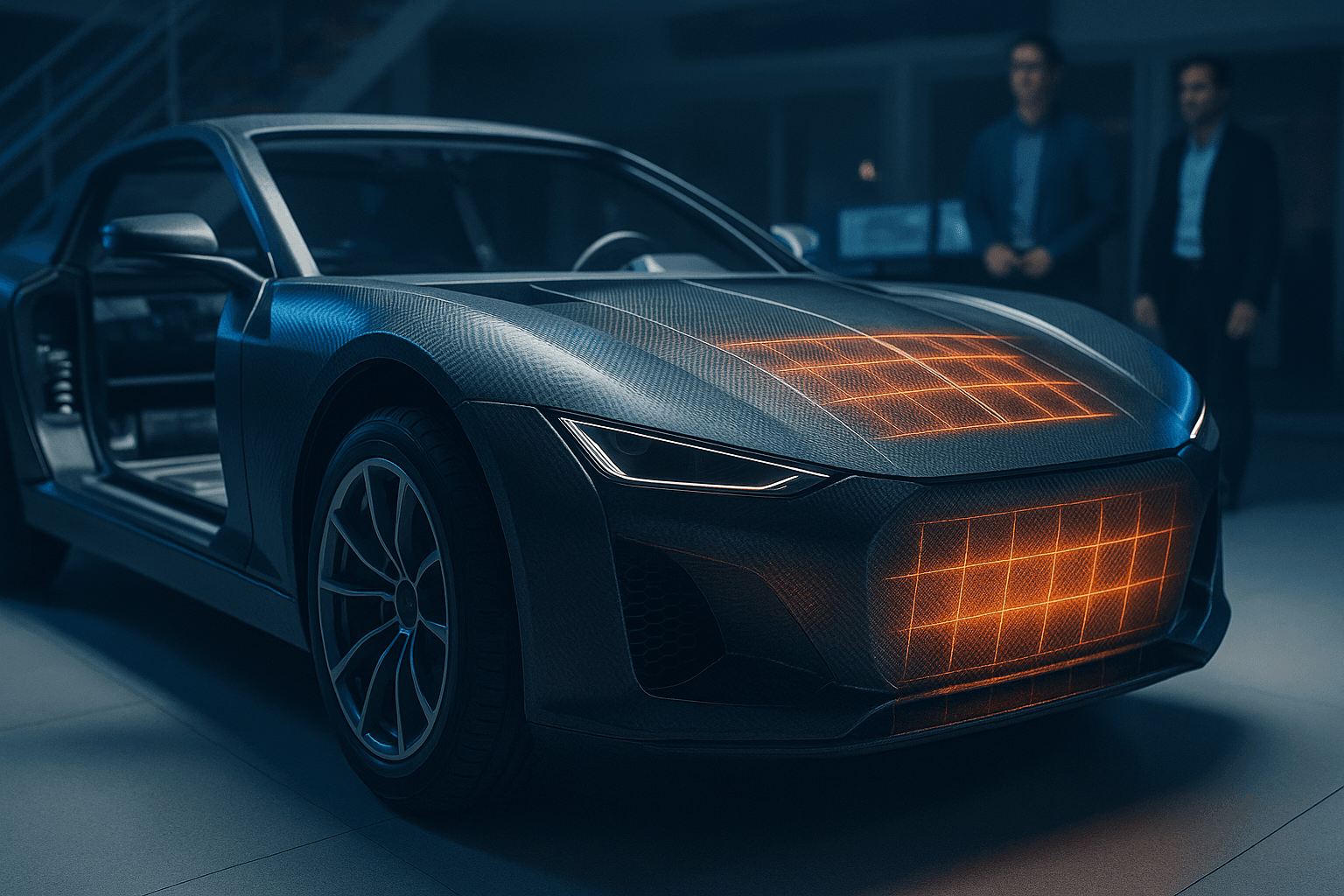
THE NEXT REVOLUTION IN ELECTRIC VEHICLES MAY COME NOT FROM NEW BATTERIES — BUT FROM THE BODY OF THE CAR ITSELF.
In a gleaming lab at Chalmers University of Technology, engineers lift a panel that looks ordinary — matte grey, carbon-fiber smooth. Yet it hums faintly with stored power. If connected to a circuit, it could light an LED strip for hours. That panel isn’t just structure; it’s storage. Welcome to the world of structural battery composites, where the wall, wing, or car chassis itself doubles as a battery. It’s a dream that could shrink electric vehicles, stretch flight time for drones, and rewrite the rulebook of energy design.
The Story
For decades, engineers have faced the same paradox: to move faster or longer, you need bigger batteries — which make you heavier, slower, and less efficient. Structural batteries solve that by fusing two traditionally separate roles: mechanical support and electrical storage.
Instead of a heavy battery pack bolted to a frame, the frame becomes the battery.
Think of it as a carbon-fiber sandwich filled with a solid electrolyte. Its fibers act as both the structural skeleton and the anode, while thin cathode layers and polymer electrolytes handle ion transport.
“We call them massless batteries,” says Leif Asp, a materials scientist behind some of the leading research. “They turn dead weight into active energy.”
Chalmers University’s latest prototype combines carbon-fiber composites with lithium-iron-phosphate chemistry, achieving energy densities around 30–40 Wh/kg and stiffness comparable to aluminum. That’s still below commercial lithium-ion cells, but when you consider that the weight of casing, housing, and battery mounts disappears, the overall system efficiency rivals today’s best EVs.
In practical terms, a car built from structural batteries could weigh 20–30 percent less, translating into more range, better acceleration, and safer balance.
Why It Matters
1. More Range Without Bigger Batteries
In an EV, every kilogram counts. A lighter structure means less energy spent moving the battery itself. Structural batteries distribute storage throughout the body, reducing both drag and mass.
2. Design Freedom
By eliminating bulky modules, designers can reimagine form. Imagine drone wings that store flight energy, or electric bikes with invisible batteries inside their frames.
3. Sustainability
Fewer components mean fewer raw materials, simpler recycling, and less e-waste. And solid electrolytes dramatically reduce fire risk.
4. Cross-Sector Impact
Aerospace and defense industries are exploring structural batteries for satellites, prosthetics, and exoskeletons — where every gram saved counts.
Sidebar – Quick Facts
Background / Context
The concept isn’t new — NASA and Boeing flirted with “multifunctional structures” in the 2000s — but materials science wasn’t ready. Today, with solid electrolytes and advanced composites, that’s changing fast.
In 2021, Chalmers scientists unveiled the first working sample that could both power LEDs and withstand load. By 2023, Volvo and the European Space Agency had partnered to adapt similar composites for EV chassis and nanosatellites.
Now, automotive start-ups in Germany and Japan are prototyping modular body panels that store power while serving as crash structures. It’s no longer science fiction; it’s engineering in slow motion.
"“It’s like turning every piece of your vehicle into a power bank,” says Asp. “You can’t tell where the battery ends and the machine begins.”"
Implications
⚙️ A New Manufacturing Ecosystem
To make structural batteries mainstream, automakers must reinvent assembly lines. Painting, bonding, and crash-testing carbon composites that also carry voltage is no trivial task.
🔋 Energy Density Race
Researchers are now chasing 100 Wh/kg targets. Hybrid systems — combining small high-energy packs with load-bearing composites — could bridge the gap for early EVs.
🌍 Environmental Payoff
If structural batteries replace metal frames and heavy housings, total lifecycle emissions per vehicle could drop by up to 20 percent. Less metal, fewer joints, lower transport emissions — every small cut matters.
🛰️ Beyond Cars
Lightweight satellites with energy-storing shells, aircraft wings doubling as batteries, even buildings that store their own solar energy — possibilities multiply once you remove the wall between power and structure.
Challenges Ahead
-
Lower Energy Density – They still can’t match lithium-ion packs.
-
Complex Repairability – Damage to a “battery panel” could disable both structure and power.
-
Manufacturing Cost – Carbon fiber and solid electrolytes remain expensive.
-
Recycling Difficulty – Separating structural layers for reuse is technically hard.
Despite these, the momentum is unmistakable. The world’s biggest carmakers are now funding research to shrink the gap between lab prototypes and production-grade panels.
"“The day your car’s roof charges itself, we’ll realize batteries were never supposed to be boxes.” — Editorial comment from The UPSC Times Tech Desk"
Conclusion
Structural battery composites represent a quiet revolution — not an incremental tweak, but a conceptual leap. They transform what we thought batteries were: from passive boxes to living parts of machines.
If the current pace of development continues, the vehicles of 2030 won’t carry their batteries — they’ll wear them. Every panel, every beam, every surface will hum with stored power, erasing the line between energy and engineering once and for all.