

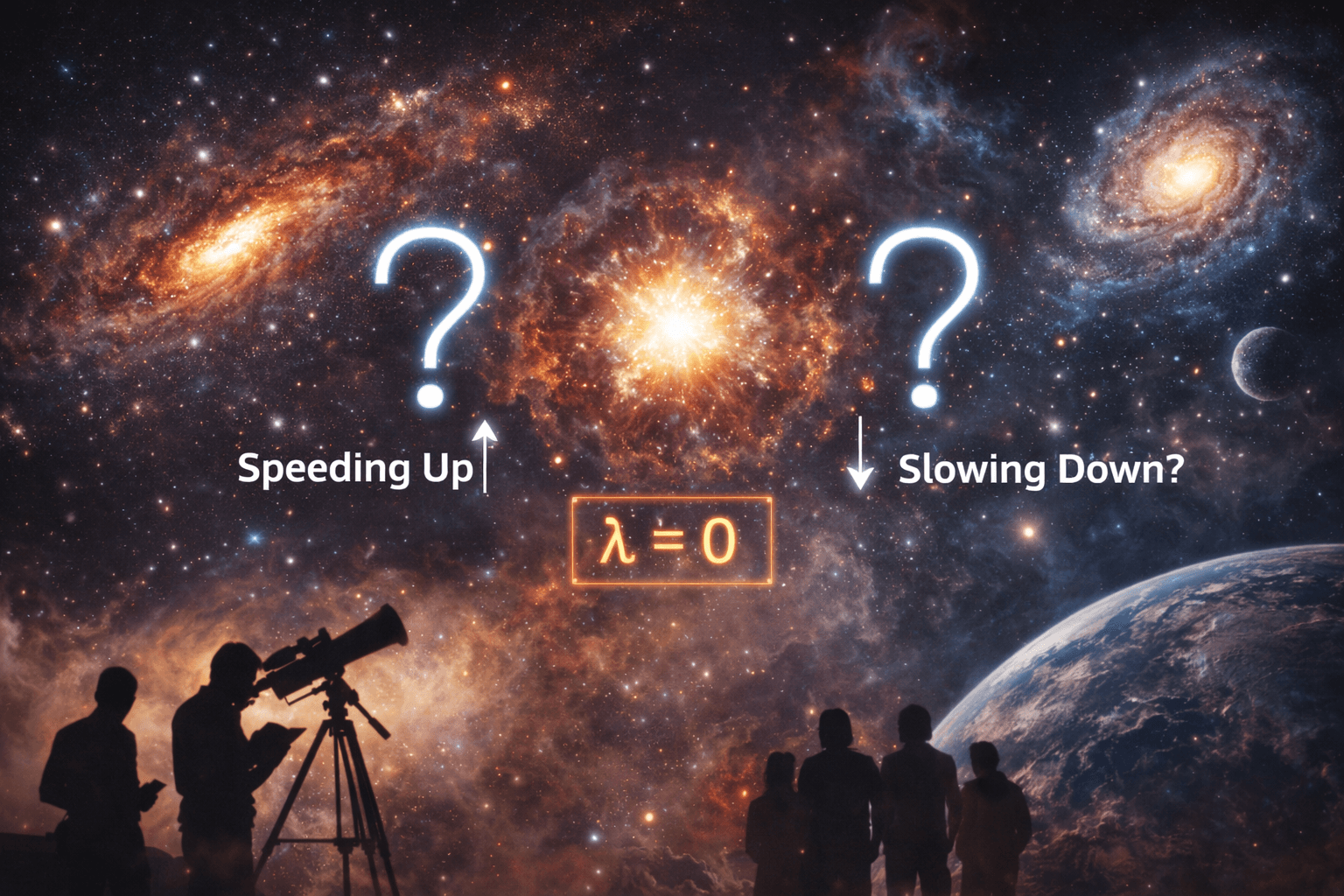
Cosmology’s great drama is that the universe refuses to behave. In the late 1990s, it surprised scientists by accelerating—expanding faster over time, not slower, as gravity alone would suggest. That discovery did not merely add a new parameter; it changed the story of the cosmos and seeded the modern idea of “dark energy”. Now comes a fresh provocation: what if the acceleration is not a permanent feature of reality, but a phase—already beginning to soften?
What’s in the news
A study led by researchers at Yonsei University, published in early November in a leading astronomy journal, argues that the universe’s expansion may have entered a decelerated phase at the present epoch. In this reading, dark energy is weakening rather than acting like a constant “cosmological constant”. The claim has triggered an intense pushback from prominent cosmologists, who argue that modern supernova analyses already account for host-galaxy systematics and do not show the level of evolution the new model needs. The debate is now moving toward verification through larger, cleaner datasets and next-generation surveys.
Background and context
To understand why this matters, it helps to recall what the current “standard model” of cosmology actually says.
The prevailing framework is Lambda–Cold Dark Matter (ΛCDM). It blends two invisible components: cold dark matter, which helps explain how structure (galaxies, clusters) forms, and Lambda (Λ), Einstein’s cosmological constant, which behaves like a constant energy density of space itself. In ΛCDM, dark energy does not dilute as the universe expands; it stays roughly constant, so its influence becomes more dominant over time, pushing cosmic expansion to accelerate.
This model fits an extraordinary range of observations: the cosmic microwave background, the large-scale structure of galaxies, and the expansion history inferred from distance measurements. But it is not a theory of “what dark energy is”. It is an extremely successful accounting framework—one that assumes dark energy’s behaviour is constant.
The Yonsei claim strikes at that assumption. If dark energy evolves rapidly with time, then Λ is no longer the right description. The universe might still be expanding, but not accelerating in the same way—or perhaps not accelerating at all in the current epoch.
Key provisions / key details
The dispute is not philosophical; it is technical and data-driven, centred on how we measure cosmic expansion.
The 1998–2011 “acceleration” backbone
The original evidence for acceleration came from Type Ia supernovae, which can be used as “standard candles” because their intrinsic brightness is predictable after calibration. By comparing how bright they appear (distance) with how much their light is redshifted (expansion), researchers inferred that the universe’s expansion began accelerating several billion years after the Big Bang. That work was later honoured with the 2011 Nobel Prize.
The Yonsei twist: are the candles changing?
The new argument leans on the idea that Type Ia supernova brightness may subtly depend on the age or properties of the stellar population that produced them. If supernovae are systematically fainter or brighter at different epochs for astrophysical reasons—rather than purely because of distance—then the distance ladder can be biased, and the inferred acceleration could be overestimated or even misread.
This is where the fight gets sharp. Critics note that contemporary analyses already “marginalise” over host-related effects such as stellar mass and star-formation history, precisely to guard against these biases. They argue that the Yonsei result depends on specific ways of slicing the data and assumptions that do not align with standard supernova cosmology practice.
The wider context: hints from galaxy surveys
The debate also intersects with large-scale surveys that measure expansion through baryon acoustic oscillations (BAO)—a kind of cosmic ruler imprinted in the distribution of galaxies. Recent results from major spectroscopic surveys, including DESI, have fuelled discussion that the best-fit dark energy behaviour might deviate slightly from a constant Λ when combined with other datasets. Importantly, this is not yet a clean overthrow of ΛCDM; it is a growing hint that motivates more precision, more cross-checks, and more caution.
In short, there are two live possibilities:
-
the Yonsei claim is a statistical mirage or a modelling artefact of supernova evolution; or
-
dark energy is genuinely dynamical, meaning ΛCDM survives as an approximation, but not as the final word.
Why it matters
If dark energy is evolving, the implications cascade.
First, it changes our forecast of the universe’s fate. A constant Λ points to endless acceleration and a future of growing cosmic emptiness. A weakening dark energy opens other futures, including slower expansion and, in extreme scenarios, a turnaround. Even if “Big Crunch” language is premature, the key point is that the long-run trajectory becomes an empirical question again, not a settled script.
Second, it would reshape the physics agenda. A cosmological constant is a simple placeholder. A time-varying dark energy invites deeper models—fields that evolve (often discussed under “quintessence”), new interactions, or even modified gravity in some proposals. These are not minor tweaks; they change what fundamental physics must explain.
Third, the debate is a masterclass in how science corrects itself. The 1998 discovery is not being “cancelled”. It is being stress-tested with better instruments and more sophisticated systematics. That is how mature disciplines progress: not by declaring revolutions daily, but by tightening the chain from observation to inference.
Arguments for and against
Supporters of the “dark energy may be evolving” view point to two broad considerations: the growing precision of galaxy surveys and the possibility that supernovae are not perfectly uniform across cosmic time. In this camp, even a small, consistent deviation from Λ across multiple probes is a legitimate signal that the model needs refinement.
Sceptics counter with an equally strong argument: extraordinary claims require extraordinary robustness. Supernova cosmology has spent two decades building defences against exactly these systematics—host galaxy correlations, selection biases, calibration uncertainties. From this perspective, the new result is intriguing but not definitive, especially if it relies on assumptions that the largest modern analyses do not support.
A sensible middle position is emerging: the evidence is strong enough to keep theorists and observers busy, but not strong enough to rewrite textbooks today.
Constitutional / legal angle
This is not a constitutional dispute, but it does touch a governance question India increasingly faces: how a country funds and evaluates frontier science.
Large cosmology advances come from long-horizon investments—telescopes, data pipelines, high-performance computing, and open collaboration norms. The legal-and-institutional angle here is about scientific integrity: transparent methods, reproducible analysis, and stable funding mechanisms that do not chase headlines but build capability. If India wants a meaningful role in the next era of cosmology, the enabling ecosystem matters as much as individual brilliance.
Implications
In the near term, expect more “model tension” headlines as different probes—supernovae, BAO, lensing, and background radiation—are combined in new ways. Some combinations will appear to favour evolving dark energy; others will lean back toward Λ. The tug-of-war will continue because systematics, not just statistics, are now the battlefield.
In the medium term, the centre of gravity will shift to datasets with scale and uniformity: millions of galaxies mapped consistently, and thousands of well-characterised supernovae observed with modern calibration.
In the long term, the outcome may be a modest but profound shift: ΛCDM remains broadly right, but with a more flexible dark energy sector—or a clearer statement that Λ is still the best description within measurement limits.
Way ahead
The decisive step is not rhetorical. It is observational.
Next-generation sky surveys are designed to do two things that today’s debate demands: massively increase sample sizes and reduce hidden biases through uniform measurement. The Vera C. Rubin Observatory, which has already begun revealing its sky-imaging power, is expected to transform supernova statistics and time-domain astronomy. NASA’s Nancy Grace Roman Space Telescope, planned for launch in the late-2026 to 2027 window, is built with dark energy measurements as a primary science pillar, with wide-field precision that can test evolution claims far more sharply than earlier datasets.
For India, the forward-looking opportunity is clear and practical: strengthen participation in global surveys, invest in domestic data-analysis capability, and build talent pipelines that combine astrophysics with statistics and computing. Whether dark energy is constant or changing, the next decade belongs to those who can measure the universe with discipline—and interpret it with humility.
Source credits
The Hindu; Notices of the Royal Astronomical Society; Royal Astronomical Society; Dark Energy Spectroscopic Instrument collaborations and scientific papers; Rubin Observatory releases; NASA Roman Space Telescope programme materials; commentary by leading cosmologists in public interviews and correspondence