

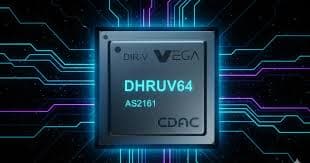
India’s processor story is finally beginning to look like a pipeline, not a one-off headline. With DHRUV64, the Ministry of Electronics and Information Technology has projected a clear intent: reduce dependence on imported processor designs and supply chains, and build a domestic foundation for electronics, telecom, and industrial control. Yet the difference between a meaningful national processor and a patriotic prototype is not the press note. It is the ecosystem: measurable performance, transparent fabrication, robust toolchains, developer hardware, security audits, and procurement anchors that give manufacturers confidence.
What’s in the news
MeitY has announced DHRUV64, an indigenous microprocessor developed by the Centre for Development of Advanced Computing (C-DAC) under the Microprocessor Development Programme. It is described as a general-purpose 64-bit dual-core processor with a 1 GHz clock, positioned for applications ranging from electronics and industrial automation to broader strategic use-cases. MeitY also frames DHRUV64 as part of a wider Indian processor ecosystem that includes SHAKTI (IIT-Madras), AJIT (IIT-Bombay), VIKRAM (ISRO-SCL), and THEJAS series (C-DAC). The launch is tied to India’s RISC-V direction and a broader effort to strengthen indigenous semiconductor and design capacity.
Background and context
Why processors are the real “strategic layer”
A microprocessor is not merely a component; it is the instruction-executing brain of modern systems. Whoever controls the processor architecture, microarchitecture choices, firmware update path, toolchain and debug stack also influences:
-
cyber security assumptions,
-
resilience against export controls and supply shocks,
-
long-term maintenance and patching,
-
and the ability to certify equipment for sensitive or regulated environments.
India is a massive processor market, but most designs and critical IP blocks used in Indian devices are sourced from global ecosystems. That dependence is not automatically “bad,” but it becomes a vulnerability when geopolitical restrictions tighten or when supply chains break at the worst possible moment.
Why RISC-V is central to India’s strategy
RISC-V is an open instruction set architecture: designers can build compatible processors without paying instruction-set licence fees and can extend features modularly. For governments and public R&D institutions, it offers a pragmatic advantage: a path to domestic designs without being locked into a single foreign ISA gatekeeper. That said, “open ISA” does not automatically mean “open everything.” The most valuable work still lies in microarchitecture, verification, physical design, security hardening, IP integration, and software enablement.
What DHRUV64 is, and what its specs really imply
DHRUV64 is described as a 64-bit, dual-core, 1 GHz general-purpose processor. These specs suggest a chip intended to do more than simple sensing or appliance logic. A 64-bit CPU is typically aimed at running modern operating systems and contemporary software stacks.
But the meaning of “1 GHz dual-core” depends on the rest of the system:
-
cache sizes and memory bandwidth,
-
the quality of the branch predictor and pipelines,
-
input/output and peripheral interfaces,
-
security primitives and trusted execution features,
-
and performance-per-watt for embedded and edge deployments.
In other words, the headline numbers tell you the category, not the readiness.
India’s processor ecosystem: where DHRUV64 sits
MeitY’s framing places DHRUV64 within a multi-institution ecosystem:
-
SHAKTI (IIT-Madras): RISC-V research-to-product pathway with multiple core variants.
-
AJIT (IIT-Bombay): Indian processor effort with academic and strategic relevance.
-
VIKRAM (ISRO-SCL): processors aligned to space and mission-grade needs.
-
THEJAS series (C-DAC): recent C-DAC designs positioned for industrial and strategic applications.
This diversity is a strength, but it also creates a coordination challenge: without shared tooling standards, software baselines, and reference platforms, India risks building islands of capability that do not converge into a scalable domestic market.
What MeitY has not revealed about DHRUV64
The announcement, as reported, is thin on engineering detail that an OEM or systems integrator would need before adopting the chip. Five gaps matter most.
1) No benchmarks, no performance context
Clock speed and core count are not performance. OEMs look for:
-
standard benchmark scores,
-
sustained throughput under load,
-
memory subsystem details,
-
and clear performance-per-watt.
Without this, “fast enough for OS” remains an assertion, not a spec.
2) Fabrication and packaging opacity
The biggest unanswered question is where and how DHRUV64 was fabricated, and what reliability and yield assumptions apply. For telecom, automotive and industrial electronics, manufacturers care about:
-
foundry and node maturity,
-
packaging type and thermal limits,
-
lifecycle availability,
-
failure rates and qualification standards.
If fabrication and packaging are unclear, buyers fear supply risk even if the design is good.
3) “Fully indigenous” is an elastic phrase
Indigenous can mean many different things:
-
indigenous ISA (not applicable here because RISC-V is global and open),
-
indigenous core microarchitecture,
-
indigenous SoC integration,
-
indigenous toolchain and verification stack,
-
indigenous ownership of critical IP blocks,
-
or indigenous manufacturing.
A credible “fully indigenous” claim needs clarity on which of these layers are domestically controlled.
4) OEM adoption questions are not answered
Manufacturers need to know:
-
availability of developer boards,
-
OS support (Linux distributions, RTOS options),
-
drivers and BSP maturity,
-
secure boot, key management, auditability,
-
debugging tools and documentation depth,
-
and whether government procurement will act as an anchor customer.
Without these, a chip struggles to move from lab success to bill-of-materials acceptance.
5) Roadmap is mentioned, not operationalised
MeitY has indicated next processors such as DHANUSH and DHANUSH+, with higher core counts and clocks. But a roadmap becomes real only when it includes:
-
tape-out and sampling milestones,
-
software compatibility commitments,
-
clear upgrade paths,
-
and long-term maintenance plans that customers can bank on.
Why it matters
1) This is about trust, not patriotism
Electronics manufacturers are not adopting chips to make a statement; they adopt chips to manage risk. A domestic processor becomes valuable when it offers a trust advantage: predictable supply, verifiable security, and credible long-term support.
2) National security increasingly begins at the silicon layer
Telecom infrastructure, industrial controllers, defence electronics and critical utilities all depend on processors. If India cannot validate its silicon roots of trust and toolchain integrity, it remains dependent not only on components, but also on update pathways and design assumptions made elsewhere.
3) It can shift India from assembly to architecture
India’s electronics manufacturing has grown, but the deepest value sits in IP, design, verification and systems integration. A successful domestic processor stack can help India climb the value chain and create a meaningful domestic design services and fabless ecosystem.
4) The biggest prize is an ecosystem flywheel
Processors succeed when a surrounding ecosystem forms:
-
toolchains,
-
compilers,
-
libraries,
-
board support packages,
-
documentation,
-
developer communities,
-
and third-party peripherals.
If DHRUV64 becomes a stable platform for startups and academia, it can catalyse a generation of embedded products and specialised systems built on an Indian base.
5) Industrial use-cases are where India can win first
India does not need to beat top-tier consumer CPUs to win. It can win first in:
-
routers and networking appliances,
-
industrial control modules,
-
secure devices,
-
telecom subsystems,
-
automotive submodules,
-
and government-grade computing where procurement can support domestic platforms.
Arguments for and against
The case for optimism
-
A visible pipeline signals institutional continuity, not a one-time experiment.
-
RISC-V lowers entry barriers and allows modular evolution of features.
-
Targeting embedded and industrial domains is realistic and economically meaningful.
-
India is simultaneously investing in design talent and semiconductor ecosystem capacity, which can support the processor stack.
The case for caution
-
Without fabrication transparency and supply assurance, OEMs will hesitate.
-
Software support is harder than silicon; weak BSPs and drivers can kill adoption.
-
Competing global vendors already provide mature ecosystems and proven reliability.
-
“Indigenous” claims without precise definitions can create credibility gaps among engineers and buyers.
Policy and strategic angle
DHRUV64 sits at the intersection of technology policy and industrial strategy:
-
Design capability is being pushed through programmes that build talent and lower barriers for chip design and prototyping.
-
Manufacturing ecosystem is being pursued through the India Semiconductor Mission and allied incentives to expand fabs, packaging, testing, and supply chains.
-
Adoption will depend on how government procurement and standards bodies create early “anchor deployments” in low-risk but high-volume areas.
In short, the state can fund design and court manufacturing, but it must also shape demand conditions where domestic chips can be evaluated fairly, adopted safely, and improved iteratively.
Schemes advancing indigenous fab and design capabilities
A few government initiatives are particularly relevant to making DHRUV64-like efforts sustainable:
-
Chips to Startup (C2S): capacity building for chip design manpower and a stronger fabless ecosystem, with a multi-year outlay and implementation across a large network of institutions.
-
Design Linked Incentive (DLI): incentives aimed at strengthening domestic chip design and productisation.
-
INUP-i2i: improving access to nanofabrication facilities and training, helping startups and researchers prototype and validate.
-
India Semiconductor Mission (ISM): an umbrella push that has approved multiple semiconductor projects across several States with large committed investment, covering fabs and packaging/testing capacity.
These initiatives matter because a processor is not only a chip; it is the visible tip of a much larger capability iceberg.
Implications
1) Expect a sharper debate on “where was it made?”
As India’s chip diplomacy grows, the credibility of “indigenous” will increasingly be judged by supply chain transparency, not only design ownership.
2) Software enablement will become the true battleground
If DHRUV64 can ship stable toolchains, boards, documentation, and security primitives, it will attract developers. If not, it risks being technically respected but commercially ignored.
3) Procurement policy will quietly decide success
If government and public-sector deployments adopt the chip in appropriate, staged ways, it can de-risk the platform and create confidence for private OEMs.
4) Ecosystem convergence will be necessary
India’s multiple processor efforts will need shared standards, reusable IP blocks, and interoperable software baselines to avoid fragmentation and duplicated effort.
5) The next milestone is not “faster clocks,” but “predictable availability”
Industrial buyers care about long lifecycle support, stable supply, and certification readiness more than peak GHz.
Way ahead
If India wants DHRUV64 to become a platform rather than a press release, a few moves will matter more than slogans:
-
Publish engineering-grade documentation: benchmarks, memory and I/O architecture, power profiles, and qualification targets.
-
Disclose fabrication and lifecycle plans: foundry node (where feasible), packaging, expected availability window, and reliability benchmarks relevant to industrial adoption.
-
Ship a developer-first ecosystem: boards, BSPs, compilers, CI-tested Linux support, reference designs, and predictable release cycles.
-
Make security auditable: secure boot chain, firmware update model, hardware security features, and third-party evaluation pathways.
-
Create anchor deployments: select controlled government and PSU deployments in telecom/industrial domains to validate at scale and iterate rapidly.
-
Align India’s processor efforts: ensure SHAKTI, AJIT, VIKRAM, THEJAS and DHRUV families can share tooling, libraries, and verification practices where possible.
Conclusion
DHRUV64 is a meaningful signal that India’s indigenous processor ambitions are maturing into a structured pipeline. But the decisive phase starts now: turning a chip into an ecosystem and turning an ecosystem into adoption. If MeitY and C-DAC can match the announcement with transparency on fabrication, measurable performance, strong software support, and credible anchor use-cases, DHRUV64 can become a practical building block in India’s technology sovereignty, not just a proud milestone.
Source credits : The Hindu; Press Information Bureau releases; MeitY programme notes; public domain briefings and reports on DIR-V and Indian processor initiatives.