

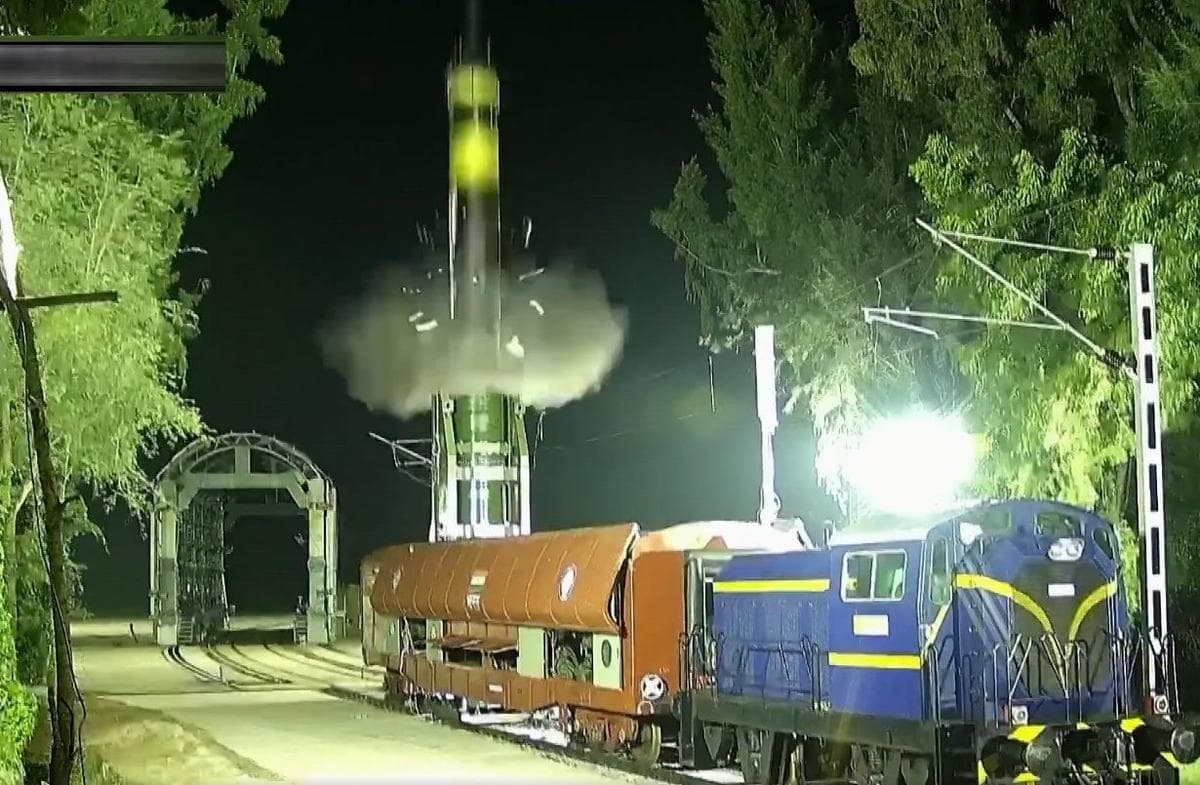
The Defence Research and Development Organisation (DRDO) and the Strategic Forces Command (SFC) on Thursday successfully test-fired the Agni-Prime missile from a specially designed rail-based launcher. The launch, conducted under full operational conditions, validated the system’s ability to provide rapid and concealed deployment across India’s railway network.
The Story
The Defence Ministry confirmed that all mission objectives were achieved, with the missile’s trajectory tracked by multiple ground stations. The Agni-Prime, also known as Agni-P, is India’s next-generation intermediate-range ballistic missile, capable of striking targets up to 2,000 km away.
Weighing less and equipped with advanced guidance, navigation, and control systems, the Agni-P is designed to replace older Agni variants. It can carry nuclear or conventional warheads and is road- and rail-mobile, making it difficult to detect and target.
This was the first test from a rail-based mobile launcher, developed to allow the missile to be transported and launched from India’s vast railway network. The design provides cross-country mobility, reduced visibility, and faster deployment times, strengthening survivability in conflict scenarios.
Why It Matters
-
Strategic mobility: Launching from rail platforms gives India greater flexibility and concealment compared to fixed launch sites.
-
Survivability: Rail mobility makes it harder for adversaries to track or neutralise missile assets.
-
Modernisation: Agni-P represents a lighter, more accurate replacement for older Agni-I and Agni-II missiles.
-
Deterrence: The test signals progress in India’s nuclear triad delivery capabilities, complementing road-mobile, air-launched, and submarine-launched systems.
Background / Context
-
Agni series: India’s family of nuclear-capable ballistic missiles, with ranges from 700 km (Agni-I) to over 5,000 km (Agni-V).
-
Agni-Prime: First tested in 2021, it is a two-stage solid-fuel missile with a range of 1,000–2,000 km. It uses composite materials and advanced avionics, making it lighter and more accurate.
-
Rail mobility: The concept has been used by other nuclear powers, such as the Soviet Union and China, to increase missile survivability. India’s adoption signals maturity in mobile missile operations.
Implications
-
Enhances India’s second-strike capability by making its missile arsenal more resilient.
-
Demonstrates DRDO’s progress in developing operationally deployable systems beyond prototype testing.
-
Signals to adversaries that India’s nuclear deterrent is increasingly mobile, survivable, and technologically advanced.
Conclusion
The successful rail-based launch of Agni-Prime underscores India’s focus on mobility and survivability in its missile programme. As the Agni-P gradually replaces older systems, it is set to strengthen India’s strategic deterrence posture in the region.