

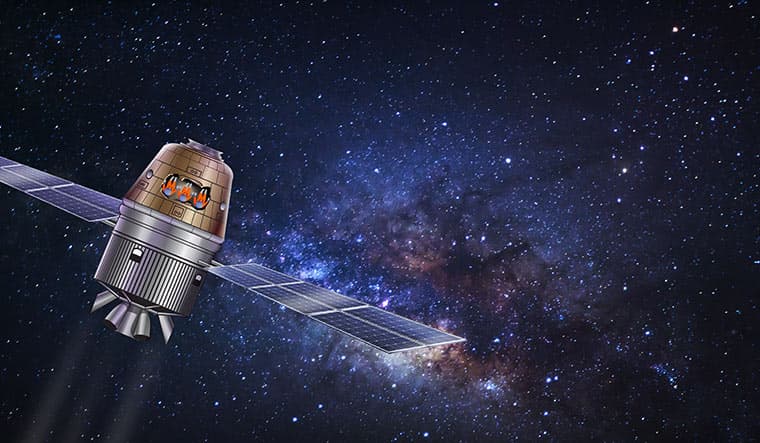
ISRO Chairman V. Narayanan has said roughly 90% of Gaganyaan’s development is done, with a trio of uncrewed missions preceding India’s first human spaceflight in 2027. The project aims to place a three-member crew in a 400-km orbit for three days and recover them safely in Indian waters. Parallelly, the joint NASA-ISRO NISAR mission has been declared healthy en route to full operations, underscoring India’s expanding blend of human spaceflight, earth observation, and commercial launch capabilities.
Gaganyaan: the mission in brief
-
Objective: Demonstrate indigenous human spaceflight—three astronauts, ~400 km low-Earth orbit, ~3 days, splashdown and recovery in the Indian Ocean.
-
Flight sequence: Three uncrewed missions first (the first with the humanoid Vyomitra), then the crewed mission targeted for 2027.
-
Recovery & range: Indian Navy-led maritime recovery; ISRO’s range safety and tracking network to manage ascent, orbit, and re-entry operations.
What “90% complete” means—and the 10% that matters
ISRO’s development stack is largely built and integrated; the remainder is the high-stakes proving of each human-critical system under realistic flight conditions:
-
Human-rating the launch vehicle: Upgraded LVM3 with enhanced reliability metrics, fault tolerance, and derated loads for crew safety.
-
Crew Escape System (CES): Rapid abort capability from pad through ascent; pad-abort and in-flight abort demonstrations validate acceleration limits, parachute sequencing, and aeroshell separation.
-
Crew Module (CM) & Service Module (SM): Pressurised habitat, avionics, power, consumables, and propulsion for orbital operations and controlled re-entry.
-
Environmental Control & Life Support System (ECLSS): Atmosphere management, fire safety, humidity/temperature control, and CO₂ scrubbing in a compact, power-efficient architecture.
-
Parachute & splashdown: Main and drogue chutes with redundancy; uprighting, flotation, and rapid crew egress drills with the Navy.
The uncrewed test path (before 2027)
-
Uncrewed Mission-1 (with Vyomitra): End-to-end validation of ascent, orbit operations, de-orbit, re-entry heating, parachute deployment, and recovery.
-
Uncrewed Mission-2: Stress cases and longer-duration checks on ECLSS and avionics; refined thermal-protection and guidance updates.
-
Uncrewed Mission-3: Final mission-readiness rehearsal with crew-module production configuration and full recovery playbook.
Astronauts, training, and ground segment
-
Crew selection: Test pilots/astronauts trained in high-G profiles, systems monitoring, and emergency procedures.
-
Training envelope: High-altitude chamber, centrifuge rides, neutral-buoyancy and sea-survival drills, simulator time for nominal and off-nominal scenarios.
-
Ground architecture: Mission control at ISTRAC; integrated health monitoring, telemetry, and abort authority with crisp go/no-go gates.
Why Gaganyaan matters
-
Strategic capability: Human spaceflight compresses decades of systems engineering into a national skillset—useful for advanced satellites, planetary probes, and defense-grade reliability.
-
Industrial multiplier: Avionics, composites, life-support, robotics, parachutes, and maritime recovery capacity seed wider high-tech ecosystems.
-
Roadmap beyond LEO: A proven crew stack moves India closer to orbital labs, lunar participation, and deep-space technology spin-offs.
ISRO today: beyond a single mission
-
Earth observation & climate: NISAR—a joint L-band/S-band SAR—extends India’s leadership in disaster response, biomass, glacier, agriculture, and crustal deformation mapping.
-
Launch services: PSLV as a workhorse; LVM3 for heavier payloads and crew; SSLV maturing for small satellites and responsive access.
-
Planetary science: From Chandrayaan-3’s soft landing to Aditya-L1 heliophysics, ISRO’s science missions underpin sensors, autonomy, and navigation advances that feed back into human spaceflight.
-
Commercialisation: NSIL/InSPACe frameworks expand private participation—smallsat manufacturing, components, downstream analytics.
-
Navigation & comms: NavIC augmentation and high-throughput communications satellites reinforce sovereignty in PNT and broadband.
India’s human-spaceflight arc: risks and mitigations
-
Risk concentration: Abort reliability, ECLSS performance, and TPS integrity are mission-critical—mitigated by layered redundancy, incremental tests, and conservative margins.
-
Schedule discipline: Human-rating demands exhaustive documentation and quality gates; ISRO’s phased, test-heavy approach reduces latent defect risk.
-
Operational readiness: Recovery weather windows, sea-state planning, and ship/helicopter choreography are rehearsed repeatedly to cut timeline uncertainty on splashdown day.
What success unlocks
-
Sustained cadence: Regular uncrewed/crewed flights establish an Indian LEO access routine.
-
Science & tech demos: Microgravity experiments in life sciences, materials, combustion, and fundamental physics aboard crewed capsules or future modules.
-
International collaboration: Seat/experiment swaps, shared docking standards, and logistics partnerships with established agencies.
Quick reference: key components of Gaganyaan
-
Vehicle: Human-rated LVM3.
-
Stack: Crew Module + Service Module + Launch Escape System.
-
Orbit & duration: ~400 km LEO, ~3 days.
-
Recovery: Indian Ocean, Navy-led.
-
Pre-crew flights: Three uncrewed missions; the first with Vyomitra.
Credits: Reporting base drawn from ISRO leadership statements and programme briefs; contemporary context aligns with The Hindu Bureau coverage.