

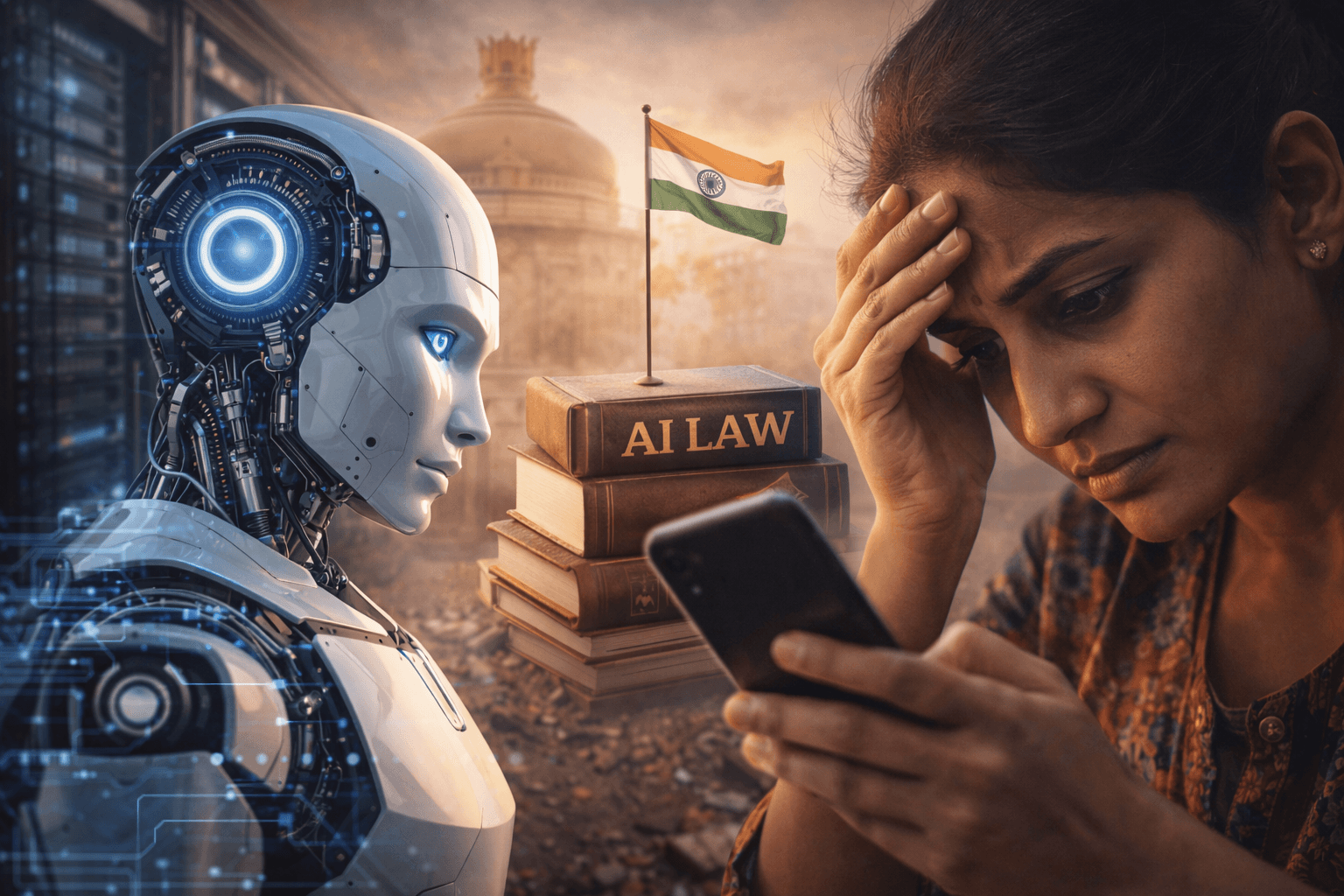
AI policy is usually framed as a choice between speed and safety. India’s real problem is different: it is trying to govern a technology it largely consumes, with institutions designed for an older internet. The result is a patchwork—useful in parts, silent in others. China’s new draft rules on emotionally interactive AI show one extreme: a state-ready “duty of care” model that can slide into intrusive monitoring. India sits on the other end: less invasive, but incomplete—especially on product safety and psychological harms.
What’s in the news
China’s cyber regulator has released draft rules for AI services that simulate human personality and build emotional interactions, including requirements to warn against excessive use and intervene when users show signs of addiction or emotional distress. India has not introduced an equivalent AI-specific consumer safety regime. Instead, it has relied on intermediary due diligence under the IT framework, targeted advisories on deepfakes and synthetic content, and sector-level governance in finance and securities markets.
Background and context
The global AI governance debate has moved beyond “content moderation” to questions of behavioural influence—companion bots, emotionally persuasive interfaces, and the subtle shaping of user decisions. That shift matters because the harm is not always illegal content; it can be dependency, manipulation, or erosion of trust.
India’s posture has been to treat AI as a layer that must comply with existing law: privacy, consumer protection, cybersecurity, and platform due diligence. This is administratively convenient, and it avoids a surveillance-heavy model. But it also creates a gap: when an AI product causes harm that is not neatly captured as “unlawful content” or “data breach”, regulatory responsibility becomes diffused.
At the same time, India’s strategic position is structurally different from that of the U.S. or China. India is a massive adopter and integrator, but it is still building domestic capacity for frontier models. That makes “regulate first, build later” a risky sequence: it can freeze local innovation while foreign models continue to enter Indian markets through private procurement.
Key provisions / key details
China’s proposed approach: a duty-of-care style regime for “emotional” AI
China’s draft measures target “human-like interactive” AI that mimics personality traits and interacts emotionally, and would require providers to nudge users away from excessive use and step in when signals of addiction or emotional distress appear. The design logic is clear: harms can arise from interaction patterns, not just content.
But the trade-off is equally clear: a regime that expects providers to infer emotional states can incentivise deeper monitoring, more data collection, and tighter behavioural profiling.
India’s current approach: adjacent controls, not a single product-safety spine
India’s controls are real, but dispersed:
-
Platform/intermediary due diligence has been used to push guardrails against deepfakes, deception, and synthetic media misuse.
-
Financial regulators have started articulating AI governance as “model risk” and accountability: the RBI’s FREE-AI framework pushes responsible and ethical enablement, while SEBI has moved through consultation on responsible AI/ML use in securities markets.
-
Public compute capacity is being expanded through the IndiaAI Mission, which aims to broaden access to GPUs and support Indian foundation models.
The gap is that these do not yet add up to a clean, general-purpose consumer safety regime for AI products—especially for harms that are psychological, cumulative, or “grey zone” in legality.
Why it matters
First, trust is now national infrastructure. Deepfakes, synthetic persuasion, and automated fraud degrade the reliability of speech, images, and identity. Once trust collapses, enforcement becomes expensive and social cohesion gets brittle.
Second, India’s dependency risk is strategic, not cosmetic. If most powerful models remain foreign and privately controlled, India’s ability to shape safety norms, audit access, and pricing is constrained. Governance becomes reactive by design.
Third, the labour market will not be disrupted evenly. AI may not “eliminate jobs” in one sweep, but it can compress entry-level work and raise baseline expectations. Without upskilling at scale, productivity gains will concentrate, and wage anxiety will spread.
Fourth, regulation that ignores deployment context misses the point. The same model is harmless in entertainment and dangerous in credit scoring, medical advice, or child-facing companions. The regulation must follow risk, not hype.
Arguments for and against
The case for India’s lighter-touch posture: It avoids institutionalising intrusive monitoring of citizens, and it is faster to implement by extending existing laws. It also reduces the risk of over-regulation choking a still-forming domestic AI ecosystem.
The case against it: Patchwork governance often fails at the seams. Psychological harms, manipulative design, and cumulative dependency do not fit neatly into “unlawful content” frameworks. When a harm occurs, accountability becomes a ping-pong match between platform rules, consumer law, privacy law, and sector regulators.
The danger of copying China’s template: It may appear “protective”, but it can hardwire surveillance incentives, especially if compliance requires inferring emotions or mental states at scale.
A mature Indian approach must hold the line on privacy while still creating enforceable product-safety duties for high-risk deployments.
Constitutional / legal angle
India’s governance choices here sit at the intersection of privacy, dignity, and state capacity. A regime that compels emotional-state inference can collide with privacy expectations and risk normalising intimate monitoring. Conversely, a regime that refuses to define a duty of care can under-protect citizens from harms that are foreseeable and preventable.
A workable legal architecture would treat AI harms through a risk-based duty-of-care lens, anchored in existing constitutional values: proportionality, accountability, and due process—without building a backdoor surveillance machine.
Implications
In the near term, India will likely continue with hybrid governance—MeitY-driven platform obligations plus sector regulator frameworks. The main risk is uneven enforcement: high-visibility harms get attention; slow-burn harms remain unaddressed.
In the medium term, the competitive edge will belong to countries that combine compute access + skills pipelines + safety assurance capacity. If India expands compute but lacks testing, audit, and incident-response institutions, it may scale deployment faster than governance.
In the long run, the choice is between being a rule-taker in AI product standards or becoming a rule-shaper through domestic capability, credible safety practices, and interoperable norms that other emerging economies can adopt.
Way ahead
India can avoid both extremes—paralysis by consensus and intrusive behavioural monitoring—by tightening governance where it matters most.
-
Build upstream capacity without over-centralising it: expand accessible compute and procurement pathways that let startups, universities, and public institutions train and evaluate models, not just rent them.
-
Regulate downstream deployment more sharply in high-risk contexts: require deployers—not ordinary users—to carry obligations such as risk assessments, red-teaming, audit trails, and transparent accountability for model outcomes.
-
Adopt incident-reporting and harm-reporting discipline: instead of monitoring users’ emotions, mandate that companies report AI safety incidents, deception events, and serious failures, with clear thresholds and penalties for concealment.
-
Upskill at population scale with employer alignment: focus on job-linked skilling (tools + domain workflows), not only generic “AI literacy”, and ensure SMEs can access training and compliant toolkits.
-
Invest in evaluation and assurance capacity: India needs independent testing labs, public-interest audits, and credible benchmarks—because without measurement, regulation becomes a press release.
This is the India-feasible path: protect citizens through deployer accountability and incident discipline, while accelerating compute access and skills so domestic capability grows alongside governance.
Source credits
Cyberspace Administration of China; Reuters; Ministry of Electronics and Information Technology; IndiaAI Mission; Press Information Bureau; Reserve Bank of India; Securities and Exchange Board of India.