

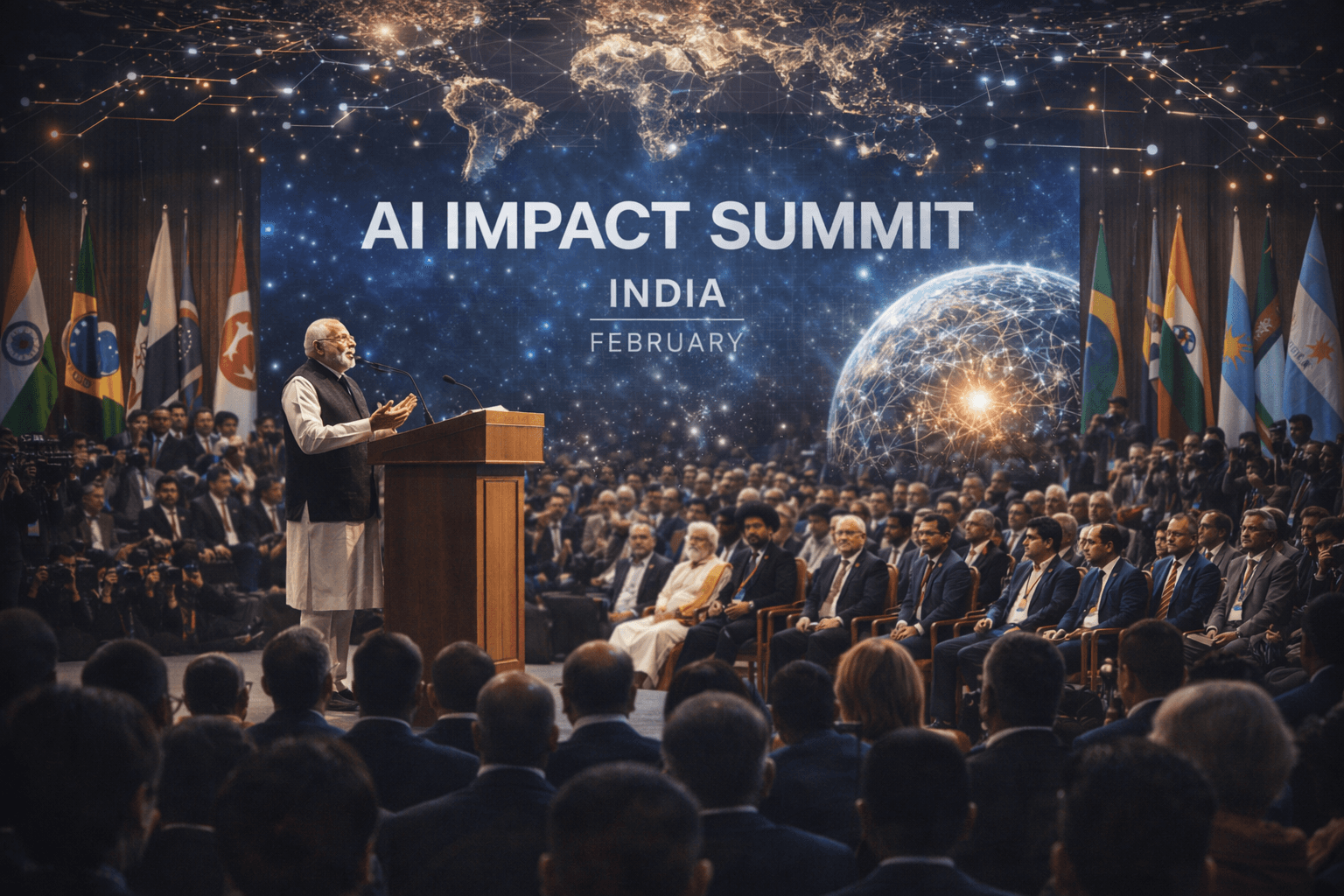
India’s decision to host the AI Impact Summit at near mega-event scale is more than a conference plan; it is a strategic signal. The global AI conversation has moved from fascination to friction—jobs, trust, deepfakes, safety, and geopolitical control of compute and models. In that world, hosting is not about hospitality alone. It is about agenda-setting: what the world treats as urgent, who gets a seat, and which rules become “common sense”.
What’s in the news
The Union government is proceeding with arrangements for the AI Impact Summit in February 2026, with officials indicating participation by 15–20 heads of state, a large number of ministers and delegations, and senior leaders from major AI firms and research ecosystems. The IT Secretary has said the main event could see around 1,00,000 participants, supported by several pre-summit programmes in India and overseas. The summit themes include AI’s impact on work, trust and safety protocols for AI models, and sector-specific deployment.
Background and context
This summit is part of a fast-evolving multilateral chain. The first global gathering in this line—at Bletchley Park in 2023—was framed around frontier AI risks and common safety concerns. Seoul in 2024 deepened the conversation into practical commitments and broader participation. Paris in 2025 widened the tent further, and India was handed the reins for the next edition.
Two shifts explain why India is leaning in now.
First, AI governance has become geopolitics. The countries that shape evaluation standards, safety thresholds, audit expectations, and cross-border interoperability effectively shape markets and innovation pathways. Rules written elsewhere eventually arrive in India as compliance burdens for Indian firms.
Second, AI’s “impact” debate is widening beyond safety labs. It now includes employment structure, public trust in information, digital fraud, and the uneven distribution of compute, data, and talent. For much of the Global South, the central anxiety is not only catastrophic risk; it is being permanently positioned as an AI consumer rather than an AI builder.
India’s hosting pitch sits precisely here: make the summit big enough to be globally consequential, and inclusive enough to avoid the perception that AI governance is a club of a few advanced economies.
Key provisions / key details
The summit design, as signalled so far, has four notable features.
Scale and signalling. Participation expectations—heads of state, ministers, CEOs, researchers—are meant to place India in the same category as top-tier conveners of global rulemaking.
Pre-summit diplomacy. Multiple preparatory events in India and abroad suggest an effort to build coalitions before the formal summit, so outcomes are not improvised in the final week.
A broadened agenda. The topics indicate a shift from narrow “AI safety” framing to a wider “AI impact” lens—work, trust, model safety protocols, and sectoral adoption. This helps India bridge two worlds: frontier-model governance and mass deployment governance.
A Global South emphasis. Officials have indicated that more countries from the Global South will participate. That matters because legitimacy in global governance today often comes from representation, not just technical excellence.
Why it matters
For India, the summit is a chance to move from participation to authorship. The biggest strategic payoff is not a communiqué; it is influence over the norms that will govern AI models, audits, and deployment.
For the world, India’s hosting could help close a credibility gap: global AI rules often appear like they are written for advanced economies’ risk profiles. A summit anchored in the Global South can push practical questions to the front—access to compute, affordable safety tooling, language diversity, public service delivery, and the balance between innovation and harm.
For markets and citizens, the most urgent frontier is trust. Deepfakes, synthetic persuasion, and automated fraud are turning “seeing” into a weak form of believing. Any summit that does not produce usable approaches to provenance, accountability, and safety testing will look performative.
Finally, for employment, the summit’s work theme is timely. AI is not only displacing tasks; it is reshaping entry-level work, apprenticeship pathways, and productivity expectations. Countries that align skilling, labour policy, and enterprise adoption will gain a long-run advantage.
Arguments for and against
The strongest argument for India’s push is strategic: hosting can convert India’s digital public infrastructure credibility and large developer ecosystem into a global governance role. It can also create a platform for Indian startups and researchers to be seen as contributors, not spectators.
There are also practical gains: attracting top labs and CEOs to India can accelerate partnerships, investment visibility, and research exchanges—especially if the summit produces a clear pipeline for collaborative projects.
But the sceptical view is equally important. Mega-events can become stage-managed showcases that generate soft language and few binding outcomes. AI governance is also sensitive: different countries have different red lines on data flows, content moderation, model access, and security. A broad tent can dilute clarity.
There is also a risk of over-indexing on optics while under-delivering on domestic readiness—such as safety evaluation capacity, enforcement against AI-enabled fraud, and the institutional bandwidth to regulate without throttling innovation.
The credibility test will be whether the summit can produce outcomes that are concrete enough to matter, yet flexible enough to be adopted across legal systems.
Constitutional / legal angle
AI governance touches multiple legal and constitutional concerns even when framed as “technology policy”.
The first is dignity and privacy: widespread AI deployment in public and private services raises questions around consent, profiling, and misuse of personal data. The second is free expression and due process: safety and misinformation controls can collide with speech rights if rules are vague or enforcement is arbitrary. The third is accountability: when AI systems cause harm—fraud, discrimination, reputational damage—law still needs a clear chain of responsibility.
A global summit hosted by India will be judged partly on whether it respects these fundamentals while advocating workable safety and trust mechanisms that can operate at Indian scale.
Implications
In the near term, the summit will sharpen India’s positioning as a convening power in AI governance and could trigger announcements on partnerships, evaluation frameworks, and sector pilots.
In the medium term, it could influence how emerging economies negotiate AI rules—pushing for capacity-building, interoperable standards, and practical safety tooling rather than one-size-fits-all restrictions.
In the long run, the summit’s success will be measured by whether it helps create a world where AI is both trusted and widely beneficial—without locking the Global South into permanent dependence on a handful of model-owning powers.
Way ahead
For India, the smartest outcome would be to make the summit deliver three kinds of credibility.
First, governance credibility: a shared approach on model evaluation, safety testing, and transparency expectations that countries can actually implement.
Second, trust credibility: practical mechanisms to fight synthetic fraud and information manipulation—provenance standards, watermarking norms, and rapid-response cooperation across platforms and states, without turning into censorship-by-default.
Third, development credibility: real commitments on compute access, skilling, and sector deployment pathways that help the Global South build, not just buy.
If India can do this, February will not be remembered only for attendance numbers. It will be remembered as the moment India helped shape what “responsible AI” looks like in the real world—at population scale.
Source credits
The Hindu; Ministry of Electronics and Information Technology; Government of India briefings; international AI summit track documents and public records from the UK and Republic of Korea; industry reporting from Economic Times, Indian Express, Hindustan Times.