

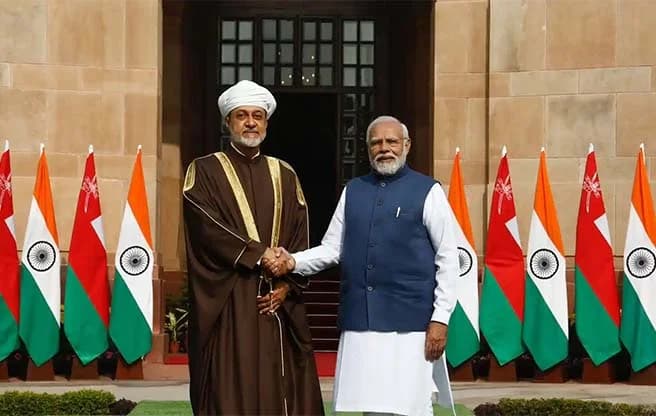
The Oman leg of Prime Minister Narendra Modi’s West Asia–Africa swing is being read too easily as protocol—another handshake, another joint statement. That framing misses the point. Oman is not just a friendly Gulf capital; it is one of the region’s most reliable “stability assets”—a state that keeps channels open when others shut doors, and a geography that sits astride the sea-lanes India cannot afford to leave to chance. In a moment marked by tariff friction, uncertain ceasefires, and shifting maritime risk, Muscat is where India’s strategic pragmatism often looks its sharpest.
What’s in the news
The visit, timed to 70 years of India–Oman diplomatic relations, is expected to review a mature strategic partnership and potentially elevate it through a trade pact and new sectoral agreements. It also takes place amid heightened regional volatility following the Gaza ceasefire and wider disruptions in West Asian security dynamics.
Why Oman matters beyond friendship
The “quiet mediator ” in a noisy region
Oman’s diplomatic value is rooted in its temperament: moderation, deliberate neutrality, and an ability to keep communication alive across rival camps. For India, which has interests spanning energy security, diaspora welfare, maritime routes and regional stability, this is not a soft virtue—it is strategic capital. When regional politics becomes binary, Oman’s preference for mediation helps preserve diplomatic room for manoeuvre.
Geography that anchors India’s western seaboard interests
Oman overlooks the Gulf of Oman and the Arabian Sea—waters that connect India to the Gulf, Europe and Africa. This matters because India’s trade and energy lifelines run through these lanes, and maritime insecurity rarely announces itself politely. A partner sitting at this crossroads offers India both operational convenience and strategic visibility.
Defence and maritime security: the hard backbone of the partnership
Duqm is not just a port, it is an operational advantage
The logistics arrangement around Duqm, concluded during the 2018 visit, is often described in technical language—turnaround, refuelling, berthing. In practice, it gives India a more sustained naval posture in the western Indian Ocean without theatrics. That is invaluable in an era when anti-piracy needs, shipping disruptions and extra-regional naval activity can all spike with little notice.
Cooperation that spans all three services
Oman is among the earliest Gulf partners with whom India’s Army, Navy and Air Force have built a habit of joint exercises and operational coordination. This “habit” is the hidden asset. Partnerships work best when they are routine, not reactive—because crises punish countries that start coordination from zero.
Security cooperation without overt bloc politics
Another reason Oman fits India’s style is that it allows security cooperation that is purposeful yet non-provocative. It strengthens maritime security without forcing India into rigid alignments that can complicate ties with other regional actors.
Trade and investment: modest totals, high strategic weight
A concentrated trade basket makes exposure sharper
Bilateral trade has risen to about $10.6 billion (FY 2024–25), but the significance lies in composition and leverage. When trade is concentrated, regulatory changes, tariff shocks or supply disruptions can hit specific sectors disproportionately. That is why a structured trade framework matters even if headline numbers seem moderate.
CEPA: not just a tariff story, but a confidence signal
A likely India–Oman CEPA is best read as an insurance instrument in a world of tariff unpredictability and supply-chain rerouting. For Indian exporters and service providers, it can create clearer rules and faster market access. For Oman, it strengthens diversification by linking deeper with one of the world’s largest consumption-and-services markets.
OIJIF and long-horizon capital
The Oman–India Joint Investment Fund has already deployed significant capital in India, signalling a patient investment relationship rather than transactional flows. That is precisely what long-gestation sectors—logistics, infrastructure, manufacturing and energy transition—need.
Digital payments and the “everyday diplomacy” layer
RuPay and payment linkages as strategic infrastructure
Fintech cooperation—through payment system linkages and the RuPay footprint—has a deeper meaning than convenience. It reduces friction for travellers and workers, lowers remittance costs over time, and embeds institutional trust into everyday economic life. When people-to-people and business-to-business transactions become smoother, diplomacy becomes harder to disrupt.
Energy transition: from hydrocarbons to new complementarity
Green hydrogen, renewables and critical supply chains
Both countries are navigating a new energy map. Oman is positioning itself as a serious green-energy player; India is scaling clean power while managing base-load realities. That creates a natural space for cooperation in green hydrogen value chains, renewable equipment, and long-term energy security planning.
Strategic petroleum arrangements and resilience
Ideas such as strategic petroleum storage cooperation reflect the same theme: resilience. In an era of shipping risk and commodity volatility, energy security is increasingly about redundancy and predictability.
Connectivity corridors: where geography meets economics
Oman’s potential role in new trade routes
Connectivity corridors are not only about ribbon-cuttings; they are about who becomes indispensable in the flow of goods, data and capital. Oman’s location and port capacity place it well to become a practical node in emerging corridor thinking—especially as India and partners explore routes that reduce chokepoint dependence.
The fine print: what could complicate the promise
Deliverables must not outpace institutional capacity
Big announcements are easy; implementation is hard. Whether on CEPA, port-linked logistics, or defence-industrial cooperation, the success will depend on regulatory clarity, dispute-resolution confidence, and sustained administrative follow-through.
A region where shocks are the norm, not the exception
West Asia’s security environment can change quickly. Any plan—trade, energy, connectivity—needs built-in flexibility so that sudden escalations do not freeze progress.
Balancing multiple relationships without mixed signals
India’s Gulf engagement is necessarily multi-vector. Deepening with Oman should strengthen stability and openness, not trigger avoidable anxieties elsewhere. That requires disciplined messaging and transparent intent.
Conclusion
The Oman visit is significant because it touches the full spectrum—security, commerce, technology, energy and connectivity—without forcing India into brittle alignments. Oman offers something rare in the region: steadiness with strategic utility. If the visit converts goodwill into well-designed agreements and dependable implementation, it will stand as a quietly consequential marker of India’s westward strategy in a world where stability is becoming the scarcest commodity.
Source credits: National reporting excerpt provided by the user; publicly available background on India–Oman strategic partnership, Duqm logistics cooperation, and bilateral trade and payments engagement