

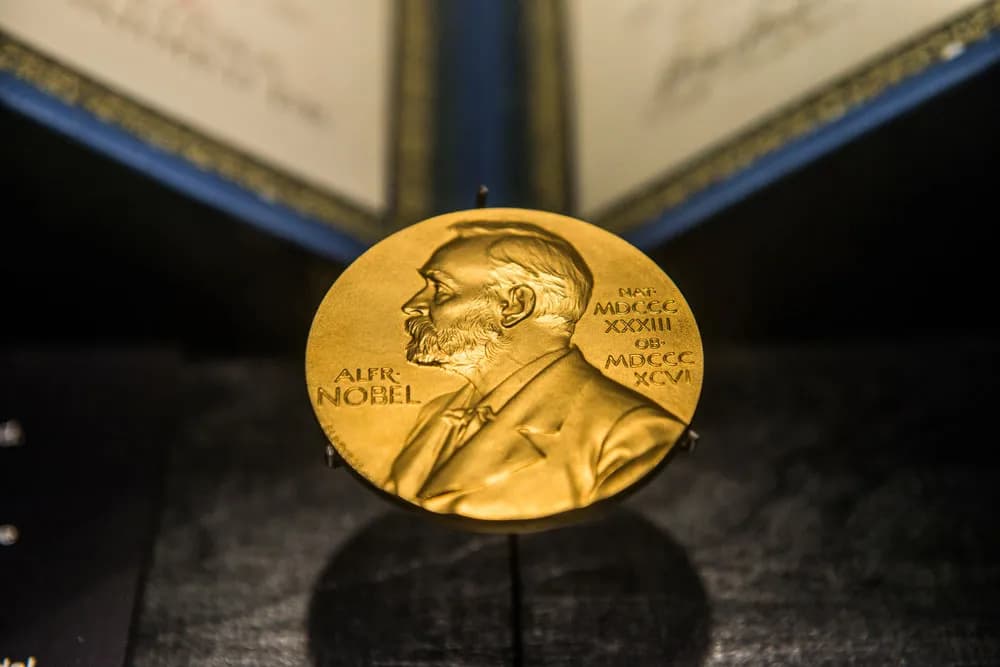
The 2025 Nobel Prize in Chemistry honours three scientists—Richard Robson (Australia), Susumu Kitagawa (Japan), and Omar Yaghi (Jordan/U.S.)—for discovering and perfecting a new class of hybrid materials called Metal–Organic Frameworks (MOFs). Their work bridged the worlds of metallic and organic chemistry, proving that two seemingly incompatible realms could produce highly stable, “breathing” materials capable of trapping gases, filtering toxins, and even harvesting water from desert air.
The Story
Chemists long believed that metallic and organic compounds could not combine into stable, ordered materials.
But beginning in the 1970s, Richard Robson at Melbourne University asked a simple question: What if positively charged metal ions could be used as connectors, linking organic molecules like beams in a molecular building?
Robson mixed copper ions with multi-armed organic linkers that attracted the metal at each end, producing a crystalline structure filled with regular cavities—like a diamond riddled with tiny rooms. Though unstable at first, this prototype revealed the architectural idea behind MOFs: metal ions as nodes and organic molecules as linkers.
In the 1990s, Susumu Kitagawa at Kyoto University stabilized these frameworks, showing that gases could move in and out, and that the structures could expand or contract without collapsing—like a lung inhaling and exhaling. These were the first “flexible” MOFs, later called soft porous crystals.
Then in the early 2000s, Omar Yaghi at the University of California, Berkeley, made the leap to rational design. He created ultra-stable MOFs, precisely tuned to trap specific molecules—carbon dioxide, water vapour, or methane. One of his famous MOFs could harvest water from dry desert air at night and release it as liquid water during the day—an elegant example of chemistry solving a sustainability challenge.
The Concept: What Are Metal–Organic Frameworks (MOFs)?
A Metal–Organic Framework is a crystalline material built from two main components:
-
Metal ions or clusters (e.g., copper, zinc, aluminium) acting as joints or nodes, and
-
Organic linkers (carbon-based molecules) connecting the metals, forming a repeating 3D structure.
Think of a MOF as a molecular sponge—its rigid yet porous network has enormous internal surface area.
-
A sugar cube-sized MOF could have a surface area equivalent to a football field.
-
Pores can be tailored chemically to absorb, separate, or catalyse specific molecules.
Key Properties:
-
Porosity: Acts like a sieve at the molecular scale.
-
Flexibility: Can expand/contract as gases enter or exit (“breathing materials”).
-
Tunability: Pore size and chemistry can be customized for a desired task.
-
Stability: Many MOFs remain intact under heat, moisture, or pressure.
Applications and Global Significance
1. Environmental Sustainability
-
Carbon capture: MOFs can trap CO₂ from industrial exhausts more efficiently than current materials, helping combat climate change.
-
Water harvesting: Some MOFs pull water vapour from air, offering low-energy solutions for arid regions.
-
Pollution control: MOFs can filter PFAS chemicals (so-called “forever chemicals”) and remove drug residues from wastewater.
2. Energy and Industry
-
Gas storage: MOFs store hydrogen or methane at high densities for clean fuels.
-
Catalysis: MOFs act as mini-reactors to speed up chemical processes while reducing waste.
-
Battery and sensor design: Conductive MOFs may become key to next-generation solid-state batteries or chemical sensors.
3. AI-driven Materials Design
With thousands of MOFs now known, chemists are using artificial intelligence to design new frameworks with specific properties—like optimizing pore size to capture a particular molecule. The field’s future lies in computational prediction and automated synthesis.
Why It Matters
The discovery of MOFs revolutionised materials science by combining chemistry, architecture, and engineering. They embody:
-
A conceptual breakthrough: metals and organics can coexist stably in a single lattice.
-
Practical versatility: from clean air and water to renewable energy and medicine.
-
Scientific legacy: the discovery has created tens of thousands of MOF variants, each a potential tool for a specific global challenge.
In essence, MOFs bridge the microscopic world of atoms and the macroscopic world of sustainability—turning chemistry into an engine for environmental solutions.
Implications for the Future
-
Climate Mitigation: MOFs may anchor next-gen carbon capture and storage technologies.
-
Water Security: Portable MOF-based water harvesters could serve drought-hit regions.
-
Green Industry: By replacing rare, energy-intensive materials, MOFs can decarbonise manufacturing.
-
AI and Quantum Synergy: Machine learning can now predict MOF architectures, accelerating the transition from lab-scale discovery to industrial deployment.
Conclusion
From a classroom experiment in Melbourne to water-harvesting devices in California, the story of Metal–Organic Frameworks is a triumph of imagination and persistence. The 2025 Nobel laureates—Robson, Kitagawa, and Yaghi—did more than combine metals and organics; they built a new bridge between chemistry and sustainability, offering materials that could help the planet breathe a little easier.
Credit: Reporting inputs adapted from The Hindu (by Jacob Koshy).