

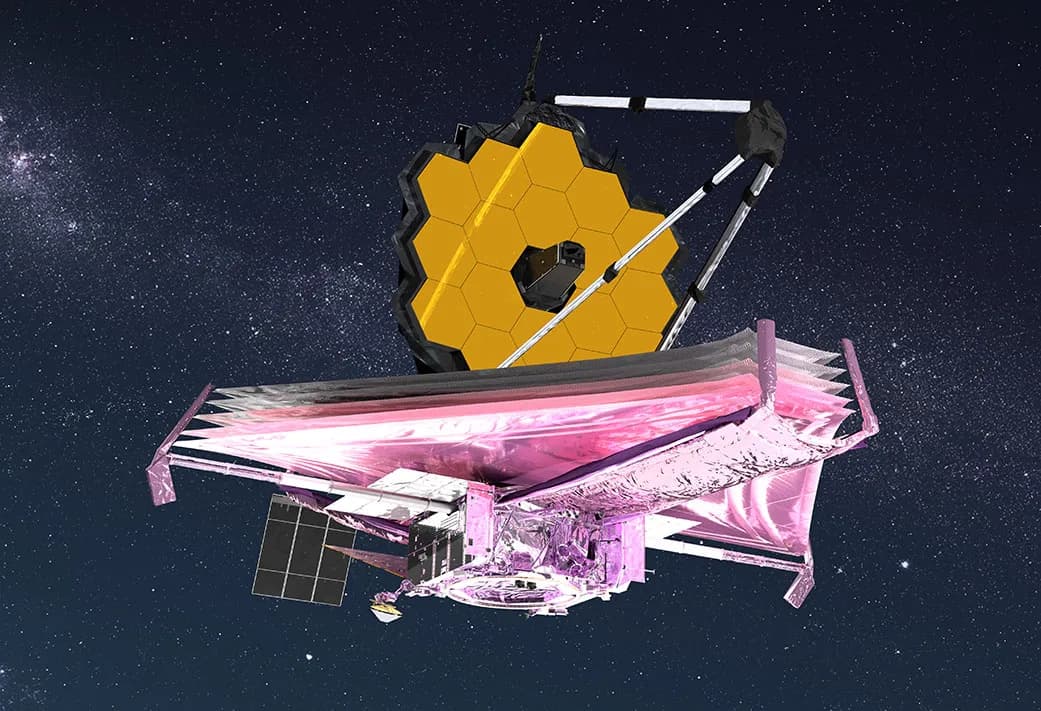
Astronomers analysing data from the James Webb Space Telescope (JWST) have identified four ancient cosmic objects that could be the universe’s first known “dark stars.” Unlike ordinary stars, which shine due to nuclear fusion, dark stars may have been powered by the annihilation of dark matter particles, making them luminous yet exotic relics of the early cosmos.
The Story
The new candidates were spotted in JWST’s deep-field observations of early galaxies dating back more than 13 billion years, just a few hundred million years after the Big Bang. Their spectral and brightness profiles match theoretical predictions for supermassive dark stars, each potentially millions of times the mass of the Sun.
Dark stars are thought to form in dense regions of dark matter, where weakly interacting massive particles (WIMPs) collide and annihilate, releasing energy. This energy prevents the star from collapsing and fuels a prolonged, cool, but intensely radiant existence.
These objects would differ from conventional stars in both composition and lifespan, glowing primarily in infrared wavelengths, which the JWST is optimised to detect.
Why It Matters
If the existence of dark stars is confirmed, it could revolutionise our understanding of the early universe.
-
It may explain why JWST has found unexpectedly bright objects in the first billion years of cosmic history.
-
It could also illuminate how supermassive black holes formed so quickly after the Big Bang — dark stars may have served as their precursors, collapsing under gravity once dark matter energy sources depleted.
Background / Context
-
Dark Matter: Invisible matter thought to make up 85% of the universe’s mass, detectable only through gravitational effects.
-
James Webb Space Telescope: Launched in 2021, JWST observes the cosmos in infrared light, allowing scientists to peer into the universe’s earliest epochs.
-
Previous Theories: Dark stars were first hypothesised in 2007 but had remained purely theoretical until JWST’s sensitivity made detection possible.
Implications
The discovery could redefine stellar evolution models and cosmological timelines.
-
Astrophysics: Offers a new mechanism for early cosmic illumination without fusion.
-
Cosmology: Helps reconcile discrepancies between observed and simulated galaxy brightness at high redshifts.
-
Particle Physics: Provides potential indirect evidence for dark matter annihilation mechanisms.
Future JWST spectroscopic analysis will be needed to confirm whether these candidates truly lack fusion signatures and match the predicted thermal profiles of dark stars.
Conclusion
The possible detection of “dark stars” marks a frontier moment in astronomy — merging the mysteries of dark matter physics with early cosmic evolution. If verified, these enigmatic entities could bridge a long-standing gap between cosmology and particle physics, revealing how darkness itself once lit up the newborn universe.