

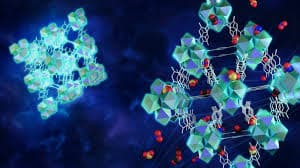
The 2025 Nobel Prize in Chemistry rewards a simple yet radical idea. If atoms in a small molecule can be arranged by design, so can bigger, repeating architectures that leave controlled empty space inside. Susumu Kitagawa, Richard Robson and Omar Yaghi pioneered metal–organic frameworks, or MOFs, crystalline networks whose adjustable pores let chemists store gases, sieve mixtures and run reactions with a precision once reserved for enzymes.
The Story
What is a MOF
A MOF is a 3D crystal built from metal nodes and multidentate organic linkers. The metal ions or clusters act as joints, the linkers as struts. As the network repeats, it creates uniform cages and channels. A single gram can host internal surface areas of thousands of square metres. Choose different metals or linkers and the pores change size, shape and chemistry, which lets you attract, repel or transform specific molecules.
Robson’s insight
In the 1970s and 1980s, Richard Robson explored how simple coordination rules could produce extended lattices with ordered voids. His copper based frameworks demonstrated that self assembly could yield diamond like nets full of cavities rather than dense, filled solids. He showed that frameworks could be designed to host guest species, hinting at size selective sieving and new catalysis.
Kitagawa’s breakthrough
Susumu Kitagawa focused on making porous networks stable and functional. In the 1990s he created 3D frameworks that could be emptied and refilled with gases without collapsing. He also established that some MOFs are soft and responsive, with pores that expand or contract as temperature, pressure or guest molecules change. These breathing behaviours turned rigid crystals into smart sponges.
Yaghi’s architecture and scale up
Omar Yaghi gave MOFs structural robustness and a design grammar. He framed the field as reticular chemistry, the deliberate stitching of strong building units into predictable nets. With MOF 5 and many families thereafter, his group delivered high surface area, thermally stable crystals that could be activated, stored and reproduced reliably, opening the door to large libraries and practical deployment.
Concept, in Plain English
Think of MOFs as scaffolds for parking molecules. The metal nodes are junctions, the organic rods are beams. The empty bays between beams are parking slots for gas or liquid molecules. By swapping the rods and junctions, you change the size of each slot and the chemical paint on its walls, so only the right cars can park or only certain reactions can run inside.
Mini Timeline
• 1970s to 1980s, Robson demonstrates extended coordination lattices with ordered voids.
• Mid 1990s, Kitagawa shows stable porosity that survives emptying and refilling with gases.
• 1999 onward, Yaghi’s robust MOF platforms establish reticular chemistry and scalable synthesis.
• 2010s to 2020s, industrial pilots begin in gas storage, separations and environmental cleanup.
• 2025, Nobel Prize recognises the field’s founding architects.
How MOFs Are Used Today
Carbon capture and separations
MOFs with amine like sites or open metal centres can selectively grab CO₂ from flue gas streams while letting nitrogen and oxygen pass. Their high capacity and regenerability lower the energy penalty compared with some conventional sorbents. Tailored frameworks also separate light hydrocarbons, for example propyne from propylene or ethylene from ethane, improving yields in petrochemical plants.
Clean water and pollution control
Specific MOFs scavenge industrial toxins. Materials with zirconium clusters and tailored linkers bind and remove PFAS forever chemicals. Others adsorb dyes, heavy metals and fluoride. Enzyme mimicking MOFs, sometimes called nanozymes, catalyse the breakdown of organic pollutants in wastewater.
Hydrogen and methane storage
High surface area frameworks store hydrogen or methane at moderate pressures and near ambient temperatures. This improves volumetric density and safety for mobility or off grid applications. For natural gas vehicles or backup power, MOF tanks can outperform empty cylinders at the same pressure.
Air to water harvesting
Hydrophilic MOFs suck moisture from dry air at night and release it as liquid water when warmed by sunlight. In arid regions, these passive harvesters can produce drinking water without grid power.
Industrial gas handling
Semiconductor fabs use toxic gases that are safer to ship and dose when buffered inside MOFs. The crystal hosts tame volatility and allow precise delivery, reducing leaks and storage hazards.
Catalysis and synthesis
Pores act as nanoreactors. Catalytic sites sit on the node or linker, while size selective channels guide reactants and stabilise transition states. This leads to cleaner reactions, better selectivity and easier catalyst recovery.
Sensors
MOFs change colour, conductivity or luminescence when target molecules enter their pores. This response enables compact sensors for explosives, volatile organic compounds and humidity.
Biomedicine
Biocompatible MOFs act as carriers that protect fragile drugs and release them in response to pH or enzymes. Some deliver gases such as nitric oxide for wound healing.
Critical metals recovery
Sulfur or nitrogen rich linkers bind rare earths and precious metals from dilute waste streams, enabling urban mining and circular flows for magnets, batteries and catalysts.
Why MOFs Are Significant
1) Programmable matter
MOFs turned materials design into a LEGO like exercise. Chemists can now pick nodes and linkers from a menu and predict the architecture and pore chemistry that will emerge.
2) Surface area on demand
Enormous internal area allows storage, separation and catalysis inside a small mass. This redefines what a kilogram of material can do in climate tech, clean water and chemical manufacturing.
3) Selectivity with finesse
By tuning pore size by angstroms and the chemical environment by functional groups, MOFs discriminate between molecules that differ only slightly. That precision saves energy in separations that currently consume large fractions of industrial power.
4) Platform for sustainability
From CO₂ capture to PFAS cleanup, MOFs address hard environmental problems that need high capacity and selectivity. They align with policy goals on decarbonisation and pollution control.
5) A new language for solids
Reticular chemistry provides a design language that has already inspired related classes such as covalent organic frameworks. It signals a shift from making whatever crystals happen to form to building the crystals we actually need.
Important MOF Families, at a Glance
• HKUST 1 or MOF 199, copper based, benchmark for gas adsorption.
• MOF 5 and descendants, zinc based, high surface area, early robust platforms.
• UiO family, zirconium based, exceptional water and thermal stability, useful for water treatment and catalysis.
• MIL 101, chromium or other metals, large cages and high capacity, strong for vapour capture.
• ZIFs, zeolitic imidazolate frameworks, mechanically tough, useful in membranes and protective layers.
What Holds MOFs Back, and How the Field Is Responding
Moisture and chemical stability
Early MOFs fell apart in humid or acidic conditions. Newer families use strong metal oxygen bonds and hydrophobic linkers to resist water and harsh streams.
Scalability and cost
Traditional solvothermal routes are solvent intensive. Scale up uses greener synthesis, continuous flow, mechanochemistry and water based routes. Binder choices and pelletisation methods preserve porosity in industrial shapes.
Selectivity in real mixtures
Flue gas and wastewater are complex. Mixed matrix membranes, hierarchical pores and cooperative binding sites improve performance under real world impurities and humidity.
Lifecycle and regeneration
Repeated adsorption and desorption cycles can degrade capacity. Process engineers now pair MOFs with smart cycling strategies and mild regeneration conditions to extend life and reduce energy penalties.
Safety and regulatory pathways
For biomedical or consumer uses, biocompatibility and linker degradation products must be vetted. The field is moving toward GRAS linkers, clean residues and full lifecycle assessments.
India Angle, Opportunities to Watch
• Pilot CO₂ capture on small to mid sized boilers using water stable MOFs and low grade heat for regeneration.
• PFAS and dye removal units for industrial clusters, paired with monitoring and recovery of spent sorbents.
• Methane storage for city gas vehicles and backup power in microgrids.
• Air to water devices for arid and coastal districts where grid power is unreliable.
• Catalytic MOFs in fine chemicals and pharma for cleaner, continuous processes.
• Academic and start up partnerships to scale green synthesis and membrane fabrication.
Implications
Climate and industry
MOF based separations can shave meaningful energy from chemical plants. CO₂ capture at point sources and hydrogen ready storage advance decarbonisation.
Water and health
Targeted removal of PFAS, heavy metals and pathogens protects public health. Modular units suit dispersed communities.
Geopolitics of materials
Recovering critical metals from waste streams strengthens supply security for magnets, chips and batteries.
Workforce and skills
MOFs blend synthesis, computation, process engineering and policy. Training programs that span these domains will accelerate deployment.
Conclusion
MOFs began as a coordination chemistry curiosity and became a platform for programmable porosity. Robson mapped the possibility, Kitagawa proved breathing and usability, and Yaghi delivered strength and design rules. Their work moved chemistry from making molecules to engineering space between them. As pilots scale across carbon, water and energy, MOFs look less like niche crystals and more like a toolkit for the hardest problems in sustainability.